
ALMATY – International experts discussed the challenges and opportunities for strengthening the Biological and Toxin Weapons Convention (BTWC) and the establishment of the proposed International Agency for Biological Security (IABS) at the “50th Anniversary of the BTWC: From Commitment to Action – The IABS Initiative” International seminar in Almaty on Oct. 14.
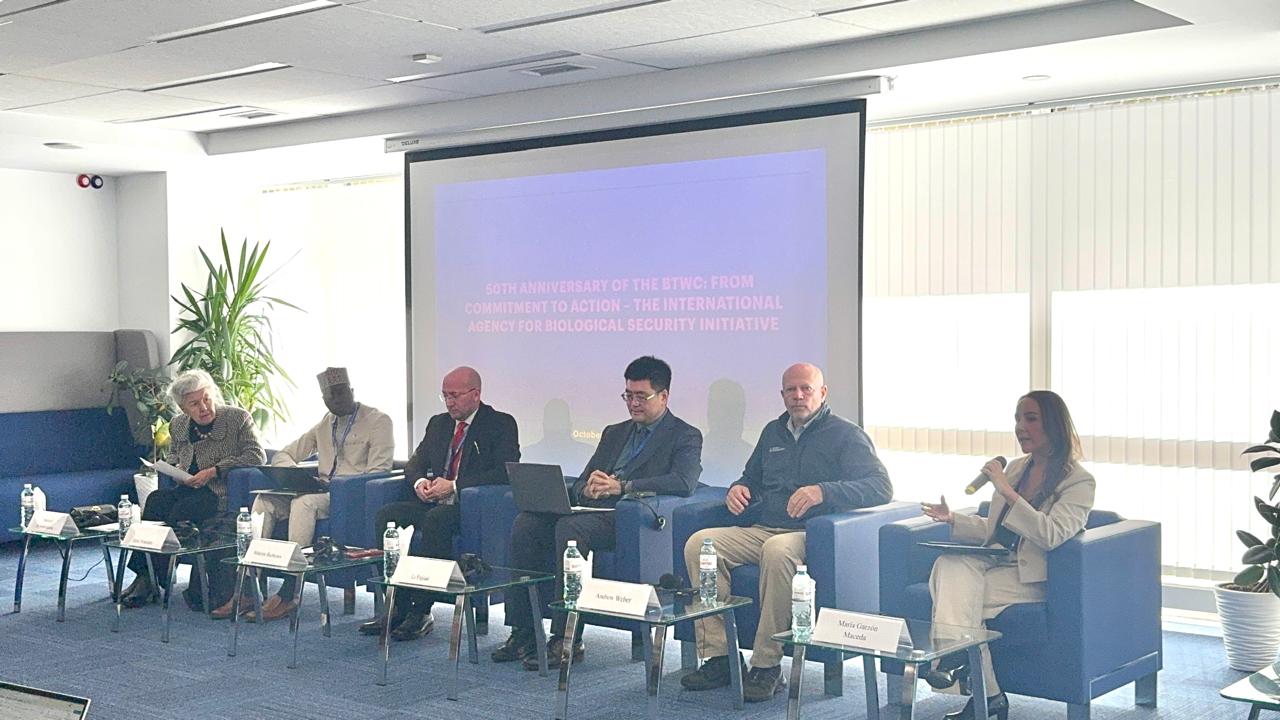
Photo credit: The Astana Times
The event, held on the margins of the International Conference on Future Challenges of Biosafety and Biosecurity, marked the centenary of the 1925 Geneva Protocol and the 50th anniversary of the BTWC, both of which underscore the enduring global commitment to the prohibition of biological and toxin weapons and the promotion of peaceful uses of biotechnology.
Kazakhstan’s leadership and multilateral vision
Opening the seminar, Arman Baissuanov, Director of the International Security Department at the Kazakh Foreign Ministry, highlighted the collaborative nature of the discussion and the contribution of key international participants.
“We are honored to have with us distinguished experts from Russia, China, and the United States, whose experience and insights are greatly appreciated,” he said.
The plenary session, moderated by Maria Garzon Maceda, project coordinator at the United Nations Institute for Disarmament Research (UNIDIR), highlighted the constructive role of various initiatives in advancing dialogue on the institutionalization of the BTWC, emphasizing the importance of sustained international engagement.
Opening the session, Akmaral Arystanbekova, former Ambassador and the country’s first Permanent Representative to the United Nations, emphasized Kazakhstan’s consistent commitment to multilateralism and the elimination of weapons of mass destruction since independence.
“Our decision to close the Semipalatinsk nuclear test site and to eliminate the world’s fourth-largest nuclear arsenal demonstrated our country’s moral leadership and its faith in multilateral cooperation,” she said.
In her remarks, the Ambassador also underscored the continuity of Kazakhstan’s engagement within the framework of the BTWC and other international instruments on non-proliferation and biosafety.
“For Kazakhstan, adherence to those principles has never been a matter of formality. We see it as an essential element of collective security – a framework that ensures that scientific progress serves only peaceful purposes,” she said.
Animal health and the world approach
Speaking at the session, Baba Soumaré, Deputy Director General of the World Organization for Animal Health (WOAH), underscored that animal health remains vulnerable to both accidental and deliberate misuse of pathogens, stressing that many pathogens used historically in biological weapons have been of animal origin.
“The most effective and sustainable way to protect against threats is by strengthening existing surveillance systems, early detection, and rapid response at source — before a threat spills over to humans and becomes a wider health problem,” said Soumaré.
Soumaré commented on WOAH’s growing cooperation with security and law enforcement agencies to prevent and respond to deliberate biological events, as well as the organization’s upcoming Third Global Conference on Biological Threat Reduction, scheduled for Oct. 28–30 in Geneva.
“Our global conferences serve as opportunities to review progress, set strategic priorities, and promote responsible conduct in science.”
Science, politics, and the BTWC’s institutional deficit
Following the discussion, Maksim Bazhenov, Head of the Center for Scientific and Technical Information at the Institute of Chemical Biology of the Siberian Branch of the Russian Academy of Sciences, warned that the foundation is now being severely tested by two powerful forces: geopolitical tensions and an unprecedented scientific revolution.
He observed that this institutional deficit is further aggravated by the rapid pace of scientific progress and the widening technological divide between states.
“On one hand, we are witnessing an erosion of trust on the international stage. On the other hand, the life sciences are experiencing explosive development. Technologies that seemed like science fiction yesterday are our reality today,” he said.
Bazhenov cited examples such as genome editing, synthetic biology, and artificial intelligence, noting that while they offer immense benefits, they also lower the threshold for creating new, more dangerous pathogens and heighten the risks of misuse.
“Our task is not to halt progress but to channel it safely – to ensure that the greatest revolution in the life sciences is recorded in history books as a synonym for hope, not fear,” he said.
Regional perspectives and policy innovation
Contributing to the discussion, Li Fujian, Deputy Director of the Center for Global Biosecurity Governance Research at the China Foreign Affairs University, described two tectonic shifts that have amplified the weakness Bazhenov has described in his speech.
“The breathtaking pace of the biotechnology revolution from CRISPR gene-editing to AI-driven protein design and synthetic biology is a profound dual-use dilemma,” he said.
Fujian also pointed to the Health Silk Road and the Central Asia-China SCO Member States Health Forum as examples of how the region is linking biosecurity with public health and sustainable development, making it a crucial vehicle for building consensus and driving a reformist agenda within the BTWC.
Continuing commitment to global biosecurity
Andrew Weber, former First Secretary of the U.S. Embassy and Senior Fellow at the Janne E. Nolan Center on Strategic Weapons, highlighted Kazakhstan’s strategic vision and decisive role in the global campaign against weapons of mass destruction.
“Thanks to the wisdom of Kazakhstan’s leadership, with assistance from the U.S. Department of Defense, those facilities have been completely destroyed,” he said.
Weber commended Kazakhstan and regional partners for their long-standing collaboration with the United States through initiatives such as the Nunn-Lugar Cooperative Threat Reduction Program, which helped modernize laboratories and strengthen public-health infrastructure across Eurasia.
“We’re proud to work with Kazakhstan in this critical mission of once and for all ridding the world of biological weapons,” he said.
The seminar fostered dialogue among international experts, identified opportunities and challenges within the BTWC framework, and developed recommendations for creating the IABS—an initiative proposed by President Kassym-Jomart Tokayev at the 75th session of the United Nations General Assembly in 2020.
Kazakhstan reaffirmed its role as a key advocate for global biological security, promoting the institutional strengthening of the BTWC and the peaceful use of biotechnology for the benefit of all nations.
The Conference on Future Challenges of Biosafety and Biosecurity will continue on Oct. 15–16 in Almaty, bringing together policymakers, scientists, and international organizations to explore pathways toward a safer, more cooperative global biosecurity architecture.
