
ASTANA – For women across Central Asia, equal rights enshrined in law do not necessarily translate into equal opportunities in everyday life, researchers said during a CAPS Unlock discussion examining barriers to women’s economic and professional advancement.
Researchers and gender experts examined how deeply rooted expectations about marriage, motherhood and professional leadership continue to shape women’s choices, even as governments seek to increase their participation in economic life. The more difficult challenge, experts noted, is ensuring that women have the freedom and institutional support to use the opportunities already available to them.
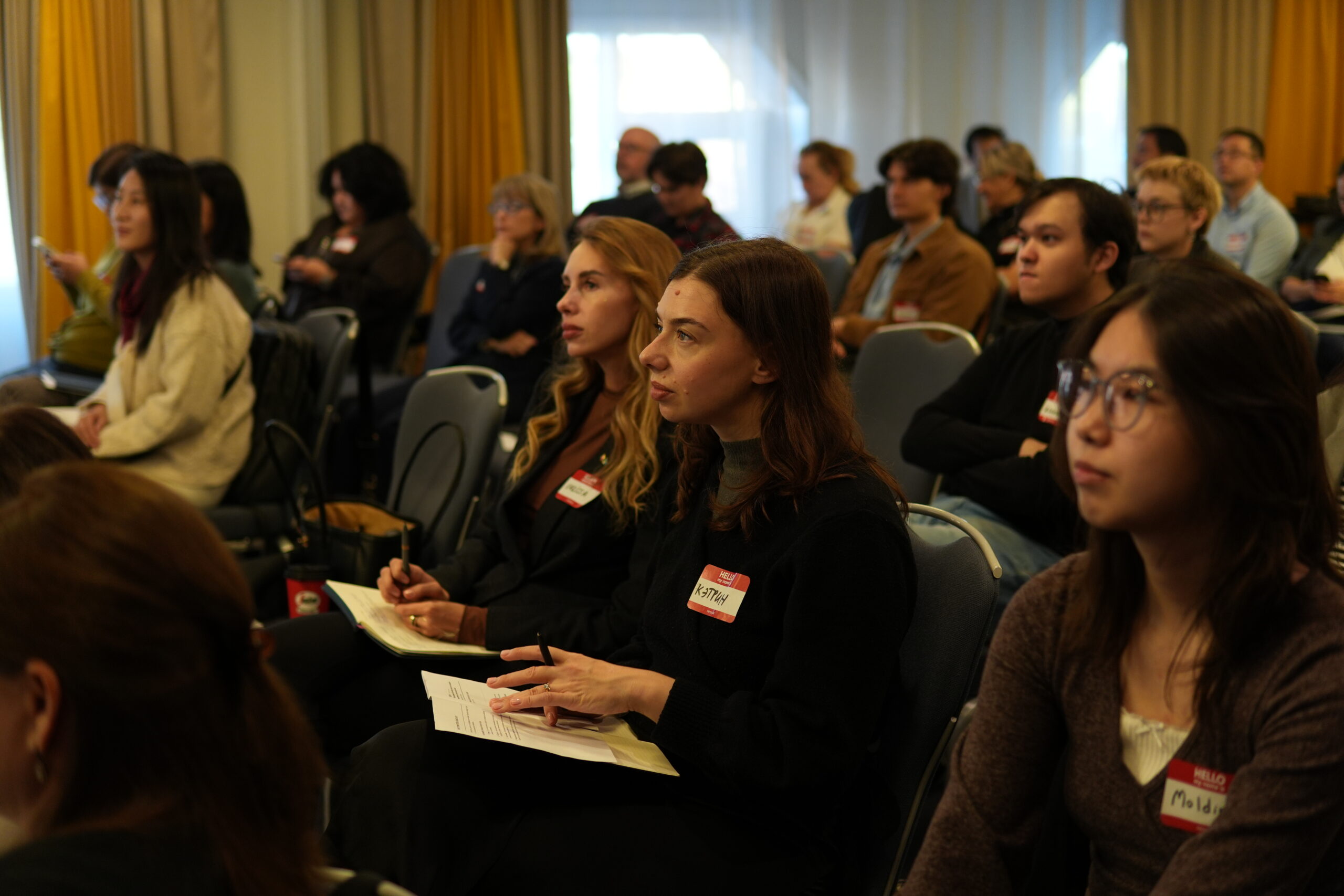
The discussion was held as part of the Central Asian Think Tanks Forum organized by Paperlab in partnership with CAPS Unlock. Photo credit: CAPS Unlock
Independent researcher Dinara Nurusheva said that workplace policies intended to support parents can fall short when employers and managers continue to operate under traditional assumptions about caregiving. For her, the barriers women face in the workplace are also personal. After she married, prospective employers repeatedly asked when she planned to have children, even though she would not become a mother until eight years later. Her experience later informed research into the “motherhood penalty,” the economic and professional disadvantages women face after having children.
Nurusheva also challenged the notion that women’s decisions to return to work, change professions or accept lower-paying jobs after maternity leave are entirely voluntary.
“What is interesting is that we often frame this as an individual problem for women to solve. A woman has to decide who will look after her child, what to do with her career and how she will earn a living. But in reality, this is a structural problem,” said Nurusheva.
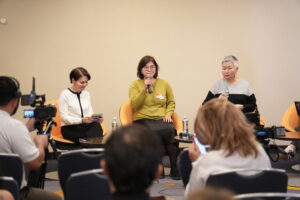
Moderator Bota Ayazbayeva, Dinara Nurusheva and Elmira Abylbek. Photo credit: CAPS Unlock
“We often talk about choice: a woman’s choice to return to work after maternity leave, to change careers or to take a job that pays significantly less than the one she had before,” she added. “We need to create conditions that allow women to make genuine choices.”
The burden of unpaid domestic work compounds those constraints. Nurusheva said 95% of women in her research spend at least an hour a day on unpaid household labor, with some spending more than six hours. Limited access to public childcare for children younger than three further restricts women’s options for returning to work, she said.
Nurusheva called for expanded early childhood care and dedicated leave for fathers, noting that men seeking to take on greater caregiving responsibilities also encounter resistance rooted in traditional gender roles. In Kazakhstan, for example, only 1% of men take parental leave.
Uzbekistan’s case
In Uzbekistan, similar tensions have emerged around efforts to encourage fathers to take a greater role in childcare.
Kamola Alieva, an associate professor of constitutional law at Tashkent State University of Law, discussed proposed legislation providing five days of paid paternity leave in Uzbekistan. However, she questioned whether the measure alone could change social expectations that caring for newborns is principally a mother’s responsibility.
“Family is a shared responsibility,” Alieva said.
She said she had also contributed to developing a draft concept titled the Well-Being of the Uzbek Family, which envisions how family life could evolve over the next decade. Active fatherhood was a central element in the concept, Alieva added, with men sharing responsibility for raising children and caring for family members. The concept had yet to be formally approved, underscoring the gap between policy ambitions and implementation.
“Whatever changes we introduce, whether in legislation or policy, everything ultimately comes down to implementation and perception. There is a strong resistance,” she said.
Alieva also questioned whether programs designed to expand women’s opportunities adequately account for the different circumstances in which women live. Equal rights, she noted, do not necessarily guarantee equal opportunities for a woman from a low-income rural household and one from a more affluent urban family.
“For me, equal opportunity means taking into account the needs of a particular group of people,” she said.
Alieva urged policymakers to assess whether programs, including educational grants and scholarships, translate into meaningful employment opportunities rather than simply measuring how many women receive support.
The barriers extend into politics. Alieva described qualitative research involving women lawmakers and local council members across five regions of Uzbekistan, who reported difficulties balancing unpaid domestic responsibilities with political duties, financial costs associated with public office and harassment. The findings also pointed to obstacles preventing women active in local politics from advancing to national leadership positions.
Alieva said women currently account for 39% of parliamentary representation in Uzbekistan.
Kamola Alieva.
“Yet women hold only around 5% of positions in the executive branch, and at present, we have no female ministers. This means women are virtually absent from decision-making processes and have very limited access to positions where resources are allocated,” said Alieva.
Overlooked economic contributions
The debate over how to support women today also raised questions about how their economic contributions have been recognized in the past. Elmira Abylbek, head of Bishkek-based Esimde research platform, highlighted research into women who became traders and entrepreneurs during the economic turmoil of the 1990s, helping sustain their families while establishing commercial networks that extended beyond national borders.
Abylbek said an earlier research project had collected more than 100 interviews, while a newer study had already exceeded its initial target of 25 interviews, reaching more than 35 and continuing to expand.
The accounts, she said, reveal not only stories of economic survival but also women’s growing influence in public life. Some became involved in social movements that later helped lay the groundwork for political organizations.
“At the very least, this should be included in history textbooks,” Abylbek said.
She noted that women developed financial and business skills long before concepts such as financial literacy became widely discussed, building cross-border trading networks and passing their knowledge to younger generations. Some of today’s entrepreneurs are the daughters and granddaughters of women who pioneered those businesses in the 1990s.
For Abylbek, documenting these experiences is also a way of challenging narratives that overlook women’s agency in shaping the region’s transformation after the collapse of the Soviet Union.
“We need to look at different periods and also talk about those periods when women pulled society and the state through very difficult times,” she said.
Abylbek also pointed to the importance of the language of assistance. Women, she noted, should be recognized as equal economic actors because portraying them primarily as vulnerable beneficiaries risks diminishing their agency.
Growing conservative backlash
The discussion also turned to what some researchers described as a growing conservative backlash against gender equality, particularly among younger generations. The discussion mentioned emerging research suggesting that young men in Kazakhstan and Tajikistan may be adopting more conservative attitudes toward gender roles, even as young women increasingly embrace more liberal views.
Abylbek, however, warned that the shift extends beyond Central Asia.
“We are seeing a conservative turn in politics, economics and practically every sphere,” she said, adding that similar patterns could be observed in the United States and the United Kingdom.
She said that the trend was reflected not only in political discourse but also in perceptions of leadership and expectations about how men and women should behave.
Alieva also pointed to growing tensions between younger generations over expectations of marriage and family life.
“Young women don’t want to live like their mothers, while young men want to live like their fathers, enjoying the same privileges their fathers had,” Alieva said.
According to her, these conflicting expectations are increasingly visible in public debates about gender roles, particularly on social media, where men who speak out in support of gender equality can face hostility. This, however, discourages influential male public figures from addressing discrimination and violence against women, leaving much of the advocacy to women themselves.
She called for more men with substantial public audiences to challenge discriminatory attitudes and serve as role models for younger generations.
