
ASTANA – Climate change does not always force people to move from their homes overnight. Sometimes, it slowly takes away the reasons to stay.
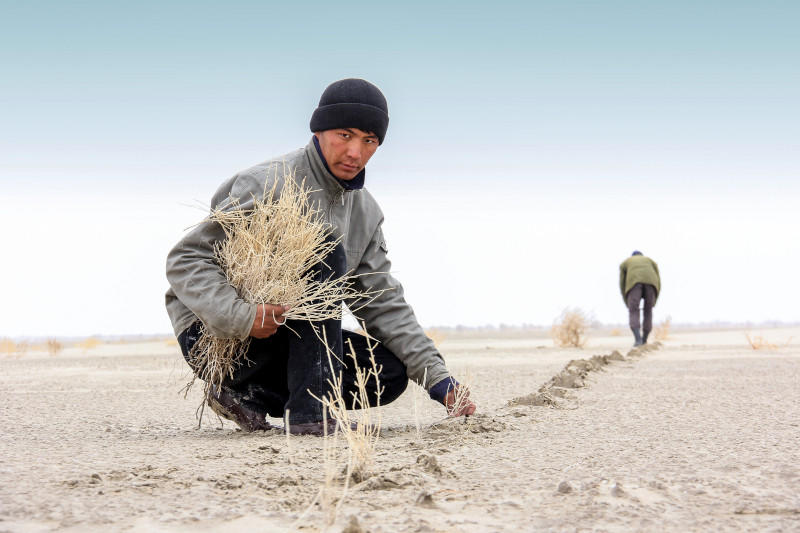
A farmer working on degraded land. Photo credit: UNDP Uzbekistan
For farmers and livestock herders, rising temperatures, prolonged droughts and reduced water supplies can mean declining harvests, shrinking pastureland and lost income. What begins as an environmental problem can become an economic one, influencing whether families stay or seek opportunities elsewhere.
Across Central Asia, such pressures could increasingly shape patterns of migration, even as researchers struggle to determine how much of the movement can be attributed directly to climate change.
Climate-related migration can take many forms. People may leave suddenly after floods or other disasters, or gradually as drought, water scarcity and declining agricultural productivity undermine their livelihoods. Such movements can be temporary or permanent, occurring within national borders or across them. Climate pressures often overlap with economic and social factors, making it difficult to identify a single reason why people move.
Where climate change may drive movement
In Central Asia, climate change could drive as many as 2.4 million people to move within their own countries by 2050, according to a pessimistic scenario modeled in the World Bank’s 2021 Groundswell report. Under alternative scenarios involving more inclusive development or lower emissions, the projected number falls to 1.9 million and 1.7 million, respectively.
Globally, the report estimates as many as 216 million people may move within their countries by 2050 across six regions.
Climate change could also reshape patterns of migration, making some areas more attractive, while increasing pressure to leave others.
The World Bank identified the Ferghana Valley, areas around Tashkent and Dushanbe, and parts of Kazakhstan, including Astana, Karagandy and Kostanai, as potential destinations for internal climate migrants, where changes in water availability and crop productivity could create more favorable livelihood opportunities.
By contrast, parts of southern Kazakhstan, areas surrounding the Ferghana Valley in Uzbekistan and Tajikistan, and the vicinity of Bishkek could become hotspots of climate-related out-migration as water availability and agricultural productivity decline.

Nugzar Kokhreidze. Photo credit: personal archive
These projections, however, do not account for the longer-term effects of glacier melt on Central Asia’s rivers, which could alter water availability and migration patterns.
“Climate change already has an impact on migration in Eurasia,” Nugzar Kokhreidze, a climate advocate, co-founder and chairman of the Dialogue of Generations Research-Intellectual Club, told The Astana Times.
Determining how much climate change already influences migration is far from straightforward. People move for economic, social and political reasons, often under pressures that are difficult to disentangle from a changing environment.
“However, it is difficult to say that ‘climate migrants’ constitute a proper, separate and clearly identifiable category. Migration has many causes,” Kokhreidze said.
“At the same time, we cannot say that migration is caused only by economic factors. Even if a person leaves after losing their home, the underlying reasons could include repeated droughts, water scarcity and decreasing harvests. Based on this example, we can say that economic pressure becomes a mechanism through which climate change affects migration,” he explained.
Environmental pressures already affect communities
While climate models offer projections of future migration, there is evidence of how environmental pressures are already affecting the population.
Kokhreidze said the strongest evidence in Central Asia comes from sudden disasters and long-term environmental degradation, rather than official statistics identifying people as climate migrants.
“For example, Kazakhstan’s 2024 floods resulted in nearly 120,000 evacuations. The Aral Sea region, particularly Karakalpakstan, also shows how environmental degradation, water scarcity, health risks, and the loss of livelihoods can contribute to outmigration,” he said.
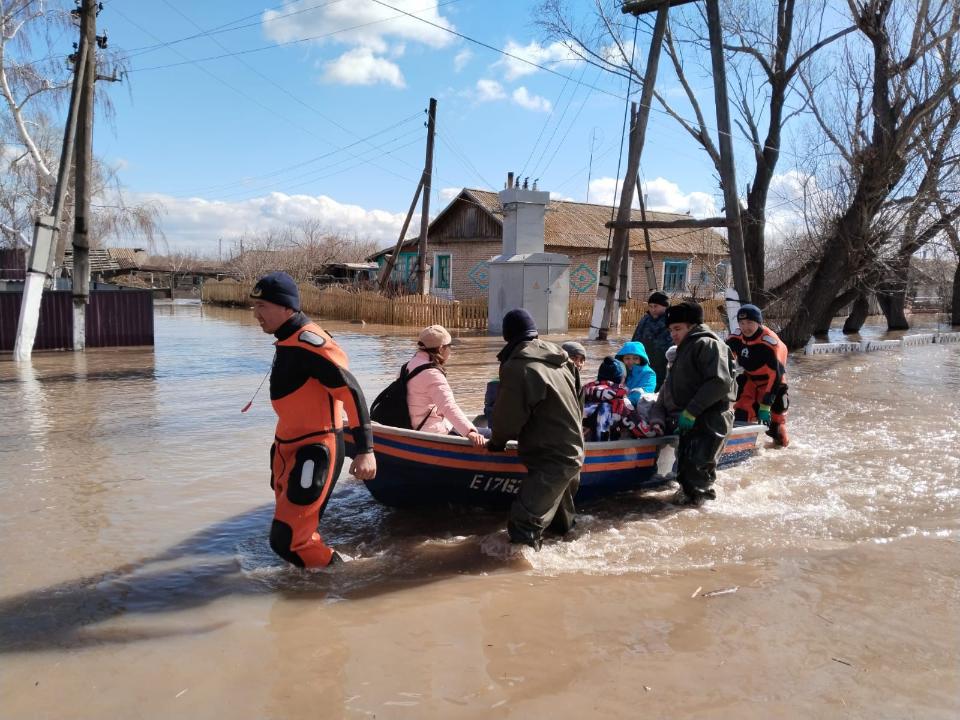
Nearly 120,000 people were displaced during massive floods in Kazakhstan in 2024. Photo credit: Kazakhstan’s Ministry of Emergency Situations
Kokhreidze cautioned, however, that the crisis cannot be attributed solely to climate change, given the significant role of decades of water mismanagement and economic hardship.
Looking ahead, he also identified the lower Amu Darya basin, southern Kazakhstan, water-stressed areas surrounding the Ferghana Valley and glacier-dependent communities in the Kyrgyz Republic and Tajikistan as particularly vulnerable to climate-related pressures over the next decade.
“These are modelled scenarios, not precise forecasts,” he added.
Similar pressures are emerging in the South Caucasus, where they range from landslides and floods in mountainous areas to drought and water scarcity in agricultural regions. In Georgia, for example, dozens of villages have been abandoned or experienced displacement because of landslides over the past four decades, according to World Bank research cited by Kokhreidze.
“Mountainous and coastal areas, including Adjara, north-western Georgia, and parts of Mtskheta-Mtianeti, remain exposed to floods, landslides, mudflows, and glacier-related risks. Eastern agricultural regions, particularly Kakheti and Kvemo Kartli, are vulnerable to drought, heat, water scarcity, and land degradation,” he said.
In Armenia, water stress and mounting pressures on agriculture in the Ararat Valley could cause further internal migration toward Yerevan.
“IOM projections estimate between 12,000 and 52,000 internal climate migrants by 2050, although these figures represent scenarios rather than observed migration,” he said.
Climate migration remains difficult to measure
The scale of climate-related migration remains challenging to measure. The Internal Displacement Monitoring Centre (IDMC) recorded 29.9 million internal displacements triggered by disasters worldwide in 2025, down from a record 45.8 million in 2024, according to its Global Report on Internal Displacement 2026.
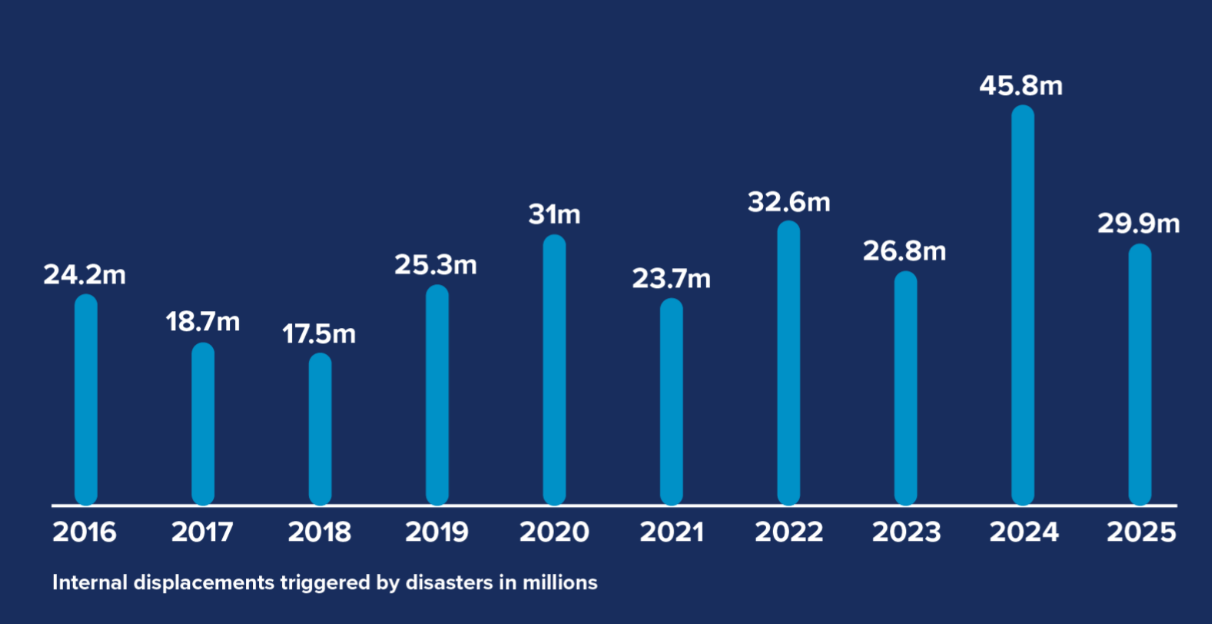
Internal displacements triggered by disasters. Photo credit: IDMC
The figures reflect forced movements, including repeated displacement of the same individuals, rather than the number of distinct people who have migrated. They also include disasters that cannot necessarily be attributed to climate change.
When asked what policymakers should look at when determining which factors impact a decision to move, Kokhreidze suggested paying attention to a “clear chain of evidence.”
“Migration data should demonstrate that departures, evacuations, or changes in seasonal migration increased after climate-related impacts, particularly in the most exposed communities. Household surveys and personal interviews are also important because they can show whether drought, water scarcity, or extreme heat materially influenced the decision to move, even when employment and income were reported as the immediate reasons,” he explained.
Kokhreidze said that while increasingly frequent or intense environmental hazards, including floods, droughts and desertification, are consistent with risks identified by climate scientists, available migration data are often insufficient to establish a direct causal link.
“At the same time, the absence of sufficient data does not mean that such a relationship does not exist. At this stage, we rely on documented observations, qualitative information, and emerging datasets rather than complete long-term statistics because we are observing climate change and its consequences while they are still unfolding,” he explained.
Researchers should examine environmental conditions alongside changes in livelihoods, migration statistics and personal accounts to determine whether climate pressures influenced people’s decisions to move.
Equally important, he noted, is recognizing that the absence of migration does not necessarily mean communities are unaffected by climate change. The difficulty is compounded by social and economic inequalities that determine how communities experience environmental risks and whether relocation is even possible. The IOM has highlighted how poverty, social inequality and inadequate infrastructure can leave some communities disproportionately exposed to environmental hazards, with fewer resources to prepare, recover or adapt.
The ability to migrate also depends on financial resources. Research discussed by Stanford University climate migration scholar Hélène Benveniste suggests that middle-income households are often more likely to move in response to climate risks than those at either end of the income spectrum.
Researchers refer to the situation in which people want to leave but cannot as “involuntary immobility,” suggesting that the absence of migration does not necessarily indicate lower exposure to climate risks.
Policy response
Governments are increasingly acknowledging the connection between climate change and migration, but experts say that international efforts to address it remain fragmented.
The 2018 Global Compact for Safe, Orderly and Regular Migration, a nonbinding United Nations agreement, calls on countries to address environmental pressures that force people to leave their homes and expand opportunities for regular migration. The Paris Agreement has also helped bring human displacement into international climate negotiations, with mechanisms established to help countries plan for climate-related migration and address the losses associated with it.
The IOM’s World Migration Report 2026 warns that growing skepticism toward migration, fragmented climate policies and competing global priorities are narrowing the political space for action, even as climate-related hazards increasingly influence where people live.
The report calls for a shift away from treating climate-related migration solely as a crisis, emphasizing policies that allow people to move safely while helping vulnerable communities adapt and remain where they are when possible.
Local governments also have an important role to play. Cities and municipalities are often the first to confront the consequences of climate-related population movements, however, many lack the resources, detailed data and institutional support needed to respond effectively.
For Central Asia, the findings raise a question. Are local authorities preparing for the demographic changes that a warming climate could bring?
