
ASTANA – Kazakhstan has signed a contract to design, supply and build its first nuclear power plant, moving the long-planned project into a new practical phase as the country seeks to strengthen energy security and prepare for growing electricity demand.
The contract was signed between Kazakhstan Nuclear Power Plants and Atomstroyexport, a subsidiary of Russia’s Rosatom state nuclear corporation, on the sidelines of the 11th Eastern Economic Forum in Vladivostok.
The signing was attended by Chairman of Kazakhstan’s Atomic Energy Agency Almasadam Satkaliyev and Rosatom Director General Alexei Likhachev.
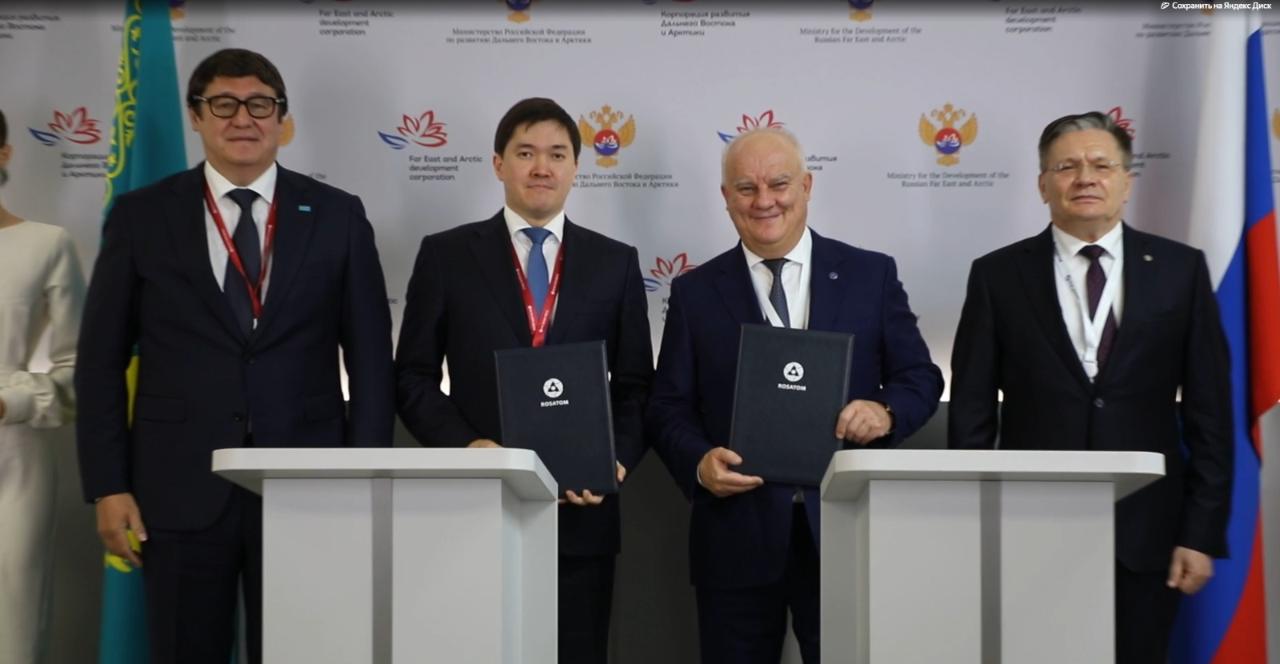
The contract moves the first nuclear power plant project beyond early site selection and political decision-making toward detailed implementation. Photo credit: Ministry of Energy.
The agreement marks a significant step in Kazakhstan’s plans to introduce nuclear generation into its energy mix. However, the project has not yet reached the final implementation stage. Under the intergovernmental agreement signed on May 28, 2026, the parties will continue the required procedures, including the necessary approval by the Kazakh government.
From political decision to construction project
The contract moves the first nuclear power plant project beyond early site selection and political decision-making toward detailed implementation. Kazakhstan approved the construction of a nuclear power plant through a national referendum in October 2024. The project is planned for the Zhambyl district of the Almaty Region, with construction expected to take about eight years.
Rosatom was selected from a shortlist that also included China National Nuclear Corporation, France’s EDF and Korea Hydro & Nuclear Power.
Rising electricity demand puts energy security at the center
The government sees nuclear power as a response to a structural increase in electricity demand. Kazakhstan’s economy, industrial production and infrastructure are expanding, while digitalization and the development of artificial intelligence are creating additional demand for stable electricity supplies. Unlike intermittent renewable sources, nuclear power is designed to provide continuous baseload generation.
Globally, nuclear energy supplies nearly 10% of electricity generation and around 20% in advanced economies, according to the International Energy Agency. With global nuclear capacity approaching 413 gigawatts across 32 countries, nuclear power remains a major source of low-carbon electricity.
The IEA estimates that nuclear power currently prevents around 1.5 gigatonnes of carbon dioxide emissions and 180 billion cubic meters of gas demand each year. For Kazakhstan, the attraction of nuclear generation is therefore twofold: it could provide additional stable capacity while supporting the country’s longer-term efforts to reduce the carbon intensity of its power sector.
At the same time, nuclear power is not a substitute for renewable energy. The IEA has emphasized that nuclear and renewable generation can complement each other as countries seek to decarbonize their electricity systems. For Kazakhstan, which has significant wind and solar potential, the final energy model will likely depend on how nuclear generation is integrated with existing thermal plants and the expanding renewable sector.
The bigger opportunity may be industrial
The economic significance of the project could extend beyond electricity generation. The Atomic Energy Agency has emphasized localization as a priority, aiming to involve Kazakh companies, specialists, goods, works and services as extensively as possible in the construction process.
This is particularly important because a nuclear power plant is a highly complex industrial project. Its supply chain requires specialized equipment, engineering expertise, safety systems and technical standards. Building those capabilities domestically could give Kazakhstan an industrial base for future nuclear projects and related activities. The government has said the first plant should help create national competencies and a personnel reserve for the further development of the nuclear sector.
Uranium producer seeks a larger role in nuclear energy
Kazakhstan enters the nuclear era from an unusual position: it is the world’s leading uranium producer but does not currently generate electricity from nuclear power. That creates an opportunity to connect the country’s existing position in the global uranium industry with a domestic nuclear energy value chain.
The first power plant could become the foundation for a broader nuclear-energy cluster, particularly if Kazakhstan proceeds with its stated plans to build three nuclear power plants.
The government has described the project as part of Kazakhstan’s efforts to strengthen energy independence and technological sovereignty. Those goals will ultimately be measured not only by the plant’s completion but by what Kazakhstan can build around it.
A successful project could provide reliable baseload electricity, support industrial growth, create specialized jobs and help establish domestic nuclear competencies. It could also give Kazakhstan greater flexibility as it balances rising electricity demand with decarbonization goals.
For a country already in a leading position in the global uranium industry, the first nuclear power plant could mark a shift from primarily supplying nuclear raw materials to producing nuclear energy.
