
Nearly 10 years after launching one of the most ambitious economic reform programs in the post-Soviet space, Uzbekistan stands at another crossroads. Having largely dismantled the inward-looking economic model inherited from the early years of independence, the country is nearing the final stage of accession to the World Trade Organization (WTO) while facing growing discussion about possible full membership in the Eurasian Economic Union (EAEU).
Photo credit: www.daryo.uz
At first glance, these two processes appear complementary. Legally, they are not mutually exclusive, since Kazakhstan, Kyrgyzstan, and Armenia belong to both organizations. The decisive question for Uzbekistan is narrower. It concerns which integration framework should shape the country’s long-term economic future.
From economic isolation to an open economy
When President Shavkat Mirziyoyev launched his reform agenda in 2016, Uzbekistan remained one of the least integrated economies in Eurasia. Foreign exchange controls, multiple exchange rates, restrictive customs procedures, and import substitution policies had constrained private investment and exports for close to 20 years.
Sobir Kurbanov.
The reforms that followed altered this trajectory. Currency convertibility was introduced in 2017, removing one of the largest barriers to foreign trade and investment. Customs procedures were simplified and increasingly digitized. Relations with neighboring Central Asian countries improved, with reopened border crossings and expanded transport links. The government launched privatization and state-owned enterprise reform programs, liberalized prices in several sectors, strengthened investment legislation, and adopted the Uzbekistan-2030 strategy centered on private-sector-led growth.
The results have been substantial. Uzbekistan’s merchandise trade has more than doubled since 2016, and exports have diversified beyond traditional commodities. The European Union granted Uzbekistan GSP+ preferences in 2021, widening access to one of the world’s largest consumer markets. Trade with China, Turkiye, South Korea, and the Gulf states has expanded, and Central Asia itself has become a more integrated economic region.
This transformation reflects a shift in economic policy. Policymakers increasingly treat trade as a source of productivity, technology transfer, and investment, where earlier policy had emphasized protection of domestic producers. Completing WTO accession is therefore the logical continuation of this reform strategy.
WTO membership: an institutional reform agenda
Public debate often reduces WTO accession to lower tariffs and easier market access. Its largest benefits come through stronger institutions, well beyond tariff reductions.
The WTO provides a universal rules-based framework governing trade among virtually all major economies. Membership requires transparent trade regulations, predictable customs procedures, equal treatment of domestic and foreign firms, stronger protection of intellectual property, and non-discriminatory technical standards covering goods and services.
For Uzbekistan, these requirements reinforce reforms already underway, and accession negotiations have become a catalyst for legislative modernization. Laws governing customs administration, technical regulations, sanitary and phytosanitary standards, intellectual property, licensing, investment, and services have been revised to align with international standards. Domestic enterprises gain from this alongside foreign firms, through greater certainty and lower transaction costs.
The largest economic benefit concerns competition. Uzbekistan has made considerable progress in liberalizing markets, yet state-owned enterprises continue to dominate banking, energy, mining, transport, and parts of manufacturing. Preferential financing and procurement advantages continue to discourage private investment and innovation.
The WTO does not prohibit industrial policy. It changes the form that policy takes. In place of high tariffs, import restrictions, and discretionary subsidies for selected firms, governments are encouraged to support competitiveness through horizontal measures such as infrastructure, skills, research and development, digitalization, and export promotion.
This distinction matters. Countries that moved into higher-value-added manufacturing, such as South Korea, Poland, and Vietnam, did so by integrating domestic firms into global production networks and steadily improving productivity, going well past simple protection of those firms. For Uzbekistan, whose long-term objective is to become an upper-middle-income economy, this approach is more sustainable than preserving import-substitution policies inherited from an earlier stage of development.
WTO accession also signals commitment to international investors. Binding commitments increase policy predictability and strengthen investor confidence. In a competitive global market for foreign direct investment, such institutional credibility often matters more than temporary tax incentives.
Why the EAEU remains attractive in the short term
None of this diminishes the importance of Russia or the EAEU for Uzbekistan.
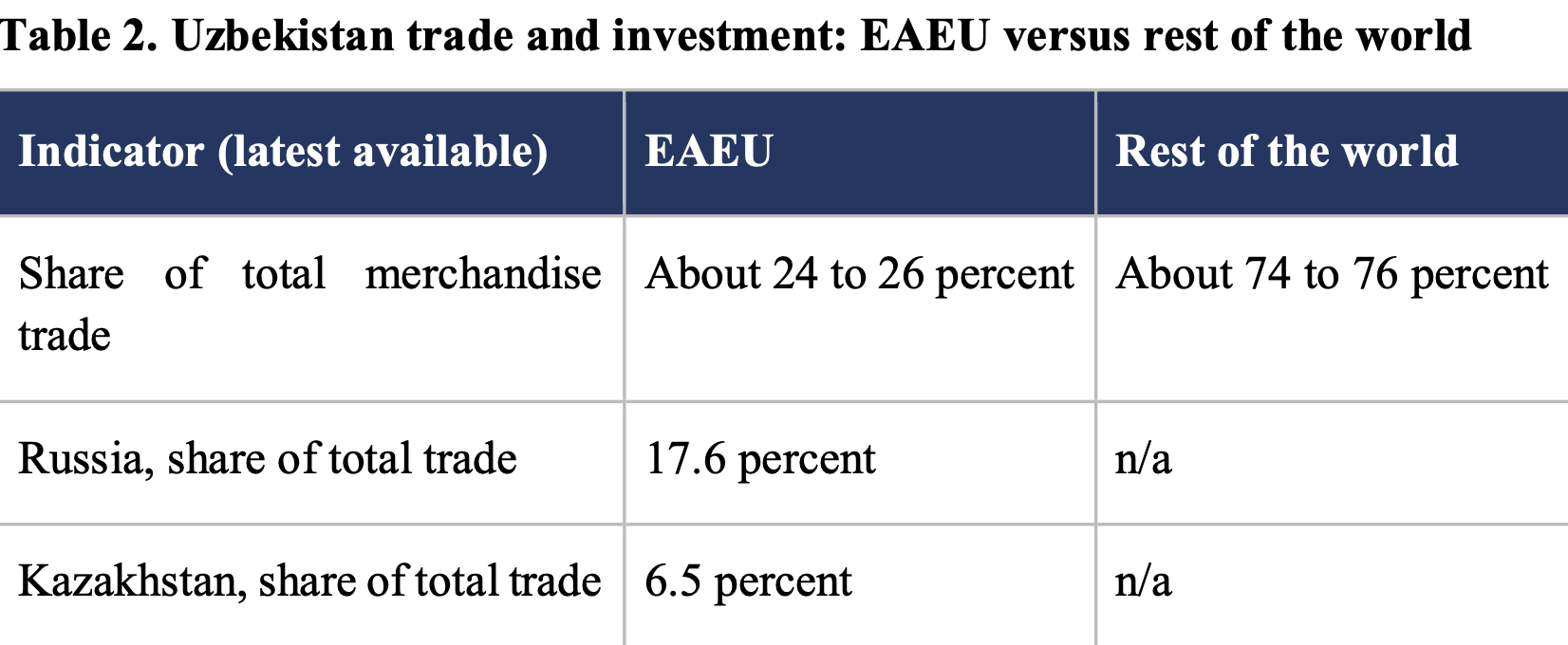
Russia remains one of Uzbekistan’s largest trading partners, alongside China and Kazakhstan. Together, EAEU members account for roughly one-quarter of Uzbekistan’s merchandise trade, about 24 to 26 percent. Russia is also a major export market for Uzbekistan and a supplier of machinery and industrial inputs.
Labor migration also shapes economic relations. As of October 2025, roughly 2 million Uzbek citizens lived abroad, about 1.6 million of them employed, with Russia the principal destination despite gradual diversification toward Kazakhstan, South Korea, Turkiye, Japan, and several European countries. Remittances reached US$18.9 billion in 2025, up from US$14.8 billion in 2024, providing income for millions of households and ranking among Uzbekistan’s largest sources of foreign exchange. Russia supplied close to 78 percent of that total.
Closer integration with the EAEU offers tangible advantages. Member states benefit from simplified labor mobility, easier recognition of professional qualifications, reduced customs formalities, and harmonized technical regulations. Businesses operating mainly within the Eurasian market may see lower transaction costs and greater regulatory certainty.
These are real economic benefits, and they explain why Uzbekistan has maintained observer status in the EAEU since 2020 rather than rejecting deeper engagement. These short-term gains should not obscure the deeper strategic question. What type of economic integration best supports Uzbekistan’s long-term development model?
The limits of the EAEU as a development strategy
The EAEU offers practical advantages for regional trade and labor mobility. Its record as a driver of structural transformation is more mixed.
Nearly a decade after its establishment, the EAEU remains a limited regional bloc, accounting for roughly 2 to 3 percent of global GDP and a smaller share of world trade. Russia represents approximately 85 percent of the Union’s total economic output, which creates asymmetry in decision-making and economic influence. The EAEU has not evolved into a deeply integrated common market with extensive supranational institutions of the kind the European Union built. Exemptions remain in services, public procurement, and sectoral regulation, and non-tariff barriers continue to affect trade among member states.
The Union has also yet to show that it can accelerate productivity growth or economic diversification among its members. Kazakhstan and Kyrgyzstan remain heavily dependent on commodity exports and external demand, and Belarus continues to rely on preferential access to the Russian market. Intra-EAEU trade has expanded in nominal terms, yet much of that growth reflects commodity prices and trade reorientation, with limited emergence of the regional value chains seen in East Asia or the European Union.
The governance model also differs from that of the WTO. The WTO rests on globally negotiated rules and legally binding commitments that apply to all members. The EAEU combines legal institutions with a stronger intergovernmental process in which Russia’s predominant economic weight gives it greater influence over agenda-setting and implementation. Recent tensions involving Armenia and periodic trade disagreements within the Union show that political considerations can intersect with economic governance, particularly when broader geopolitical interests are involved.
For Uzbekistan, the common external tariff is a further consideration. EAEU membership requires adherence to a common customs policy, which reduces national flexibility in tariff negotiations with third countries. This does not make WTO membership impossible, as Kazakhstan and Kyrgyzstan show, yet it complicates accession negotiations and may constrain Uzbekistan’s ability to tailor trade policy to its industrial priorities. For a country pursuing diversified economic partnerships with the European Union, Turkiye, the Gulf states, South Asia, East Asia, and North America, strategic flexibility remains an important asset.
WTO first, regional integration second
Uzbekistan’s transformation since 2016 has been built on greater openness and stronger market institutions. WTO accession is the logical culmination of this process. It locks in domestic reforms and integrates Uzbekistan into the global rules-based trading system, while strengthening competitive neutrality.
The EAEU can offer useful regional benefits, particularly in labor mobility, logistics, and trade facilitation. It is better viewed as a complementary regional arrangement than as the principal framework for Uzbekistan’s long-term development.
The structure of Uzbekistan’s external economic relations underlines the value of a globally diversified strategy. The EAEU accounts for roughly one-quarter of Uzbekistan’s merchandise trade, with Russia and Kazakhstan as key commercial partners and Russia central to labor migration. The remaining three-quarters runs with non-EAEU economies. China has become Uzbekistan’s largest trading partner, and the European Union, Turkiye, South Korea, the Gulf states, and South Asia are increasingly important as export markets and sources of technology and investment. Investment patterns point even more strongly toward diversification. China is now the largest foreign investor, followed by partners from the Gulf, Europe, and Turkiye. Uzbekistan’s future growth will depend on open access to global markets and diversified sources of investment more than on any single regional bloc. That makes an independent, outward-oriented trade policy anchored in WTO membership an important strategic objective.
The sequencing therefore matters. Completing WTO accession first would preserve negotiating flexibility, reinforce domestic institutional reforms, and widen Uzbekistan’s access to global markets, technology, and investment. Only once these foundations are firmly in place should the country assess whether deeper participation in the EAEU would yield net economic gains without constraining its broader objectives of diversification and strategic autonomy.
Uzbekistan’s strategic choice is less about Russia versus the West, or regional versus global integration, than about two models of economic development. One emphasizes preferential access to a relatively limited regional market. The other anchors domestic reforms in a universal system built to promote competition and integration into the global economy. For a country whose long-term prosperity depends on innovation and export diversification, the second offers a more durable path to sustainable growth.
The author is Sobir Kurbanov, an international development expert and fellow at Nightingale Int. network.
Disclaimer: The views and opinions expressed in this article are those of the author and do not necessarily reflect the position of The Astana Times.
