
ASTANA – Kazakhstan and Canada are seeking to expand cooperation beyond traditional trade and resource industries, harnessing opportunities presented by emerging areas such as artificial intelligence and digital innovation, officials and business leaders said at the seventh meeting of the Kazakhstan-Canada Business Council in Astana on June 10.
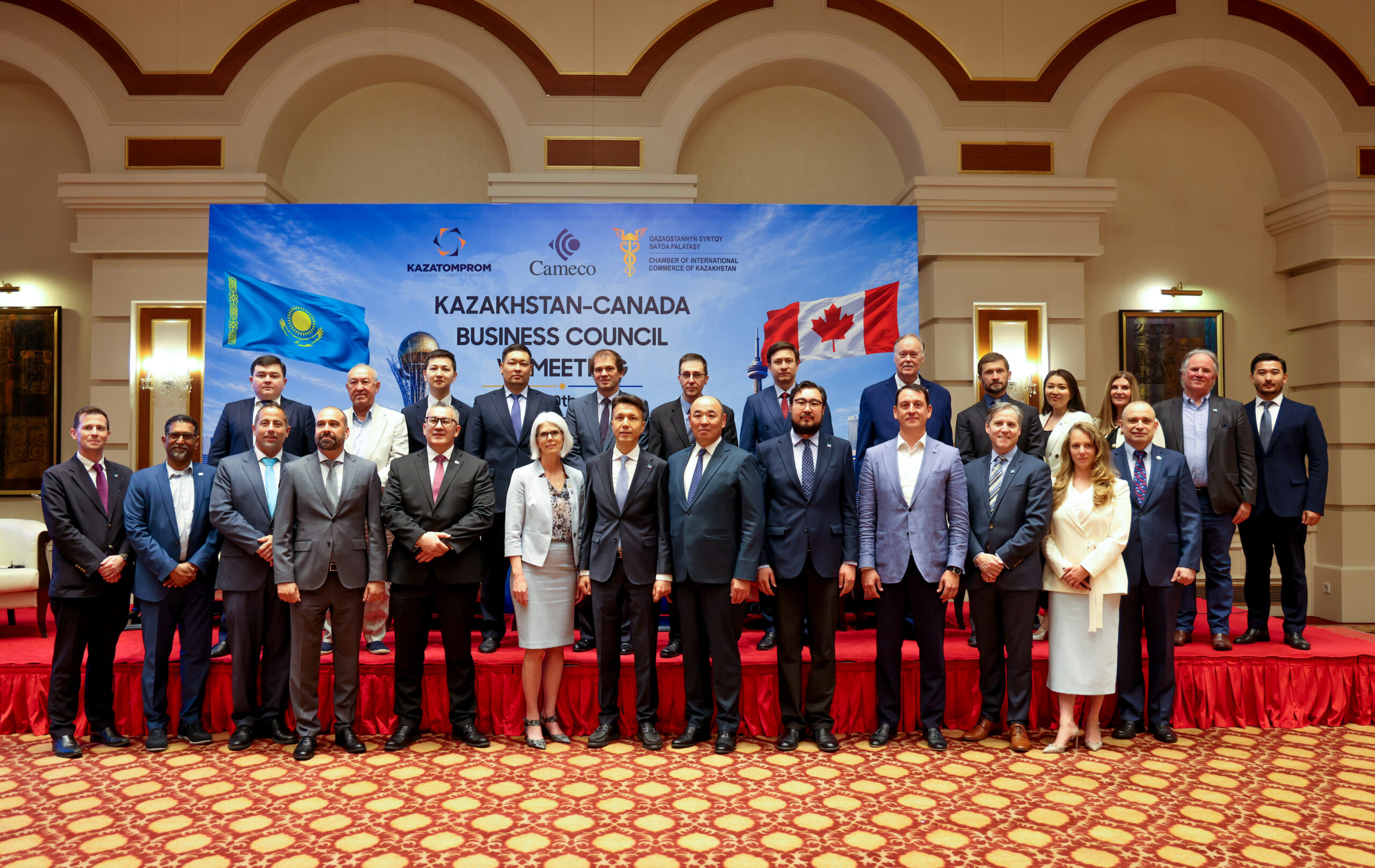
Canadian direct investment in Kazakhstan has exceeded $6 billion. Photo credit: Kazatomprom
“Kazakhstan and Canada are separated by thousands of kilometres, including the ocean, but united by shared values such as openness, the rule of law and the firm belief that business partnership is the foundation of long-term prosperity,” said Kazakh Deputy Foreign Minister Alibek Kuantyrov.
Canadian direct investment in Kazakhstan has exceeded $6 billion, while more than 170 Canadian-linked companies operate in the country, figures cited by Kuantyrov showed. He said the numbers reflect growing confidence among Canadian investors.
According to him, Kazakhstan and Canada are moving beyond a traditional trade relationship toward deeper industrial and technological cooperation. As an example, he cited an agreement signed in April by Canadian manufacturer Brandt to localize agricultural machinery production in Kazakhstan.

More than 170 Canadian-linked companies operate in the country. Photo credit: Kazatomprom
Kuantyrov noted that Kazakhstan is seeking partnerships that are technology-driven, strategically significant and focused on long-term results, adding that the government remains committed to expanding bilateral cooperation.
One of the most prominent examples of bilateral economic cooperation is Kazakhstan’s long-standing partnership with Canadian uranium producer Cameco, said Kazatomprom CEO Meirzhan Yussupov.
Cameco and Kazatomprom, the two companies co-chairing the business council, have worked together for more than three decades, including through the Inkai joint venture. Established in 1996, Inkai has become one of Kazakhstan’s largest uranium projects, with Cameco holding a 40% stake.
Yussupov said cooperation between Kazakhstan and Canada extends beyond uranium mining to sectors including mining and metallurgy, energy and agriculture, with growing interest in technology-driven industries.
According to him, the business council provides a platform for businesses to explore investment opportunities, deepen trade ties and identify new areas of cooperation. The council last met in Toronto during the Prospectors & Developers Association of Canada convention in 2024 and convened this year on the sidelines of the Mining and Metallurgy Congress in Astana.
Bilateral trade reached $458 million in 2025, including $324 million in exports and $134.1 million in imports. Canadian exports to Kazakhstan consist primarily of industrial machinery, equipment and parts, while imports from Kazakhstan are dominated by petroleum-related products, said Ambassador of Canada to Kazakhstan Christopher Duggan.
He identified mining, energy, agriculture and information and communications technology as sectors with significant untapped potential but said bilateral cooperation remains below its full capacity.
“I don’t think that we are operating anywhere near our full potential,” he said, adding that greater engagement between businesses and governments would be needed to unlock new opportunities and diversify trade and investment.
“Canadian companies continue to bring world-class expertise, long-term investments, and high standards in governance, sustainability, and innovation. Kazakhstan remains a strategic partner in Central Asia, with significant potential for further growth and diversification. I am especially pleased to see today’s focus on artificial intelligence and digital innovation, which resonates very well with Kazakhstan’s national priorities and Canadian capacity and expertise,” said the ambassador.
Agricultural cooperation is another strong pillar of the bilateral ties, according to Yernar Zharkeshov, deputy governor of the Akmola Region. Zharkeshov traced the partnership back to the 1950s, when agronomist Alexander Barayev studied soil conservation practices in Saskatchewan, a Canadian province, helping introduce no-till and conservation farming methods that later transformed agriculture in northern Kazakhstan.
The partnership’s newest phase, Zharkeshov noted, is focused on artificial intelligence and digital agriculture. During a visit to Canada last month, a delegation from the Akmola Region explored advanced agricultural technologies, including livestock monitoring, herd management, data analytics and AI-powered farming solutions.
The region is now working with Canada’s TELUS Agriculture & Consumer Goods to expand the use of digital technologies in areas such as soil management, livestock production, veterinary services and workforce training.
Zharkeshov said that digital livestock management technologies linked to TELUS Agriculture have been used in the country since 2014, particularly in the beef sector. According to him, implementation of digital feedlot and ranch management systems at one of Kazakhstan’s leading beef producers increased average daily weight gain by 70%, more than doubled feed-conversion efficiency and reduced livestock mortality by two-and-a-half times.
