
ASTANA – Central Asian countries presented their strategies for developing critical minerals and expanding regional cooperation during the C5+1 Critical Minerals Dialogue with the United States on June 10 in Astana.
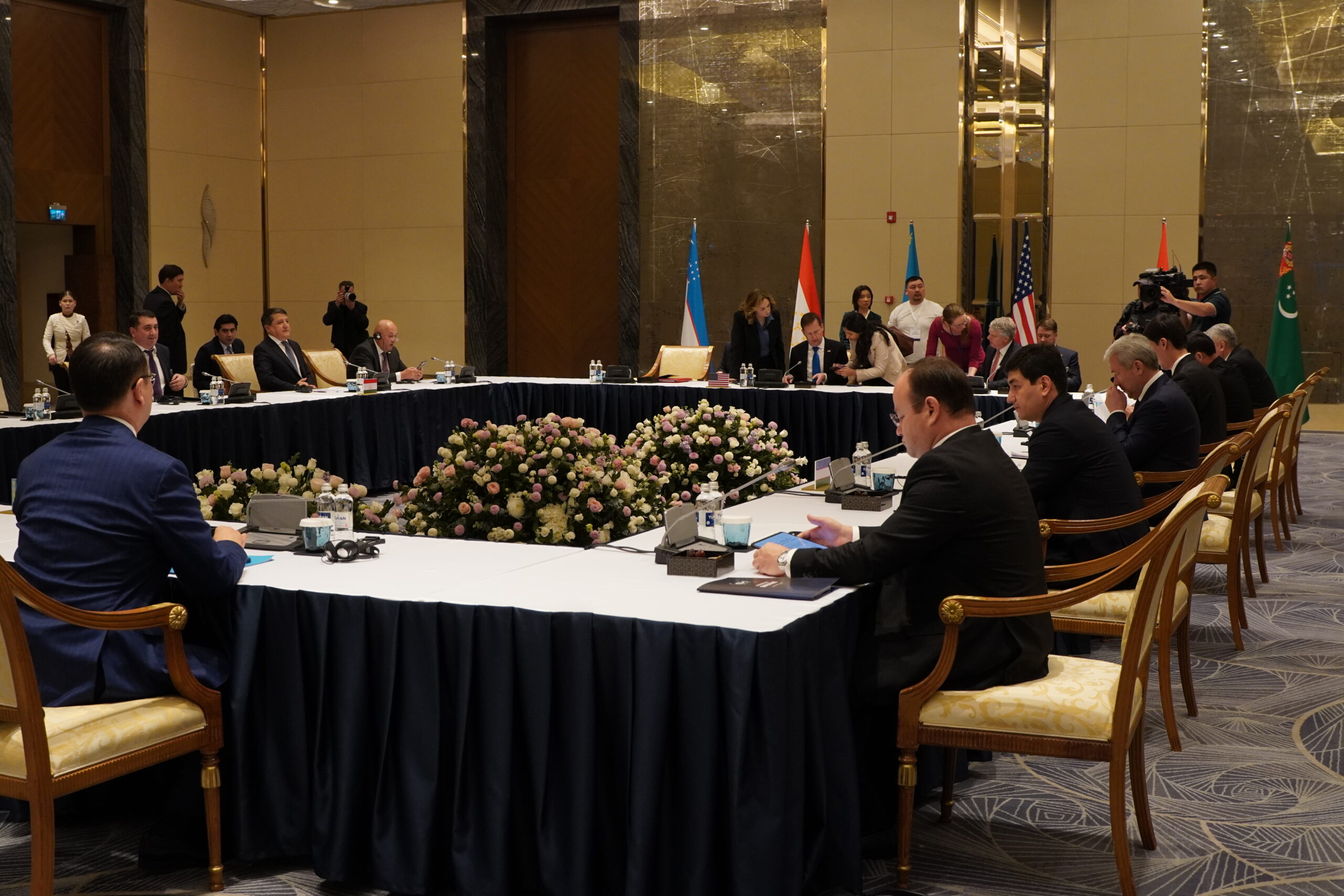
Senior officials from Central Asian countries and the United States participated in the C5+1 Critical Minerals Dialogue on June 10 in Astana. Photo credit: The Astana Times/ Fatima Kemelova
The discussions focused on geological exploration, data transparency, investment incentives, workforce development and regional supply chain integration.
Geological data key to investment
David L. Fogel, U.S. assistant secretary of commerce, said accessible, high-quality geological data is one of the most important factors influencing investment decisions in the mining sector.
“Data is the new gold. U.S. companies have told us time and again that digitized, accessible and high-quality geological data is the catalyst for investment, not political risk and not infrastructure challenges,” Fogel said.
Fogel said Central Asia has the resources, energy and talent needed to become a major player in the critical minerals sector, but emphasized that translating potential into economic growth will require concrete action.
He outlined five priorities for attracting investment: modernizing geological databases through international reporting standards and digitalization, providing fiscal incentives for exploration, improving transport and customs infrastructure, investing in workforce development, and ensuring long-term regulatory stability.
Fogel cited Kazakhstan as an example of the region’s potential, noting that the country has thousands of unexplored deposits and could attract billions of dollars in new exploration and processing investments by the end of the decade.
Kyrgyz Republic expands critical minerals program
Ruslan Kalilov, deputy director of the Kyrgyz Geological Service under the Ministry of Natural Resources, Ecology and Technical Supervision, noted that the Kyrgyz Republic has identified 22 critical minerals and adopted a state program through 2030 to support sector development.
The program includes four priority projects, five key deposits and 16 prospective exploration areas.
Kalilov said the government is considering tax incentives for companies conducting exploration and has introduced specialized courses on critical minerals in partnership with universities to develop a skilled workforce.
He emphasized the importance of modern technologies, transparent governance and engagement with local communities in developing the sector.
Tajikistan promotes green energy advantage
Tajikistan’s Minister of Industry and New Technologies Sherali Kabir highlighted the country’s mineral resources, renewable energy capacity and industrial growth.
According to Kabir, 98% of Tajikistan’s electricity comes from hydropower, providing a competitive source of clean energy for mining and mineral processing.
“Tajikistan has significant potential in the field of mining and processing of minerals. The country has identified around 800 mineral deposits, including lithium, antimony, copper and rare earth elements, with around 100 already under development,” Kabir said.
Kabir noted that Tajikistan aims to become a regional center for mineral processing and rare earth production and is exploring partnerships with international investors.
He also outlined efforts to modernize geological data systems through the use of satellite imagery, artificial intelligence and standardized data-sharing platforms.
Turkmenistan seeks greater regional integration
Toguli Nurov, minister of industry and construction production of Turkmenistan, noted that the country views the C5+1 Critical Minerals Dialogue as an important platform for expanding international cooperation.
He highlighted Turkmenistan’s reserves of iodine, bentonite, lithium, boron, magnesium and other minerals, as well as ongoing geological exploration programs.
According to Nurov, Turkmenistan’s priorities include modernizing geological databases, attracting foreign investment while maintaining national control over resources and moving further up global value chains through domestic processing.
“Foreign investors are guaranteed a stable legal framework, free movement of profits and assets, and protection against adverse legislative changes for up to ten years,” Nurov said.
Turkmenistan also proposed creating a regional geological data center and establishing a joint working group with the U.S. Geological Survey to develop common geological survey methodologies.
“Investing in the quality of geological data today is investing in the competitiveness of the entire region tomorrow,” he said.
Uzbekistan targets exploration and processing growth
Uzbekistan’s Minister of Mining and Geology Bobir Islamov said critical minerals should be viewed not only as national resources but also as the foundation for building resilient supply chains between Central Asia, the U.S. and global markets.
Islamov noted that around 40% of Uzbekistan’s territory has been geologically surveyed, leaving significant untapped potential.
The country plans to complete more than 500,000 meters of additional drilling by 2027 and is conducting airborne geophysical surveys covering 60,000 square kilometers.
“Uzbekistan is open to joint exploration projects involving digital mapping, artificial intelligence and advanced geological data analysis,” Islamov said.
He also highlighted the establishment of the Uzbek Technological Metals Company in 2024, which manages a portfolio of critical minerals projects valued at more than $3.5 billion and is developing industrial clusters focused on tungsten and molybdenum.
To attract investors, the country has adopted a new subsoil law and tax incentives that exempt exploration projects from income taxes, property taxes and customs duties on imported equipment.
According to Islamov, more than 100 foreign companies are currently operating in Uzbekistan’s mining sector, including 20 focused on critical minerals.
The country also supports the creation of a unified regional digital geological platform under the C5+1 framework to improve transparency, facilitate investment decisions and strengthen regional cooperation.
“We are convinced that the future of geological exploration in the region is linked to the formation of a modern system for cross-border exchange of geological information,” Islamov said.
Earlier in the day, Kazakhstan’s Minister of Industry and Construction Yersayin Nagaspayev outlined the country’s critical minerals reforms and investment opportunities, while U.S. Special Envoy Sergio Gor highlighted Central Asia’s growing importance in U.S. foreign and economic policy.
