
ALMATY — Kazakhstan is stepping up trade, investment, and industrial cooperation with member countries of the Organization of Turkic States (OTS), as officials and business leaders gathered in Astana on Jan. 8 for the third General Assembly of the Union of Turkic Chambers of Commerce and Industry.
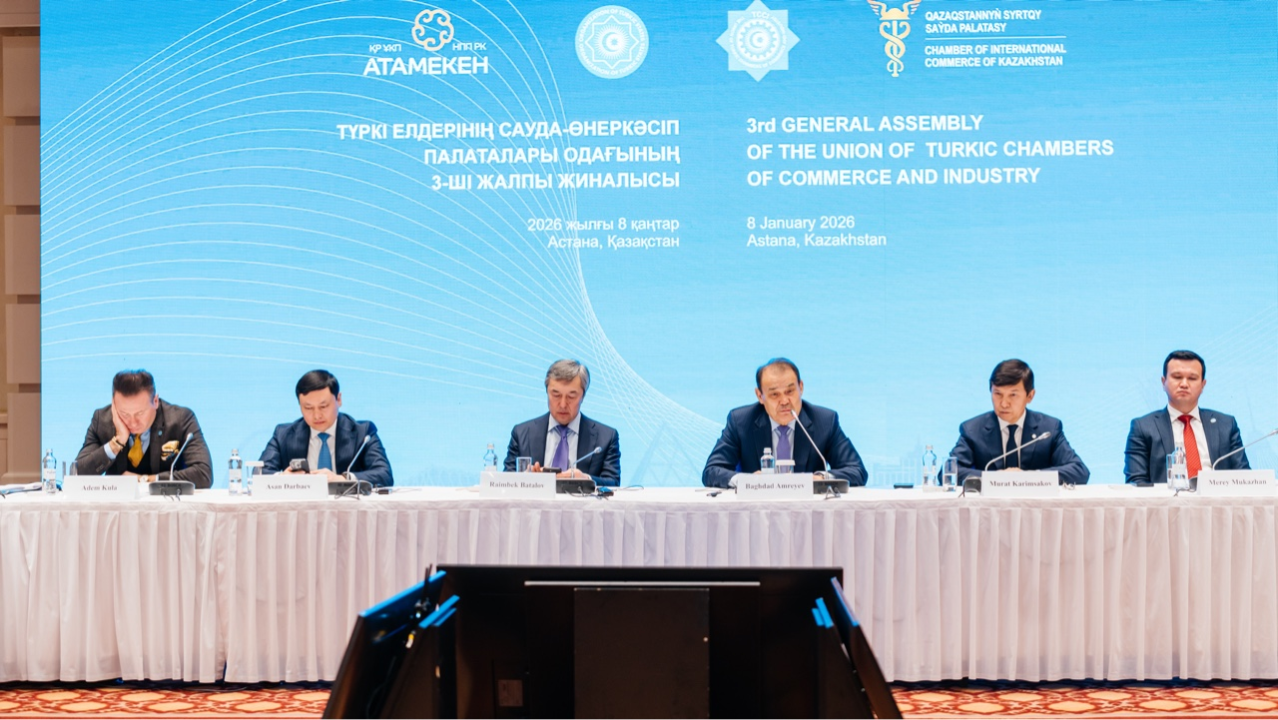
Business leaders and officials gathered in Astana on Jan. 8 for the third General Assembly of the Union of Turkic Chambers of Commerce and Industry to discuss Kazakhstan’s investment attractiveness. Photo credit: Ministry of National Economy.
Speaking at the assembly, Vice Minister of National Economy Assan Darbayev described the OTS as a strategic platform for deepening economic integration, expanding investment ties, strengthening industrial cooperation, and developing regional logistics corridors, reported the ministry’s press service.
“The Turkic region today has significant economic potential. Our shared task is to unlock it fully by creating sustainable value chains and new growth points for business,” Darbayev said.
Trade with Turkic states shows strong growth
According to Darbayev, trade figures confirm the growing relevance and resilience of economic cooperation within the OTS. In January-October 2025, Kazakhstan’s trade turnover with OTS member states reached $10.4 billion, up 10.9% year-on-year.
Exports grew by 17.1% to $7.6 billion, while imports totaled $2.8 billion, resulting in a positive trade balance of $4.8 billion. Export growth was driven by higher shipments of copper and copper cathodes, crude oil, wheat, refined petroleum products, sunflower oil, as well as metallurgical and agro-industrial goods.
Long-term economic goals
Darbayev also highlighted Kazakhstan’s investment attractiveness, pointing to the country’s consistently strong performance in international business environment rankings, including the World Bank’s Doing Business study and the Business Ready 2025 ranking.
The government also aims to attract at least $150 billion in foreign direct investment and increase the share of fixed capital investment to 23% of GDP by that year.
To support these objectives, Kazakhstan has adopted an Investment Policy Concept through 2030 and revised its approach to capital attraction, placing greater emphasis on competitive, high value-added production. Investors are offered a comprehensive package of financial and non-financial state support measures.
Kazakhstan to chair Turkic Chambers Union in 2026
During the assembly, it was announced that Kazakhstan will assume the chairmanship of the Union of Turkic Chambers of Commerce and Industry (TCCI) in 2026, reported the Kazinform news agency.
The country plans to focus on implementing practical industrial cooperation projects, forming a portfolio of joint initiatives, and advancing key transport and logistics corridors, including the Middle Corridor and the North–South route.
Raimbek Batalov, the chairman of the presidium of the Atameken National Chamber of Entrepreneurs, was appointed President of the Turkic Chamber of Commerce and Industry for a one-year term in 2026. He emphasized that cooperation with Turkic countries remains a priority in Kazakhstan’s foreign economic policy.
“It is important to stress that this positive dynamic is driven by the expansion of exports with higher added value. Shipments of grain, sunflower oil, petrochemical products, food goods, and processed materials have grown significantly,” Batalov said, noting that the region is moving from simple trade toward more complex forms of industrial and agro-industrial cooperation and the creation of joint production chains.
Officials added that Kazakhstan will continue promoting initiatives to improve the business climate, reduce trade barriers, and enhance transport connectivity across the Turkic region, including support for the Turkic Investment Fund and the development of digital and trade platforms.
