
ASTANA – Social media has surpassed traditional platforms as the country’s primary source of information, driven by the rapid expansion of mobile internet and the increasing popularity of short-form content. For many young Kazakh citizens, social networks are no longer just communication tools – they have become central to daily life, shaping how people learn, work, stay informed, and engage civically.
The 2024 Youth of Kazakhstan analytical report by the Ministry of Culture and Information and Zhastar Research Center shows that social networks are the second most popular form of leisure among young people. Approximately 66.2% of respondents use them regularly, 21.5% occasionally, and fewer than 2% report never having used them.
Digital platforms now serve as the country’s main communication channels and a powerful environment for content distribution. The surge of brief text posts and short videos continues to reshape media consumption, as audiences increasingly turn away from long, structured formats.
Globally, the digital trend is accelerating.
DataReportal’s Digital 2026 Global Overview Report estimates that the total number of internet users worldwide reached 6.04 billion by October 2025, with global penetration reaching 73.2%. Social media users climbed to 5.66 billion, nearly 69% of the global population, doubling in size in just under 11 years. The contrast is stark: when the first website went live in 1991, only around five million people were online.
Kazakhstan’s digital growth accelerates
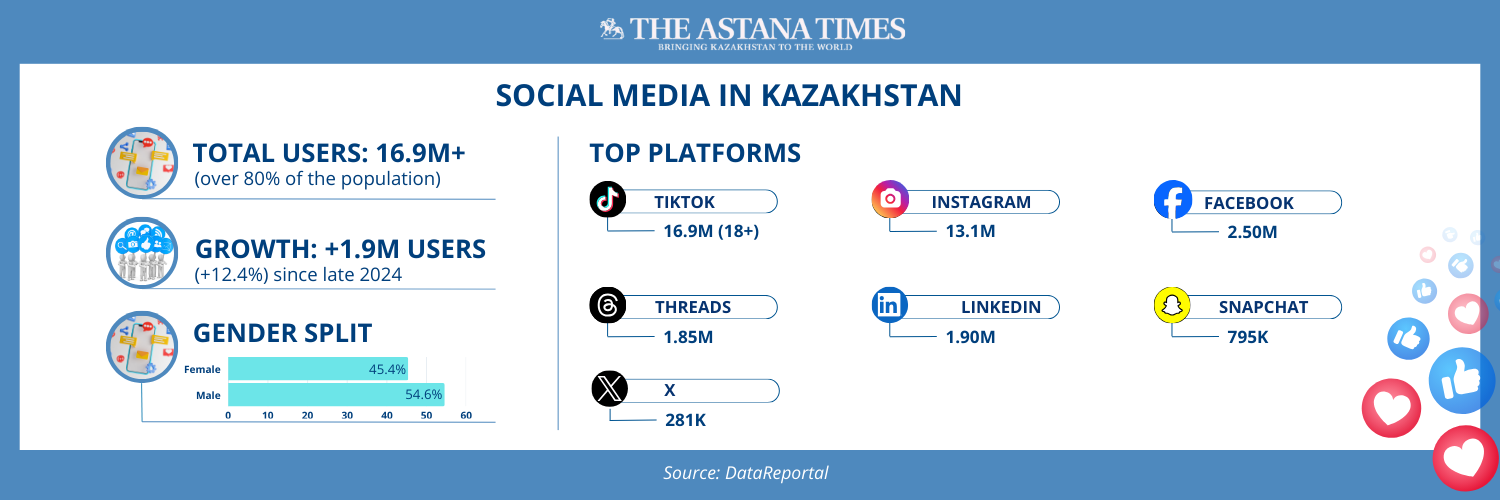
In Kazakhstan, more than 16.9 million people, over 80% of the population, use social networks, according to DataReportal’s Digital 2026: Kazakhstan report. The audience grew by nearly two million in the past year alone, underscoring social media’s role in everyday communication, media consumption, and business activity.
Instagram remains the country’s most influential platform. By late 2025, it comprised 13.1 million users, or 63% of the population. More than 90% of Kazakh internet users aged 18 and older visit Instagram monthly.
TikTok shows similar dominance, reaching 16.9 million adult users, around 86% of Kazakhstan’s internet users. Its momentum reflects the appeal of short-form video and its increasing use for news and learning among both young people and adults.
Threads emerges as a new player
Threads, launched by Meta in 2023, has quickly attracted 1.85 million users in Kazakhstan, nearly 9% of the population. Interestingly, 59% of its adult users are women. Much of its growth stems from seamless integration with Instagram and users’ readiness to adopt new formats for real-time conversation.

Muragul Muratbekova, a software engineer and research associate at the Kazakh-British Technical University. Photo credit: Muratbekova’s personal archieve
Muragul Muratbekova, a software engineer and research associate at the Kazakh-British Technical University, said each platform has a generational cycle that often lasts around a decade.
“At first, it was VKontakte and Odnoklassniki [Russian social platforms]. Then they gradually died out. Even Instagram started losing momentum. Then TikTok and Threads appeared with a fresh format, and that’s why they immediately took off,” she told The Astana Times.
Threads, she added, filled the void left by X, formerly known as Twitter, for users seeking a space to express opinions freely.
“Instagram does not offer much room for writing, and long captions often go unread. When Twitter faded, people needed a place to express themselves again and Threads filled that gap,” she said.
Muratbekova noted that Threads technically benefits from not requiring separate registration. Linking accounts to the Instagram streamlines onboarding and boosts adoption.
“There was the trend factor – everyone rushed to join, which motivated others. And there was curiosity to read people’s thoughts. Plus, there were not so many ads and promotions. Since the platform was still ‘clean,’ early users had the chance to establish themselves and even monetize,” she said.
Users say the platform has unexpectedly become a digital “window into Kazakhstan” as global audiences encounter more Kazakh content. Muratbekova said this may stem from algorithms that are not yet fully localized for the countries in the region, which amplifies their cross-regional reach.
“Kazakh posts often gain traction because they are written in Russian and feature relatable, energetic content from customs and everyday life to food, currency rates, and family stories. Many foreign users note that Kazakh posts appear so frequently that they have grown curious about the country, even considering travel,” said Muratbekova.
She added that such popularity encouraged deeper interest in Kazakhstan’s culture and traditions.
Risks of constant connectivity
While social media offers new avenues for creativity and cultural exchange, experts warn of adverse psychological effects when time spent on social media becomes excessive.
A GWI analysis of online behavior among 250,000 adults in more than 50 countries for the Financial Times shows a clear shift in how people use social platforms. The share of users who say they go online to keep in touch with friends, express themselves or meet new people has dropped by more than a quarter since 2014. At the same time, more people say they open the apps simply to kill time, a sign of a broader move from intentional engagement to “mindless browsing.”
Olga Mustafina, a master of social sciences and a child neuropsychologist, noted that social networks began as an easy way to stay connected. Yet, the rise of advertising and curated lifestyles has turned them into a “vanity fair.”
“Constant, uncontrolled use can lead to stress, anxiety, and loneliness. Seeing idealized lives online can make people feel their own lives are dull, triggering a ‘fear of missing out,’” said Mustafina in an interview with The Astana Times.
She added that young people are especially vulnerable because virtual interaction cannot replace genuine relationships. Excessive scrolling can also disrupt sleep.
To reduce digital dependence, Mustafina recommended setting time limits, avoiding feeds immediately after waking up or before sleep, and choosing content that inspires rather than harms mental well-being.
“Try to follow content that uplifts you, and unfollow any accounts that make you feel jealous, guilty, or ashamed,” she said.
