
More than one hundred delegations from nearly 60 countries gathered in Astana, the capital of Kazakhstan, on Sept. 17-18 to participate in the eighth Congress of Leaders of World and Traditional Religions.
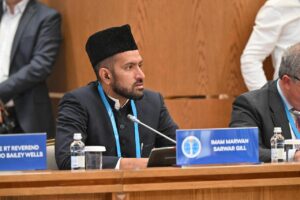
Marwan Gill, The President of the Ahmadiyya Muslim Community in Argentina
During the sessions, participants addressed issues of global concern. The agenda included the humanitarian catastrophe in Gaza, climate change, the ethical use of artificial intelligence and growing geopolitical tensions.
The message sent by Pope Leo XIV emphasized the synergy between religions as a driving force for hope and reconciliation. The Pontiff expressed his gratitude for the gathering and stressed that “faith unites rather than divides,” insisting that interfaith collaboration does not seek to eliminate differences, but rather to turn diversity into a source of mutual enrichment.
The Pope recalled historical precedents such as the 1986 meeting in Assisi and the Document on Human Fraternity signed in 2019, examples of how cooperation between faiths can translate into concrete actions in favor of peace and solidarity. “When leaders of different faiths come together in defense of the most vulnerable, of our common home and of the dignity of all people, they bear witness to the truth that faith unites rather than divides,” the Pontiff said in his message.
For his part, António Guterres, the Secretary-General of the UN, sent a recorded message in which he thanked Kazakhstan for its role in promoting dialogue between religions and cultures.
“The United Nations was founded on the conviction that dialogue leads to peace. Today, that truth is more important than ever. Especially now, with increasing conflicts, inequalities, the climate crisis and geopolitical divisions. We need to build bridges in our fractured world,” Guterres said, according to the official statement.
The Ahmadiyya Muslim Community in Argentina attended a special session dedicated to the protection of religious sites, sponsored by the UN Alliance of Civilizations.
My message was clear: the protection of sacred places is deeply rooted in our past, present and future as humanity. Societies that fail to protect such sites will gradually also violate the sanctity of human life and human dignity. In other words, the sanctity of every human life goes hand in hand with the sanctity of religious sites.
The Astana meeting reaffirmed the conviction that interfaith dialogue is a fundamental pillar for building more just and peaceful societies. The challenge, according to the participants, now lies in transforming words and commitments into real initiatives that contribute to reconciliation and coexistence in a world marked by diversity and uncertainty.
The encounter and dialogue between religious representatives is the first step on this long road towards building a more humane and peaceful world. Peace, which we all desire and which is the essence of all religions, requires a joint effort. The next vital step will be to convert dialogue and words into concrete deeds and actions.
The author is Marwan Gill, President of the Ahmadiyya Muslim Community in Argentina.
