
ASTANA — China views building a community with a shared future for humanity as the ultimate goal of its diplomacy, Chinese Ambassador to Kazakhstan Han Chunlin said, outlining Beijing’s vision for a changing global order and its priorities in Central Asia.
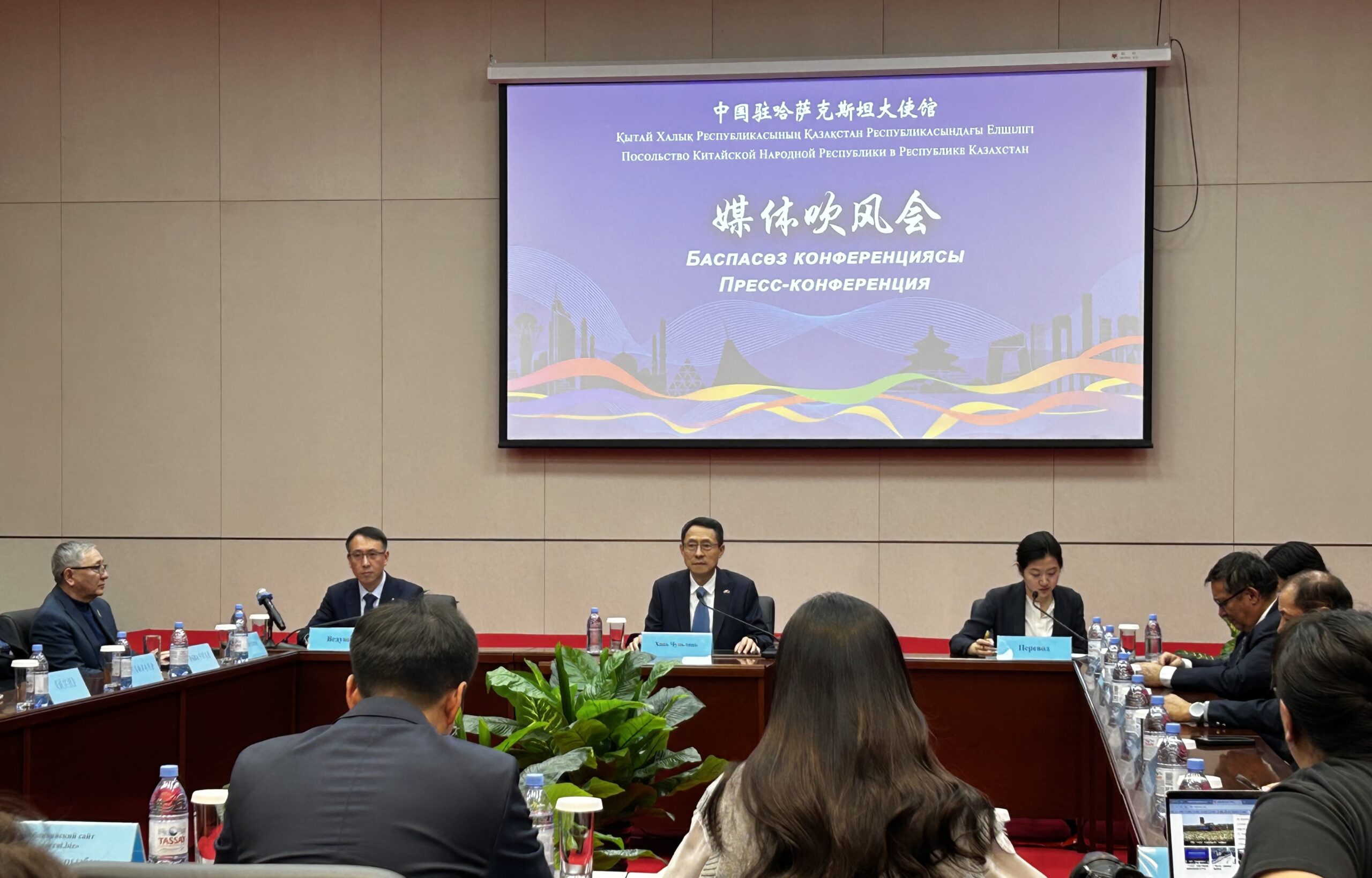
Chinese Ambassador to Kazakhstan Han Chunlin outlined Beijing’s vision for a changing global order and its priorities in Central Asia on Nov. 26 Photo credit: The Astana Times/Aida Haidar
Responding to a question from The Astana Times at a press briefing on Nov.26, Han said from China’s perspective, global stability requires a more inclusive approach to development, security and international cooperation.
“China consistently acts as a builder of peace around the world and contributes to international collective security,” he said.
He also presented China as a contributor to global development, a defender of the international order and a provider of public goods, emphasizing Beijing’s support for developing countries and greater representation in international decision-making. Han said China advocates economic globalization that is equitable, universally beneficial and inclusive, presenting it as an alternative approach to addressing the challenges facing the international community.
“We support economic globalization that is equitable, universally beneficial and inclusive. This is China’s approach to addressing a number of pressing problems and serious challenges facing the modern world,” he said.
He noted that building an equitable and orderly multipolar world means recognizing the equality of all countries, regardless of their size, and advancing the democratization of international relations. Such an approach, he said, should also help address development imbalances between countries and within societies, while allowing each nation to choose a development path consistent with its national conditions.
Han pointed to four global initiatives put forward by Chinese President Xi Jinping as the foundation of this vision.
“China has put forward the Global Development Initiative, the Global Security Initiative, the Global Civilization Initiative and the Global Governance Initiative. These four global initiatives are important public goods presented by President Xi Jinping to the world and serve as strategic guidance for building a community with a shared future for humanity,” he said.
The initiatives address different dimensions of international cooperation. The Global Development Initiative focuses on achieving the UN Sustainable Development Goals, while the Global Security Initiative promotes resolving international disputes through dialogue and consultation. The Global Civilization Initiative encourages exchanges and mutual learning between civilizations, and the Global Governance Initiative seeks to reform existing global governance mechanisms. Together, they form what Beijing describes as a framework for a fairer and more inclusive international system.
Whether China seeks to replace the existing international order or reshape it from within remains central to assessing its growing global influence. This reporter explored the issue earlier in a recent piece on China’s Rise and Central Asia, which examined how shifts in the global balance of power could affect the region over the next decade.
Central Asia as a strategic priority
Turning to China’s relations with Central Asia, Han emphasized that the region remains a priority in Beijing’s neighborhood diplomacy. He said China’s approach to neighboring countries, outlined by Xi Jinping, is based on amity, sincerity, mutual benefit and inclusiveness, with an emphasis on strengthening regional stability through comprehensive cooperation.
“For China, Central Asia is not only a close neighbor in geographical terms, but also a reliable, long-term strategic partner and a partner on the path to modernization,” Han said.
He noted that more than three decades of cooperation had helped China and the five Central Asian countries build a strategic partnership at both bilateral and regional levels.
A significant milestone came in June 2025, when Astana hosted the second China-Central Asia Summit. The leaders of the six countries signed the Treaty on Eternal Good-Neighborliness, Friendship and Cooperation, formally enshrining the principle of lasting friendship in their relations. Han described the agreement as evidence of growing political trust and closer strategic coordination.
“This demonstrates that political trust between China and the countries of Central Asia has reached a new level, while strategic cooperation has taken another step forward,” he said.
“For China and Central Asia, we are partners in common development and friends in creating a better future. We hope to see a peaceful, stable, prosperous and united Central Asia,” he added.
Han also expressed China’s interest in seeing the region develop into an important bridge connecting Asia and Europe, facilitating exchanges and cooperation between East and West.
Kazakhstan’s growing role in regional connectivity
Transport and logistics remain among the most tangible dimensions of Kazakhstan-China cooperation, with Kazakhstan’s geographic position placing it at the center of major overland trade routes. Han said approximately 85% of land freight transported between China and Europe passes through Kazakhstan. Kazakh officials have also highlighted the country’s central role in these routes, putting the share above 80%.
The growing volume of bilateral rail freight reflects the scale of this cooperation. According to Kazakhstan’s Ministry of Transport, railway cargo transportation between the two countries reached 31.8 million metric tons in January-October 2026, an 8% increase compared with the same period last year. Of that volume, 12.1 million metric tons moved from China to Kazakhstan, while shipments in the opposite direction reached 19.7 million metric tons.
The two countries are also expanding air connectivity. In November, their aviation authorities agreed to increase permitted weekly flight frequencies from 150 to 180 and add Chengdu and Kashgar to the destination network.
Han also highlighted the role of the China-Kazakhstan logistics cooperation base in Lianyungang, a Chinese port that provides Kazakhstan with access to maritime trade routes. The facility enables Kazakh agricultural and industrial goods, including wheat, sunflower seeds and nonferrous metals, to reach markets in Japan, South Korea and Southeast Asia through multimodal transport corridors.
The route is already being used for agricultural exports. In 2025, Kazakhstan shipped 17,000 tons of wheat in 10 grain trains through China’s port of Lianyungang to Haiphong, Vietnam, demonstrating how the logistics corridor can open new export opportunities for the landlocked country.
Xi, Trump and Putin at APEC amid a shifting global order
The briefing also touched on the 33rd Asia-Pacific Economic Cooperation (APEC) Economic Leaders’ Meeting, held in Shenzhen on Nov. 18-19. Asked about the trilateral meeting between China, the United States (U.S.) and Russia on the sidelines of the summit, Han focused his response on the broader regional cooperation agenda and the framework for building an Asia-Pacific community.
He outlined four key pillars of this framework: economic and trade cooperation, connectivity, innovation and development. Eight priorities support these pillars, including the Free Trade Area of the Asia-Pacific, infrastructure connectivity, harmonized rules and standards, people-to-people exchanges, the digital economy, emerging technologies, capacity building and sustainable growth.
Xi, U.S. President Donald Trump and Russian President Vladimir Putin held a trilateral meeting on Nov. 19 in Shenzhen. The three leaders issued a joint declaration reaffirming that a nuclear war cannot be won and must never be fought, and pledging dialogue on reducing nuclear risks and preventing nuclear proliferation. However, the declaration included no concrete commitments or timetable for reducing nuclear arsenals.
For Beijing, these regional and global initiatives reflect an interconnected diplomatic approach: promoting a greater role in global governance while strengthening economic and strategic partnerships with neighboring regions, including Central Asia.
