
ASTANA – For some young people in Kazakhstan success means building a career. For others, it is returning home with new skills, starting a family, becoming financially independent or contributing to society. Increasingly, it also means having the freedom to decide what a fulfilling life should look like, rather than following a predetermined path.
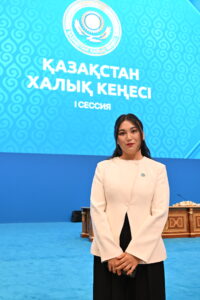
Aknur Turdaliyeva. Photo credit: Turdaliyeva’s personal archive.
“Financial independence, stable employment, owning a home and the ability to build one’s life independently are becoming important benchmarks,” Aknur Turdaliyeva, chair of the Zhas Ulan youth organization, told The Astana Times.
However, Turdaliyeva, who is also a member of Kazakhstan Khalyk Kenesi (People’s Council), does not see money and career as the only priorities for today’s generation. She said many young people want to stay connected to family and tradition while making their own choices about work and the lives they build.
According to the British Council’s Next Generation Kazakhstan study published in 2025, 66% of respondents aged 18 to 35 identified family as their primary source of guidance. The study, which included a representative survey of 1,202 young people and qualitative research involving another 68 participants, also highlighted the importance of education, employment opportunities and economic stability.
The Kazakhstan Youth – 2025 national report similarly found that parents remained a key source of support for young people, cited by 68.8% of respondents.
“I believe the main change is that young people increasingly want to decide for themselves what success means to them, rather than meet the expectations of others,” Turdaliyeva said.
Expectations and the freedom to choose
Marriage remains an inspiration for many young people in the country, but financial security may shape when they feel ready to start a family. In a 2026 United Nations Population Fund’s survey, more than 72% of respondents ages 18 to 39 said they would like to marry. When asked what they considered important conditions for having children, 74.6% cited financial security, 71.7% homeownership and 68.4% stable employment.
Alina Kazybayeva, who spent around five years studying and working abroad before returning to Kazakhstan, has experienced how expectations around age, career and stability can differ between countries.

Alina Kazybayeva in a photoshoot, directed and styled by her. Photo credit: Kazybayeva’s personal archive.
After moving to the Netherlands at 18, she studied business administration. She later studied economics and management at Bocconi University in Milan and worked as a social media assistant at Loro Piana.
Her return to Kazakhstan was partly motivated by the opportunities she sees in the country’s creative industries. She believes the sector offers room for young people to experiment, introduce new ideas and build projects rather than simply enter an established system.
However, having spent much of her formative years abroad, she said she sometimes feels pressure in Kazakhstan to meet major life milestones on a set timetable.
“I think there is still a fairly strong idea of the age at which you should get married, start a family, buy an apartment, take out a mortgage and build a certain level of stability. Perhaps other goals have simply been added to these expectations – a career, travel, self-realization and independence,” she told The Astana Times.
Milan gave her a different perspective. She said that in her experience high rents, salaries that did not keep pace with living costs and difficulty finding stable work can delay decisions about buying a home or starting a family. What may look like a more relaxed approach to those milestones, she suggested, can also reflect economic pressures.
“What matters most to me now is understanding what I really want, without rushing into decisions just because that is what is expected or because I feel I should have achieved something by a certain age,” she said.
Turdaliyeva said eight years of working with children and young people have shown her that success has no single measure. For some, it is career and income; for others, it is family, entrepreneurship or public service.
Education, international experience and returning home
Iliyas Marat, a digital creator studying midwifery in Greece and law at Solent University in the United Kingdom, said studying overseas has broadened his horizons. He hopes to return home as a specialist and put what he has learned to use.
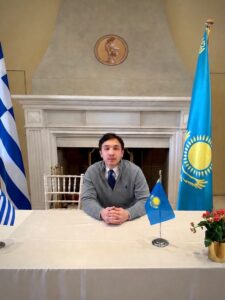
Iliyas Marat. Photo credit: Marat’s personal archive.
“For me, the most important thing in a profession is to bring real benefit to people,” he said in a comment for this story.
His understanding of success also goes beyond professional status or financial achievement. Marat’s interest in Stoic philosophy began while he was living in Athens.
“For me, success is not money, status or a position, but the ability to appreciate the process of life itself, not only the result,” he said.
He considers financial independence important, but believes that freedom begins internally, international experience and a connection to Kazakhstan are not competing choices.
Kazybayeva has not ruled out living in Milan again, but for now wants to explore opportunities at home.
Success beyond personal achievement
The idea of success also extends beyond individual financial security and career advancement.
“Public contribution is also an indicator of success,” Turdaliyeva said. “It is not necessarily measured by the scale of a project or the position a person holds. Sometimes a small initiative that helps solve a specific problem at a school or in a community can mean much more to people than a large event.”
Youth organizations and community groups, she said, can help young people build responsibility, work with others and take part in decisions affecting their lives. That requires more than inviting them to events. Young people should also be able to propose ideas, contribute to decision-making and see the results of their work.
One example is the Youth Movement under Kazakhstan’s People’s Council. Established on Nov. 16 with 126 members from different regions and professional backgrounds, it aims to connect young participants with the council’s members, involve them in discussions and help them develop proposals on issues affecting young people.
Turdaliyeva also supports reverse mentoring, through which younger people can share their knowledge and perspectives with older generations. She said it can make cooperation between generations more reciprocal.
This emphasis on participation also connects with the broader challenges facing Kazakhstan’s youth. According to the Bureau of National Statistics, the share of young people aged 14 to 35 who were not in employment, education or training stood at 5.7% in the second quarter of 2026, while youth unemployment among people aged 15 to 34 was 2.9%. These are different indicators: the category includes people who are not necessarily looking for work, while the unemployment rate measures those actively seeking employment.
Danara Saranova, chief expert at the Regional Affairs Department of the Kazakhstan Institute for Strategic Studies, said the country’s young population represents significant potential, but demographic numbers alone do not guarantee social progress.
Opportunities for education, professional development, employment and participation in public life are essential to helping young people develop independence and responsibility, she said.
A generation defining its own pace
Young people are not rejecting familiar milestones. They are wedging them alongside other ambitions: professional independence, international experiences, meaningful work and community contribution. Different perspectives suggest that success is less a fixed checklist than a personal choice, shaped by circumstances, values and the freedom to choose and decide what matters and when.
