
ASTANA – Kazakhstan will develop a unified set of investment instruments for the agricultural sector by the end of the first quarter of 2027 to improve access to long-term financing and simplify procedures for farmers, President Kassym-Jomart Tokayev said at a Nov. 20 third Forum of Agricultural Workers.
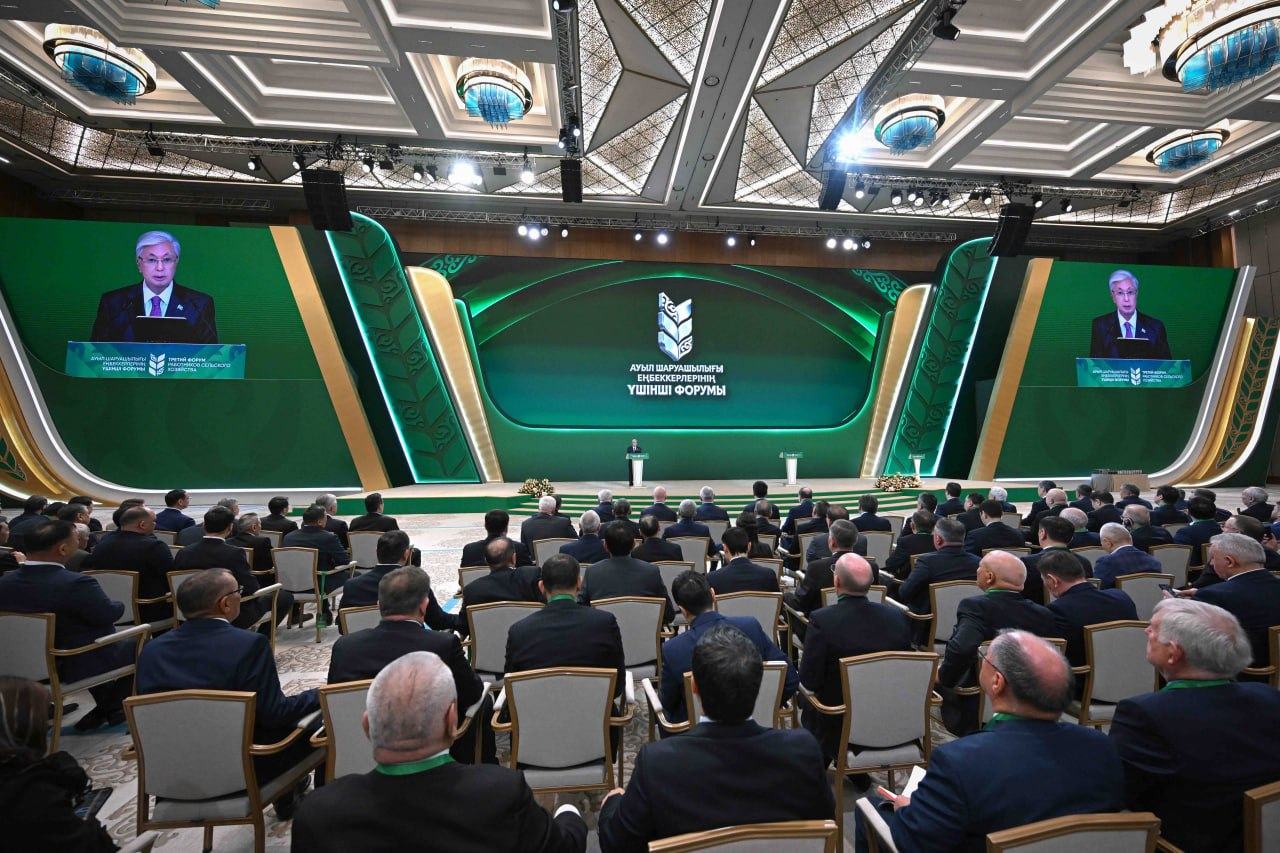
Tokayev speaks at the Third Forum of Agricultural Workers in Astana, where he called for a unified set of investment instruments for the agricultural sector by the first quarter of 2027, greater use of artificial intelligence and expanded agricultural processing. Photo credit: Akorda.
According to him, the government will work with the Baiterek holding company and financial regulators to prepare the proposal. Tokayev also noted that existing financing instruments offered by the Agrarian Credit Corporation and KazAgroFinance involve lengthy application reviews, complicated procedures and insufficient digitalization. The new framework is expected to make credit decisions more transparent, shorten application processing times and reduce administrative barriers.
Tokayev also called for a special program to improve agricultural productivity, developed jointly with international financial institutions. It should provide long-term financing, technical and expert support, and access to modern technologies and scientific developments, drawing on international experience.
He highlighted artificial intelligence as one of the tools that could help Kazakhstan strengthen its position in global food production.
“Leading global companies in the field of artificial intelligence recently advised us to focus on introducing AI into agriculture, as forecasts for global food security are unfortunately pessimistic,” Tokayev said.
He pointed to the potential impact of the El Niño climate phenomenon and said Kazakhstan could use its agricultural resources and AI technologies to become a major global food supplier.
“Why not? I believe this task should be addressed primarily to the government and the relevant departments,” he said.
Agricultural output and processing
Tokayev said Kazakhstan had made significant progress in agriculture over the past seven years. Food production increased by 28%, while 1,630 investment projects worth a combined 2.7 trillion tenge (US$5.2 billion) were launched.
Agricultural exports doubled to nearly $7 billion, with processed products accounting for 52% of total exports. The country harvested 24.5 million tons of agricultural crops during the latest autumn harvest campaign.
Tokayev also emphasized the need to expand deep processing of agricultural products to reduce dependence on food imports. Over the past three years, domestic food production increased by nearly 15%, including a 36% rise in vegetable oil production and a 25% increase in meat and dairy production.
He called on the government to promptly assess potential food-processing projects and begin their implementation.
Rural development and accountability
President Tokayev also cited rural development initiatives, saying that 921 projects worth 173 billion tenge (US$336 million) were implemented in nearly 500 villages last year. Water supply systems were modernized in 277 settlements. However, he questioned whether the reported figures fully reflected the results on the ground and called for a detailed assessment of the work.
“Previously, we were presented with a beautiful, almost perfect picture. And, frankly, we were all genuinely pleased with it. Then we looked for convenient excuses, saying that we had not been given accurate statistics, and simply put the issue aside. Such an approach is unacceptable in the future,” he said.
Tokayev also stressed that public officials must be judged by their current performance and adherence to the law, regardless of their previous achievements or qualifications.
“Many times I have said, and I will remind you again: the principle of Law and Order, enshrined in the Constitution, is immutable and applies equally to all citizens, regardless of their credentials or position in society,” he said.
He described encroachment on public funds and violations of constitutional norms as serious crimes against the state, adding that the government would continue its efforts to combat corruption.
At the same time, Tokayev reaffirmed Kazakhstan’s commitment to attracting foreign investment, supporting business activity and improving the investment climate.
“Our strategic course involves both creating a favorable investment environment and strengthening the institutional foundations for doing business in the country without obstacles,” he said.
