
ASTANA – Kazakhstan plans to launch several campuses of international universities in Astana next year, President Kassym-Jomart Tokayev said during a roundtable with heads of international organizations and leading foreign universities on Nov. 19.
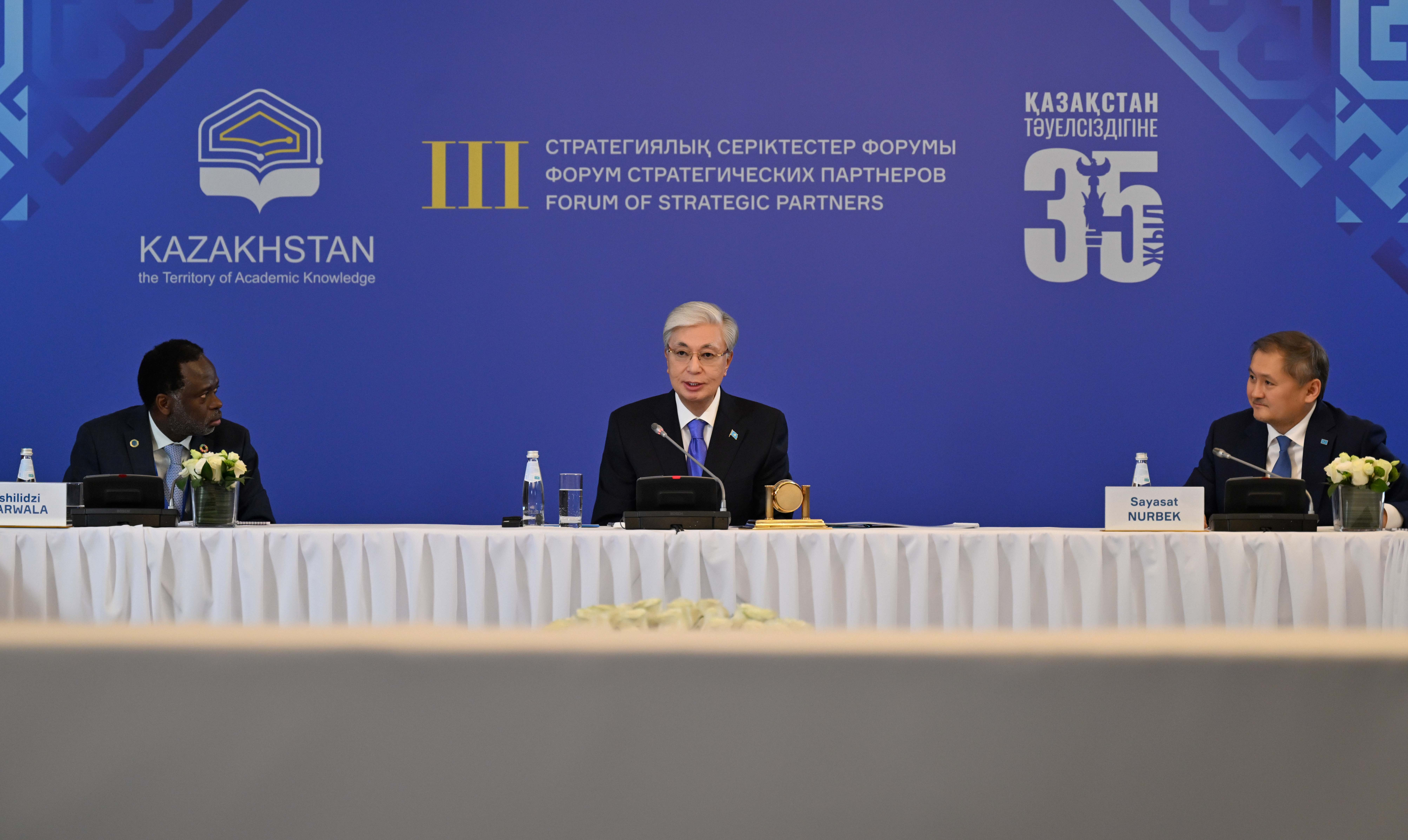
President Kassym-Jomart Tokayev discusses expanding international academic cooperation during a roundtable with university and international organization leaders in Astana on Nov. 19. Photo credit: Akorda.
Tokayev said the initial stage of cooperation with foreign universities had been completed, with the necessary infrastructure established and partnership agreements formally signed. The next priority is to move beyond institutional arrangements toward joint research, technology development and practical solutions addressing the needs of Kazakhstan’s economy.
“I hope that next year we will launch several campuses here in Astana. This work must certainly continue, because it is a top priority for us,” Tokayev said, adding that he was ready to support any university interested in opening a branch in Astana or other regions of Kazakhstan.
Strengthening international research cooperation
Addressing representatives of international organizations and universities, Tokayev said growing geopolitical tensions were increasingly affecting scientific and technological cooperation.
“Scientific cooperation is increasingly viewed through the lens of security. Advanced achievements are less often perceived as a common good and increasingly become instruments of competition,” he said, noting that artificial intelligence, new materials, energy technologies and biotechnology were transforming economies, labor markets and education systems.
According to him, human capital development, education, science and innovation were central to Kazakhstan’s national strategy and had been enshrined in the Constitution as strategic priorities for the first time in the country’s history.
Water security and engineering education
Tokayev identified water security as one of the priority areas for international scientific cooperation, describing it as a matter of economic and social stability for Central Asia.
He highlighted the need for joint efforts in managing transboundary rivers, developing modern monitoring systems, introducing water-saving technologies and advancing science-based water diplomacy. Kazakhstan is counting on the expertise and capabilities of the United Nations University in this area.
Another priority is training specialists for the country’s large-scale infrastructure modernization. Tokayev referred to the People’s Construction initiative, which he said encompasses not only individual construction projects but a broader renewal of national infrastructure, including energy, nuclear power, transport, water management and digital infrastructure.
He called on international partners to contribute to training a new generation of engineers, technical specialists and researchers, as well as conducting applied research in these fields.
“The basic principle of this nationwide initiative is very simple: ‘Build, and build again,’” Tokayev said, describing the initiative as Kazakhstan’s response to the challenges of the artificial intelligence era.
Integrating AI into education and research
President Tokayev also called for the integration of artificial intelligence into education and science, emphasizing that its adoption should go beyond purchasing software. He said this would require updated curricula, teacher training, reliable digital infrastructure and clear principles for the responsible use of AI.
Tokayev invited participants to identify obstacles to international cooperation, including financial constraints, administrative procedures and barriers to academic mobility. He also called for concrete proposals and commitments that could translate the discussion into joint projects in the near future.
