
ASTANA – Kazakhstan ranks 13th among Asian countries by the number of UNESCO World Heritage properties, with seven sites associated with the country, according to a ranking published by the Asia Nexus channel on social media platform X.
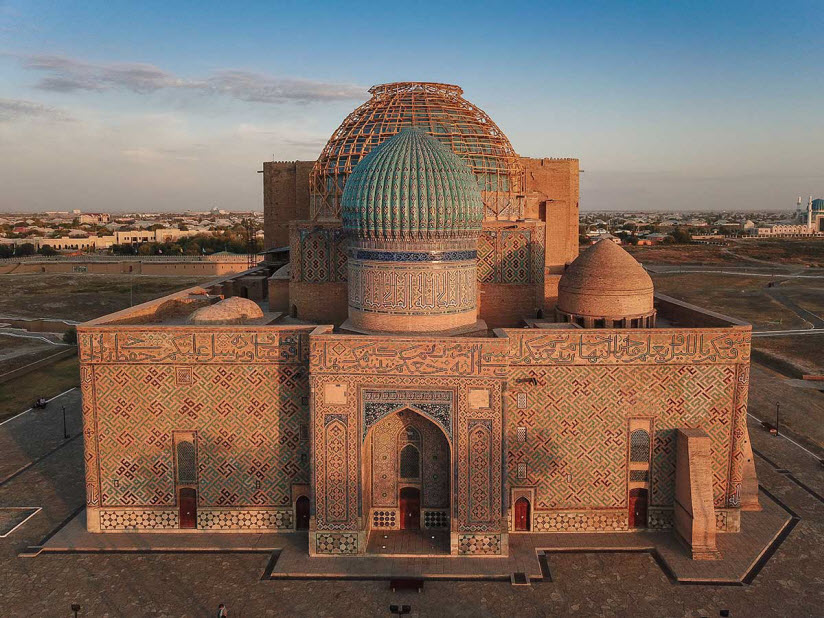
The Khoja Ahmed Yasawi mausoleum. Photo credit: Kazakhtourism
The ranking is based on data from the UNESCO World Heritage Center and covers cultural, natural and mixed properties.
Some World Heritage properties are transnational, meaning they extend across the territories of several countries. These properties are included in the counts of each participating country, so the ranking does not represent the number of unique sites across Asia.
China tops the list with 61 World Heritage properties, followed by India with 45. Russia ranks third with 33, while Iran and Japan take fourth and fifth places, with 30 and 27 properties, respectively.
China’s latest addition was the Jingdezhen porcelain industrial heritage site, inscribed on July 25 during the World Heritage Committee session in Busan, South Korea. The site preserves a porcelain production system that operated from the 10th to the 19th centuries.
India’s latest addition was the ancient Buddhist complex of Sarnath, where, according to Buddhist tradition, Buddha delivered his first sermon after attaining enlightenment.
Other countries also added properties during the session. Iran secured the inclusion of Alamut Castle and its associated fortifications, while Japan added the ancient capital of Asuka-Fujiwara.
South Korea, which hosted the session, ranks seventh in Asia with 17 properties. Countries can submit only one nomination per year, contributing to the gradual pace at which the rankings change.
Mangystau sites become Kazakhstan’s seventh UNESCO property
Kazakhstan received its seventh World Heritage property on July 25, when the Rock Mosques and Sacred Sites of Mangystau were inscribed on the list.
The property includes the sacred sites of Shopan-Ata, Karaman-Ata, Shakpak-Ata, Sultan-Epe and Beket-Ata, as the underground mosques served not only as places of worship but also as centers of religious education.
Earlier, Vice President Erlan Karin said the work to secure the inscription had been revived at the initiative of President Kassym-Jomart Tokayev and had reached a new level.
“These rocks preserve the historical memory of our people and the legacy of our ancestors,” he said.
Kazakhstan’s other World Heritage Properties
Kazakhstan’s first UNESCO World Heritage property was the Mausoleum of Khoja Ahmed Yasawi in Turkistan, inscribed in 2003.
The country’s other properties include the Tamgaly petroglyphs and the Silk Roads: the Routes Network of Chang’an-Tianshan Corridor, as well as natural sites such as Saryarka, Steppe and Lakes of North Kazakhstan, the Western Tien-Shan and the Cold Winter Deserts of Turan.
Three of these properties are transnational and shared with neighboring countries. Kazakhstan, China and Kyrgyzstan share the Silk Roads corridor; Kazakhstan, Kyrgyzstan and Uzbekistan share the Western Tien-Shan; and Kazakhstan, Turkmenistan and Uzbekistan share the Cold Winter Deserts of Turan.
Kazakhstan is preparing further nominations for the UNESCO World Heritage List following a presidential directive. Potential candidates include the wooden Jarkent Mosque, the Ascension Cathedral in Almaty and the Karatau petroglyphs.
The Jarkent Mosque and Ascension Cathedral are already on UNESCO’s Tentative List, a preliminary stage that countries must complete before submitting a full nomination.
