
ASTANA – Kazakhstan plans to issue tokenized government bonds in the first quarter of 2027, National Bank Governor Timur Suleimenov said at the 14th Congress of Financiers of Kazakhstan on Nov. 13 in Almaty.
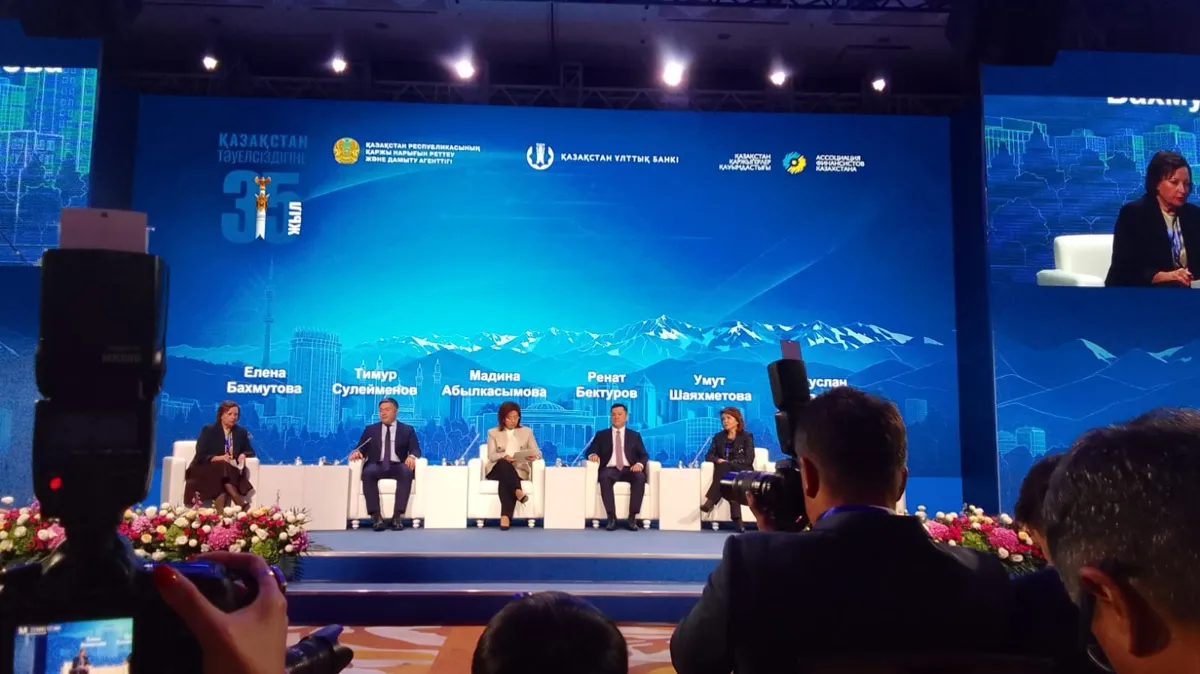
Almaty hosted the 14th Congress of Financiers of Kazakhstan, where regulators and government bodies dicussed the transformation of financial trends. Photo credit: NBK.
“We plan to issue tokenized government bonds jointly with the Ministry of Finance in the near future. This will probably take place in the first quarter of next year,” he said.
Kazakhstan is also expanding tokenization for financial and real-world assets. On Oct. 27, the Kazakhstan Stock Exchange (KASE) platform hosted the first issuance of digital financial assets by private issuers. On Nov. 9, the National Bank issued its own notes in tokenized form for the first time.
National Bank Governor Timur Suleimenov. Photo credit: NBK.
“The successful conduct of these trades means that we have tested the full readiness of the infrastructure, all institutional arrangements and so on, to expand this mechanism,” Suleimenov said.
The National Bank’s tokenized notes were issued for 10 billion tenge (US$21.5 million) through KASE’s digital financial assets platform. The notes were placed through an auction in both traditional and tokenized forms, with a maturity of 91 days. Their weighted average yield stood at 15.72% per annum.
Suleimenov said the next area of development would be tokenizing real-world assets, including real estate, precious metals and mineral resources.
“Tokenization transforms a financial asset into any type of asset. In this way, it democratizes access to finance and reduces its cost,” he said.
Regulators discuss unified financial market strategy
The congress’s plenary session also addressed the development of a unified strategy for Kazakhstan’s capital market and coordination among financial regulators.
Suleimenov said closer cooperation was needed to ensure that investors could navigate the country’s regulatory environment, which includes the National Bank, the Agency for Regulation and Development of the Financial Market, the Astana International Financial Center and, potentially, Alatau City.
“In our view, it is extremely important to ensure synergy, mutual recognition and mutual circulation, so that these markets can develop. We are not going to prescribe or dictate exactly what each one should do. This is simply about defining a kind of specialization for each market. At the same time, it is important to ensure that each market does not remain confined within its own jurisdiction. Money is fluid by nature; it cannot be locked in,” Suleimenov said.
He stressed the importance of effective cooperation and information exchange among regulators to ensure the financial system operates as a unified whole, distinguishing the strategy from day-to-day regulatory measures.
Madina Abylkassymova, chair of the Agency for Regulation and Development of the Financial Market, said the existing financial market development concept, adopted in 2020, needed to be updated in light of changes over the past five years.
“The profound changes that have taken place in the financial market over the past five years require this concept to be updated. Last year, we conducted an assessment, and approximately 80% of the concept had already been implemented,” she said.
Some changes are already reflected in the new banking law, while further measures are expected to be included in programs to develop the capital and insurance markets. Abylkassymova identified the rapid development of artificial intelligence and tokenization as key trends the new strategy should address.
“I think that by 2030 we will see very significant changes in the financial system, both globally and in Kazakhstan,” she said.
