
ASTANA — A new survey by TikTok and the Atameken National Chamber of Entrepreneurs found that more than 70% of surveyed companies use the platform for business at least once a month, while 88.3% reported a positive effect on attracting new customers. The study also found that more businesses associate TikTok activity with a share of their revenue.
Photo credit: Dado Ruvic (REUTERS)
The findings were presented at the TikTok Impact Forum in Almaty on Oct. 28, ahead of Entrepreneur’s Day, as the platform and Atameken released the second annual edition of their study, The TikTok Effect: The Platform’s Impact on Small and Medium-Sized Businesses in Kazakhstan.
From visibility to revenue
The survey, conducted in September and October this year, covered 206 companies across all 20 regions of Kazakhstan and seven industry groups: culture, entertainment and tourism; health, beauty and sports; food and nonfood products; catering; education; and real estate services. Among respondents, 43.7% said they used TikTok for business monthly, up from 29.5% in the previous survey, an increase of 14.2 percentage points. Another 27.2% reported using the platform weekly or more often.
Regular use is not limited to recently established companies. Among businesses operating for more than 10 years, 31% said they use TikTok for marketing weekly or more frequently. Comparable figures were 15.4% for companies established less than a year ago, 30.8% for those operating for one to three years, 32.2% for businesses with three to five years of experience, and 20% for companies operating for five to 10 years.
The survey also found that 57.8% of respondents attributed more than 5% of their revenue to TikTok activity, an increase of 12.3 percentage points from the previous survey. For 14.6% of companies, revenue associated with the platform accounted for at least 25% of total income. Among businesses using TikTok weekly, approximately 11% said that half or more of their total revenue was linked to activity on the platform.
Organic content leads, but paid promotion is growing
Organic video content remains the most common way surveyed companies use TikTok. In 2026, 77.6% said they published videos on the platform. Collaboration with content creators more than doubled, rising from 10.4% in the previous survey to 22.8%. Paid advertising was used by 18% of respondents. Overall, 75.7% of respondents said they allocated a budget to TikTok-related promotion in 2026, up from 62.3% in 2025. The measure includes paid advertising and creator partnerships, as well as content production, social media management and other marketing activities.
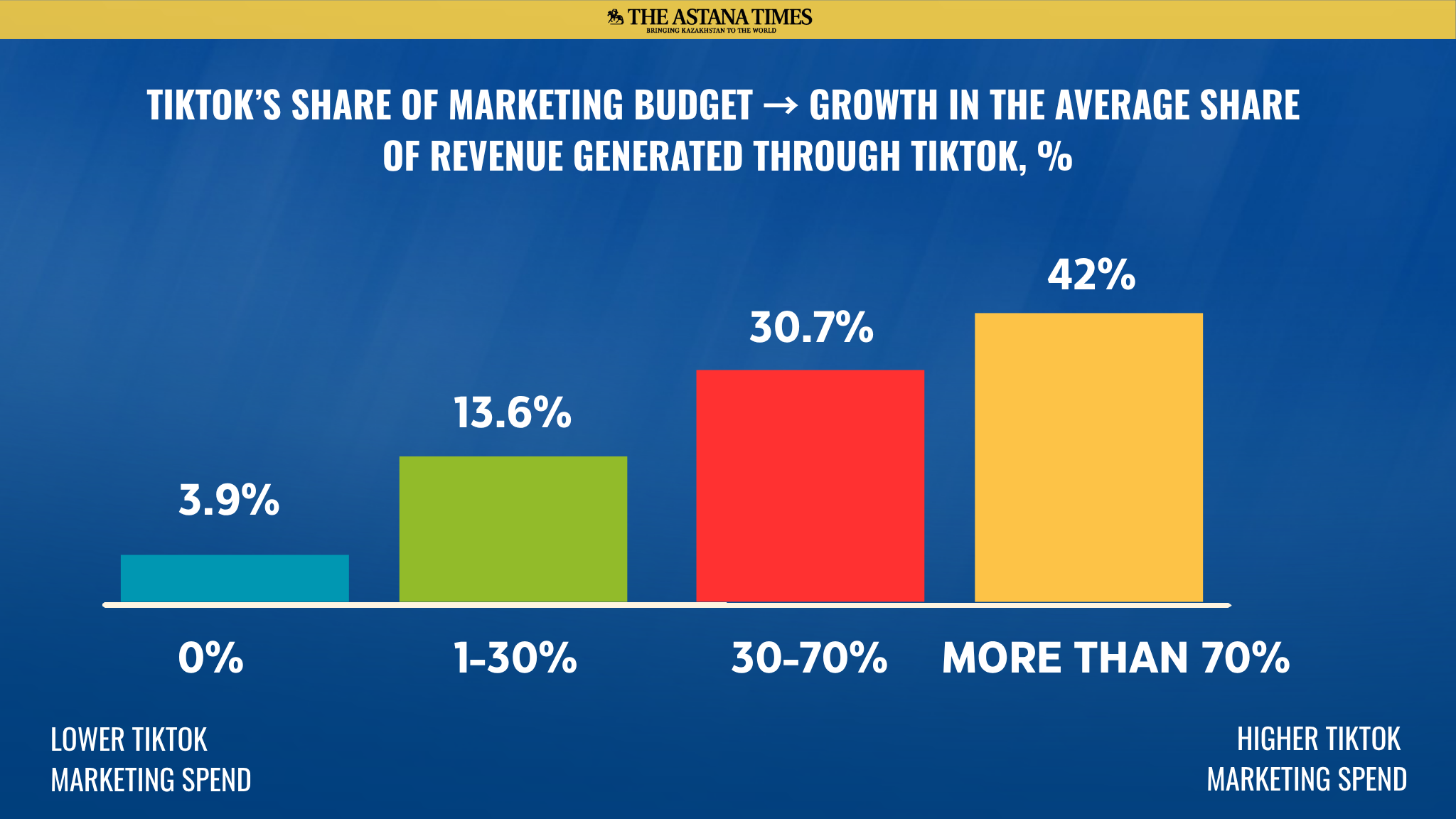
Spending levels also tracked with the share of revenue businesses attributed to the platform. Companies without a dedicated TikTok budget attributed an average of 3.9% of their revenue to it. Among businesses allocating more than 70% of their marketing budget to TikTok, the average reached 42%. Beyond revenue, 83.5% of respondents said TikTok helped them interact with customers, while 73.3% said it helped their businesses stand out from competitors.
Real estate and tourism report the sharpest increases
The share of surveyed businesses attributing at least 5% of their revenue to TikTok rose most sharply in real estate services, increasing by 40.6 percentage points to 66.6%. Culture, entertainment and tourism rose 24.7 percentage points to 60.5%, while food products rose 18.1 percentage points to 56.8%. Catering retained one of the highest shares, at 68%, up from 57.7%. Education rose to 56.2% from 44.4%, while health, beauty and sports rose to 54.5% from 37.5%. Nonfood products showed little change, edging up from 53.3% to 53.5%.
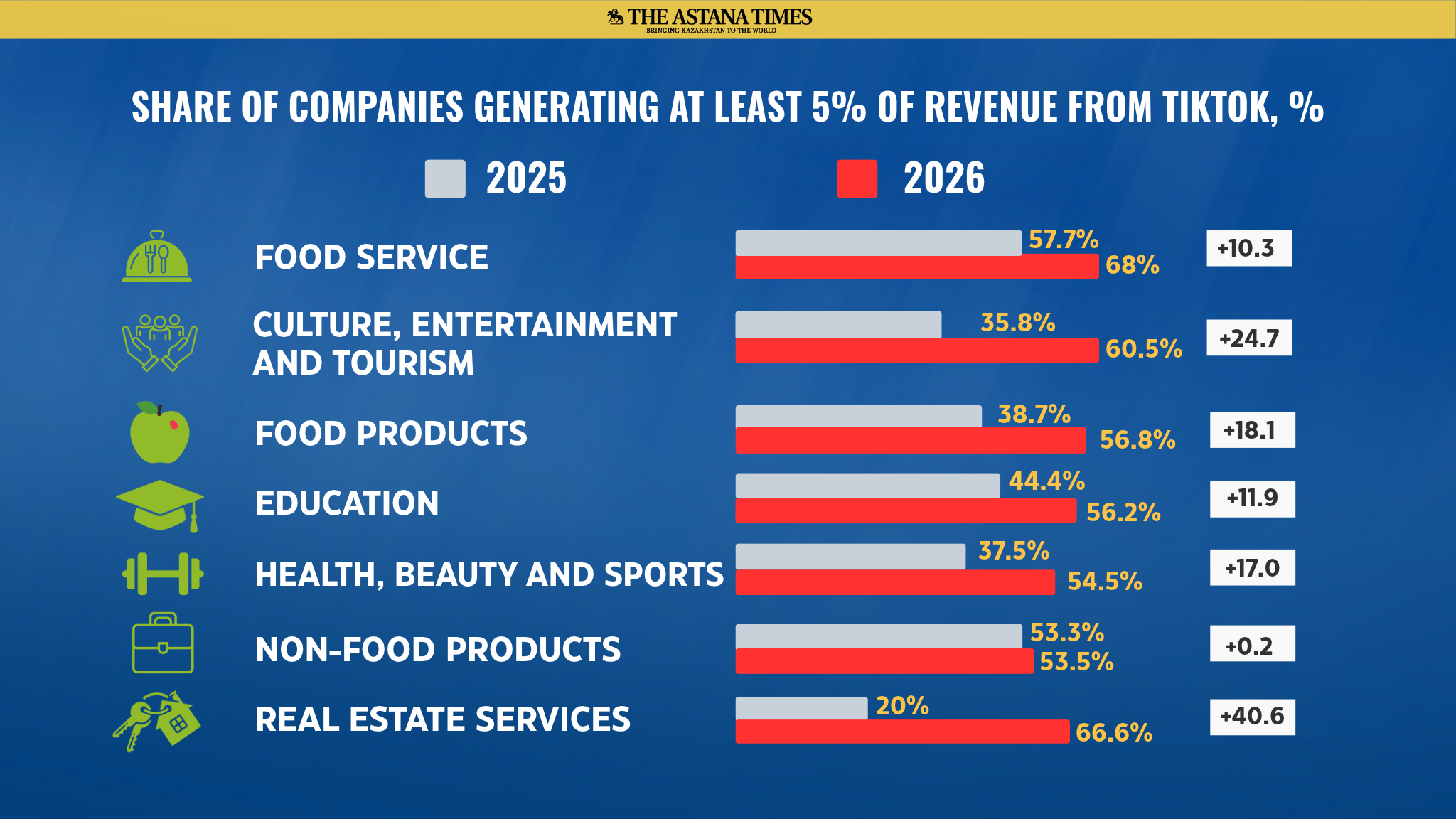
The results show considerable variation across sectors, with the largest reported increase in real estate services and consistently high figures in catering.
Estimating TikTok’s potential economic scale
To estimate TikTok’s potential revenue scale, researchers developed a model using respondents’ reported turnover, the share of revenue they attributed to the platform, and official statistics on the number of small and medium-sized enterprises in Kazakhstan. The model considers three scenarios based on the proportion of entrepreneurs actively using TikTok: 10%, 15% and 20%.
Under the conservative scenario, assuming 10% of entrepreneurs use TikTok actively, estimated TikTok-related revenue reached 531.6 billion tenge in 2026. Under the moderate scenario, with 15% active use, the estimate rises to 797.4 billion tenge.
Under the accelerated digitalization scenario, assuming 20% active use, it reaches 1.0632 trillion tenge. The researchers selected the 10% scenario as the conservative baseline, citing comparable studies in countries including the United Kingdom and Australia.
The three estimates are equivalent to 0.33%, 0.50% and 0.67% of Kazakhstan’s gross domestic product, respectively. In the previous survey, the corresponding ratios were approximately 0.16%, 0.25% and 0.33%.
These are model-based estimates of revenue that entrepreneurs associate with TikTok, not measurements of the platform’s direct contribution to GDP. The calculations do not establish how much of that revenue would have been lost without TikTok and exclude indirect effects such as job creation, supply-chain development and changes in household consumption.
The researchers also note that the 2025 and 2026 samples are not identical or statistically representative of all small and medium-sized businesses in Kazakhstan. The figures therefore reflect reported experiences and scenarios based on surveyed companies’ responses, rather than measured growth across the entire small and medium enterprises (SME) sector.
Local businesses put the platform to work
The survey and forum also highlighted companies using TikTok to expand their audiences and sales. One Shymkent-based clothing brand increased its TikTok audience by approximately 15,000 followers over one year, while sales rose by about 20%, according to the company. A one-hour TikTok livestream generates an average of 15 to 20 inquiries and between three and six sales.
In East Kazakhstan, a natural honey producer has focused on organic content showcasing its products and beekeeping operations. The company has found customers outside Kazakhstan and links growth in export revenue to interest from international audiences generated by its TikTok content.
One of Almaty’s fast-food chains has used the platform to build relationships with its audience. Its account now has more than 1 million followers, and some customers travel from other cities to visit the restaurant after discovering it through videos. Over four years, the business has expanded to 13 locations in Almaty and plans to enter another city soon. Last year, it received a TikTok award for Best Small Business Account. The team attributes its success to keeping content authentic and lively, saying this helps sustain audience interest and turn casual viewers into regular customers.
Expanding support for entrepreneurs
TikTok says it is seeking to expand its role in Kazakhstan’s business community beyond content distribution.
“Every business has its own story. Sometimes it begins with a small idea, a family enterprise or a short video that unexpectedly resonates with thousands of people,” said Yulia Kushnir, TikTok’s head of business development for Central Asia and Eastern Europe.
“The updated study shows that Kazakh entrepreneurs are increasingly confident and effective in using TikTok, and that the platform is increasingly becoming not only a place to raise awareness but also a full-fledged tool for promotion, sales and growth. We want businesses of every size to be able to find their audience on TikTok and grow with it — and we are doing everything we can to make that possible,” she said.
Atameken said the research was intended to better understand how new technologies work in practice and what opportunities they offer domestic businesses.
“For Atameken, it is important to understand how new technologies work in practice and what opportunities they offer domestic entrepreneurs. That is why studying business experience has become one of the areas of our cooperation with TikTok,” said Aslan Kaligazin, a member of the board and deputy chairman of the board of the Atameken National Chamber of Entrepreneurs.
“This year, with the active participation of regional chambers of entrepreneurs, we updated the study and collected practical examples of how Kazakh companies use the platform,” he said.
The partnership builds on several initiatives. TikTok for Business was introduced in Kazakhstan in 2021, offering tools for businesses of different sizes. In 2022, TikTok and Astana Hub launched the TikTok Startup Academy, which had graduated three cohorts by 2025.
In 2024, TikTok and Atameken organized the Made in Kazakhstan competition, bringing together more than 800 micro and small enterprises working on social and environmental projects.
The latest survey suggests that TikTok has become a regular part of marketing for many of the businesses questioned, with some reporting substantial revenue linked to their activity on the platform. Whether that translates into a comparable impact across Kazakhstan’s wider SME sector remains an open question.
