
ASTANA – Kazakhstan has the energy resources, technological talent and growing computing infrastructure needed to develop its own artificial intelligence industry, NVIDIA founder and CEO Jensen Huang said during his first visit to the country on Oct. 23, urging Kazakhstan to turn its natural resources into a competitive advantage in the global AI economy.

Fireside chat with Zhaslan Madiyev. Photo credit NVIDIA.
“In just a very short time, frankly, you have made incredible progress,” Huang said during a fireside chat with Deputy Prime Minister and Minister of Artificial Intelligence and Digital Development Zhaslan Madiyev.
“While the rest of the world is deciding how to engage and how to build the AI economy, here in Kazakhstan, you are doing it already,” he added.
Huang, whose company makes the advanced chips used to train and run many of the world’s leading AI systems, praised Kazakhstan’s ambition to become an AI-driven economy. His visit concluded Kazakhstan’s AI Month, a series of events bringing together technology companies, developers, investors and researchers to promote the country’s growing AI ecosystem.
“This is the first country that I have been to where the president declared the country to be an AI nation,” Huang said.
Turning energy into intelligence
Speaking at the alem.ai International AI Center, Huang said Kazakhstan could move beyond exporting energy to producing and exporting AI-powered intelligence.
“Kazakhstan has a fundamental advantage because you have so many natural resources already. You have so much energy. Instead of just exporting energy in the future, you can transform the energy into intelligence and export intelligence,” said Huang.

This is Huang’s first visit to Kazakhstan. Photo credit: Dariga Bassybayeva/ The Astana Times
He pointed to the vast amounts of resources that AI development would require as it rolls out around the world.
“These AI factories require natural resources and the natural resources it needs is electricity. It needs data. And it needs offtake. The offtake is coming from the inspiration of the leadership in Kazakhstan,” said Huang,
He also emphasized the importance of sovereign AI, noting that countries should retain control over their own data and develop the capacity to operate AI systems suited to their languages, cultures and national requirements.
“I believe it to be a national security concern,” Huang said when asked whether Kazakhstan should invest in developing its own large language models.
“That data belongs to you, just as your natural resources belong to you. The data of your society is also part of your natural resources,” he added.
He welcomed the development of Kazakh-language AI models and said open-source technologies could help the country build national capabilities without having to develop every underlying technology from scratch.
“You have so many programmers, developers. You are rich with expertise here,” Huang added.
He also stressed the importance of developing and deploying AI responsibly as increasingly autonomous AI systems gain access to sensitive information and digital tools.
Robotics and the next wave of AI
Moving on, Madiyev raised the question of physical AI, which combines AI with robotics and systems that interact with the physical world.
“You want Kazakhstan to be an AI nation. AI starts with cognitive AI, cognitive intelligence, soft intelligence. But AI includes everything all the way to physical AI. Physical AI is the largest industry of all, of course, because most of the world includes interaction and understanding of the physical world,” Huang explained.
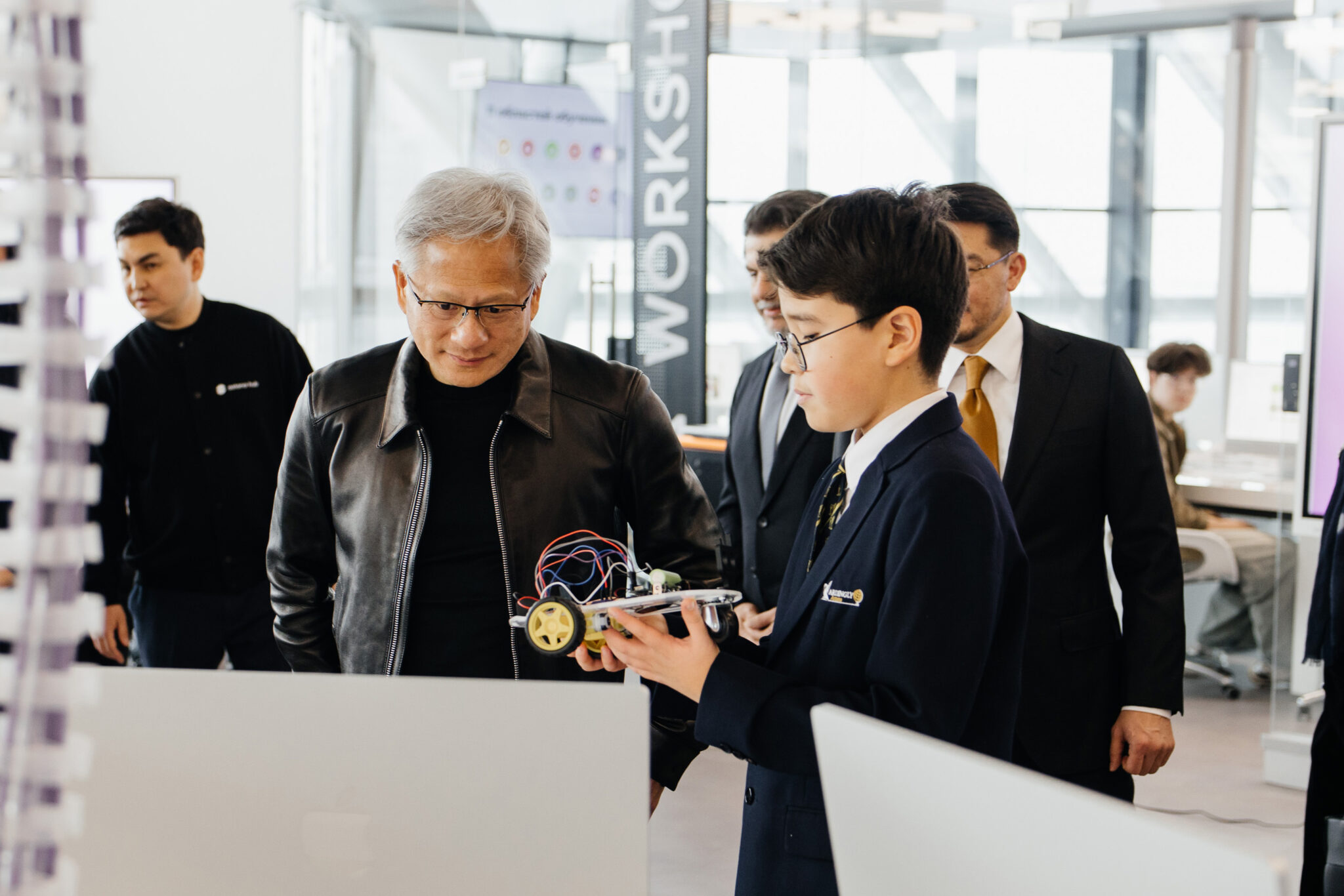
Huang tours alem.AI international center. Photo credit NVIDIA.
According to him, Kazakhstan could become a center for developing and training physical AI systems, particularly in sectors where the country already has substantial expertise, including mining, agriculture, logistics and energy.
He also said the technology’s applications extend beyond robots to geological exploration, seismic analysis, mapping mineral deposits and improving industrial processes.
“Now, we are at the beginning of the physical AI journey. This is the next wave,” he said, describing physical AI as an opportunity for countries to help shape an emerging industry rather than merely adopt technologies developed elsewhere.
Local AI talent
The discussion also highlighted NVIDIA’s investment in Higgsfield, an AI video-generation startup with a significant presence in Kazakhstan and a valuation of $5.4 billion.
“The first thing and the last thing is you invest in people, not companies,” Huang said.
He believes Kazakhstan’s technology ecosystem could benefit from a combination of local talent, expanding computing infrastructure and stronger international connections.
“The only thing that matters is do you have ambition? If you have ambition, then AI and robotics will lift you,” said Huang, addressing concerns that AI could displace workers.
He cited examples ranging from farmers using robots to expand agricultural operations to scientists and engineers using AI assistants to pursue more complex research and designs.
Madiyev agreed, stressing the importance of education and developing AI skills from an early age, pointing to programs at the center.
“It is our job as parents to imbue our children, instill our children with hope, ambition, aspiration, to help them dream bigger. When you dream big, then AI will lift you to achieve that. Same exact idea for children as well as for adults, for companies as well as countries and nations,” Huang explained.
‘Envy being 18-year-old’
Toward the end of the discussion, Huang was asked what he would do if he were 18 years old and living in Kazakhstan today.
“I envy being 18 years old today,” he said, reflecting on how rapidly technology is changing and the opportunities it presents for a new generation.
“I was fortunate because when I was 18 years old, the personal computer was just becoming possible. I’ve been working for 43 years, my generation was defined by the creation of the computer. All of our four decades of endeavors have led to artificial intelligence, which is a complete reset of everything that we’ve done,” Huang said.
“I would dedicate myself to be the world’s best programmer of AI,” he said, emphasizing that young people should understand how the technology works, including its strengths, weaknesses and limitations, to make the most of its capabilities.
Ongoing partnership
Huang’s visit coincided with AI infrastructure commitments in Kazakhstan. NVIDIA is set to take part in the development of the Data Center Valley project in Ekibastuz, a town in northeastern Kazakhstan.
NVIDIA reported on Oct. 23 that U.S.-based Firebird signed an investment agreement with the Kazakh government and has secured a U.S. export license for 45,000 NVIDIA Grace Blackwell GPUs (Graphics Processing Unit).
The company is developing the first phase of a facility with Kazakhtelecom, the country’s largest telecommunications company, at Data Center Valley in Ekibastuz, with commercial operations expected to begin in the third quarter of 2027.
Kazakhtelecom has already deployed 880 NVIDIA GPUs in Astana and Almaty. In 2027, it plans to deploy more than 2,000 additional GPUs, including over 1,000 NVIDIA Vera Rubin processors in Ekibastuz.
