
ALMATY – Central Asian countries are increasingly shaping how China invests, builds infrastructure and develops technological partnerships in the region, challenging the perception that Beijing follows a single model of global engagement, experts said at an Oct. 20 discussion in Almaty.
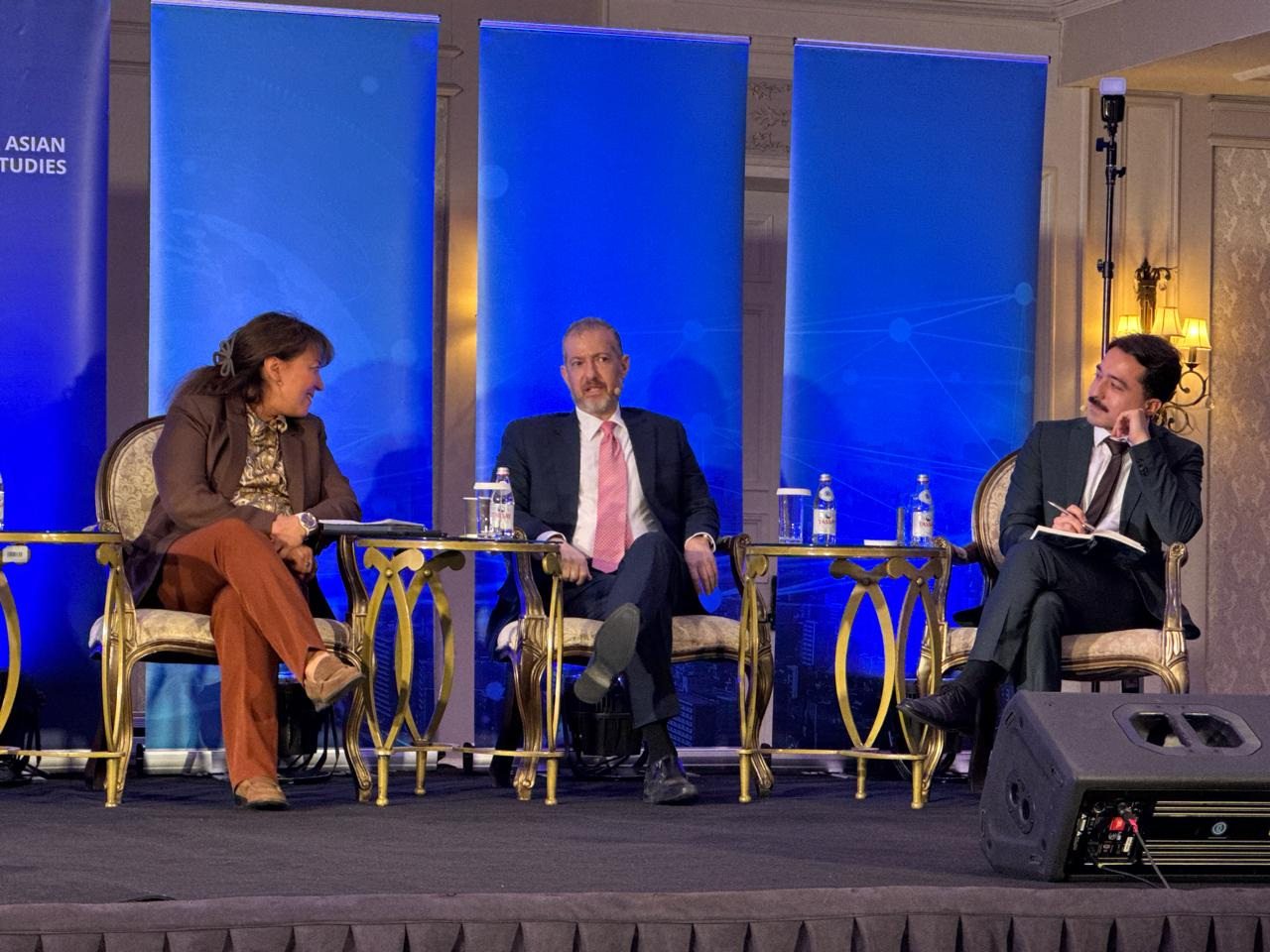
From L to R: CAPS Unlock Executive Director Aida Aidarkulova, Evan A. Feigenbaum, vice president for studies at the Carnegie Endowment for International Peace and Temur Umarov of the Carnegie Russia Eurasia Center. Photo credit: The Astana Times.
Organized by the Almaty-based CAPS Unlock think tank and the Carnegie Endowment for International Peace, the discussion examined how local governments, institutions and businesses influence China’s activities across different regions. Experts stressed that Central Asian states are not merely responding to China’s growing presence but are using their own development priorities and bargaining power to influence the terms of cooperation.
At the same time, intensifying competition between the United States and China could make it more difficult for countries in the region to maintain diversified international partnerships, even as global uncertainty creates new opportunities for them to advance their interests.
From a single China model to local adaptation
Carnegie launched the China Local/Global initiative nearly six years ago to study Chinese engagement across seven regions: Central Asia, South Asia, Southeast Asia, Latin America, Africa, the Middle East and North Africa, and the Pacific.
Evan A. Feigenbaum, vice president for studies at the Carnegie Endowment for International Peace, said the initiative was designed to examine how Chinese engagement differs according to local political, economic and institutional conditions.
“While that may be part of the story, it is very clearly not the whole story,” Feigenbaum said of the assumption that China imposes a uniform model on countries around the world. In many cases, he noted, Chinese actors adapt to local practices and partner with domestic stakeholders.
For Central Asian countries, the question is not only how to attract Chinese investment, but also how to ensure that cooperation supports domestic priorities, including economic growth, employment, technological development and the creation of higher-value industries.
CAPS Unlock Executive Director Aida Aidarkulova said the partnership was intended to bring regional expertise into international debates rather than simply introduce foreign perspectives to Central Asia.
“We believe such exchanges enrich everyone involved,” she said, describing the think tank’s broader goal as generating knowledge about Central Asia from within the region and contributing to a regional research agenda.
Investment is shifting beyond raw materials
Djoomart Otorbaev, former prime minister of the Kyrgyz Republic, emphasized that China’s economic engagement in Central Asia has evolved over the past three decades, with a growing emphasis on foreign direct investment, industrial localization and more structured approaches to borrowing.
“Engagement between China and Central Asia is not merely borrowing now, but a structural shift towards FDI, foreign direct investment, industrial localization, and far more disciplined sovereign borrowing,” Otorbaev said.
According to the figures cited by Otorbaev, accumulated Chinese foreign direct investment in Central Asia reached $56 billion by mid-2025, nearly doubling over the previous decade.
While raw materials accounted for approximately 68% of Chinese investment in the region a decade ago, that share has since declined to 54%. Manufacturing now represents 22%, while energy, including renewables, accounts for 12%.
“Today manufacturing accounts for 22% of Chinese FDIs in Central Asia. In energy, including renewables, 12%. This is industrial embedding to my classification,” he said.
Kazakhstan remains the largest single recipient of Chinese investment. Uzbekistan has emerged as an increasingly significant competitor for capital, Otorbaev said. He pointed to the expansion of Chinese investment in Uzbekistan as a reason for Kazakhstan to strengthen its own investment environment.
“Yes, we are competing very, very hard with each other to be better,” he said. “So now I think, with all my excuses, it is a wake-up call for Kazakhstan.”
“What we want from China is cooperation in new 21st century economies. China’s most disciplined expansion is happening in Central Asia,” he added.
U.S.-China rivalry puts pressure on regional choices
Feigenbaum cautioned, however, that the growing role of local governments could be challenged by intensifying strategic competition between Washington and Beijing.
“The way I would describe the change is the securitization of everything, by which I mean that every issue, including economic flows, goods, capital, people, technology, data, are being refracted by both Washington and Beijing through the prism of national security in their own competition,” he said.
“If you’re sitting in this region, as in most regions of the world, I often use a mathematical metaphor. The mathematical operations that matter are addition and multiplication, not subtraction and division,” he added.
He warned that the growing rivalry could make it harder for regional governments to maintain that flexibility.
Umarov. Photo credit: The Astana Times.
Temur Umarov of the Carnegie Russia Eurasia Center similarly urged analysts to pay closer attention to political and economic changes originating within Central Asia.
“I do believe that we pay too much attention to what is happening outside of Central Asia, not so much to what is actually happening here,” Umarov said. “And I think that this is one of the biggest problems that we have as people who write, observe, and analyze events in Central Asia, because it is not just unfair, it is wrong.”
He said international developments, including the geopolitical shocks and U.S.-China tensions, influence the region, but should not overshadow the agency of Central Asian governments themselves.
“The initiative in that activity is not coming from Washington,” Umarov said, stressing that regional political leaders have used international uncertainty to attract attention and expand their diplomatic and economic options.
He added that a new generation of actors is emerging across Central Asia’s political institutions, businesses and civil society.
“It is actually happening on all of the layers of government or any other institution, body, company, business, NGOs. Everywhere you see the new generation appearing,” Umarov said, highlighting that the current international environment, despite its instability, creates opportunities for countries located between major powers to strengthen their own positions.
The discussion also featured how regional experience can inform policymakers beyond Central Asia, reinforcing the organizers’ argument that understanding China’s global role requires attention to local conditions rather than assumptions about a single, universal model.
