
Editor’s note: The Astana Times continues a section featuring articles by our readers. As a platform that values diverse perspectives and meaningful conversations, we believe that this section provides space for readers to share their thoughts and insights on various topics that matter to them and the AT audience.
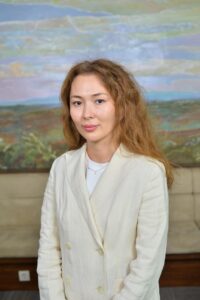
Adilya Tugel. Photo credit: Adilya Tugel’s personal archive
A girl born today in Central Asia will not live long enough to witness gender parity if progress continues at its historical pace. The World Economic Forum (WEF) released a 2026 Global Gender Gap Report, stating that closing the region’s gender gap could take 202 years. On its current trajectory, Central Asia would be the last region in the world to reach parity. The index is based on an established reasoning: economies are less competitive when they fail to develop and use the talents of their entire population. Kazakhstan presents a striking paradox, ranking fourth out of five countries of the region. Since the WEF began measuring gender gaps in 2006, the country has experienced substantial economic growth, rapid digitalisation and deeper integration into the global economy. It has nearly closed its gender gaps in education and health. Yet in political empowerment, only 12.3% of the gap has been closed. More strikingly, Kazakhstan’s overall gender-parity score remains within one percentage point of where it stood in 2006.
The paradox is not that Kazakh women have been left outside the country’s development. Quite the opposite. Women are economically active and deeply embedded in the institutions of the state. The problem is: representation did not automatically translate into authority and power. The bottleneck is visible in the statistics. While women make up a majority of Kazakh civil servants, their representation declines sharply as authority increases. As of January 2024, women accounted for 56% of Corps B administrative civil servants, but only around 12.9% of Corps A and around 8.3% of political civil servants. Women increasingly disappear on the way up. The reasons are clear and well known: gender stereotypes, unpaid care work and expectations about women’s roles.
Artificial intelligence could reinforce existing gender inequalities.
The International Labor Organization has found that female-dominated occupations are almost twice as likely to be exposed to generative AI, partly because of women’s greater concentration in administrative roles. These findings matter for a public sector in which women constitute the majority. Kazakhstan needs to ensure that traditional rungs of the career ladder are not eliminated without creating stronger pathways for women towards leadership roles.
The government has already laid the foundations for the solution. It has invested considerably in e-Qyzmet to digitize significant parts of recruitment and personnel administration to make HR processes more transparent and standardized. However, while women enter the civil service in large numbers, they still progressively disappear as positions become more powerful. The next task is to make that leadership pipeline visible. Among civil servants with comparable qualifications, competencies, and performance, do women and men progress at similar rates? If not, at what point do their careers begin to diverge? Technology can help institutions ask these questions systematically. HR analytics could identify where promising employees stall, who receives the assignments and experience that prepare officials for senior leadership.
This is not to say that gender should become a criterion for promotion, but rather an audit variable. AI could eventually strengthen this process by identifying capabilities that conventional career paths or solely human judgement may overlook. The purpose of technology should therefore not be to decide who deserves to lead, but to make the evidence behind human decisions more visible and accountable.
One may argue that the government cannot solve a problem that ultimately lies in society. Assumptions about leadership, family obligations and informal professional networks do not disappear because recruitment rules are formally neutral. Culture became a convenient explanation for institutional inertia. However, Kazakhstan cannot wait for social attitudes to evolve over generations. The right policies and strong institutions can potentially shape and change the culture to drive further progress.
Closing the gender gap is not only about justice. The government has invested heavily in women’s human capital. The economic question is whether the country is receiving the full return on that investment. A country that educates women, brings them into professional life and employs them throughout the machinery of government, but loses much of that talent before the highest levels of decision-making, is not only facing a gender-equality problem. It is facing a human-capital allocation problem. For Kazakhstan, the next phase of gender equality is therefore not primarily about getting women through the door. It is about turning existing representation into influence. The 202-year projection is not destiny. It is an extrapolation from the past. Whether Kazakhstan follows that trajectory will depend, in part, on the policies and institutions it designs now.
The author is Adilya Tugel, a graduate student at the Nazarbayev University Graduate School of Public Policy.
Disclaimer: The views and opinions expressed in this article are those of the author and do not necessarily reflect the position of The Astana Times.
