
ASTANA – Kazakhstan plans to increase annual transit cargo volumes to 100 million tons by 2035 as it expands transport infrastructure and strengthens connections between major Eurasian trade corridors, Prime Minister Olzhas Bektenov said at Kazakhstan Transport Week in Astana on Oct. 15.
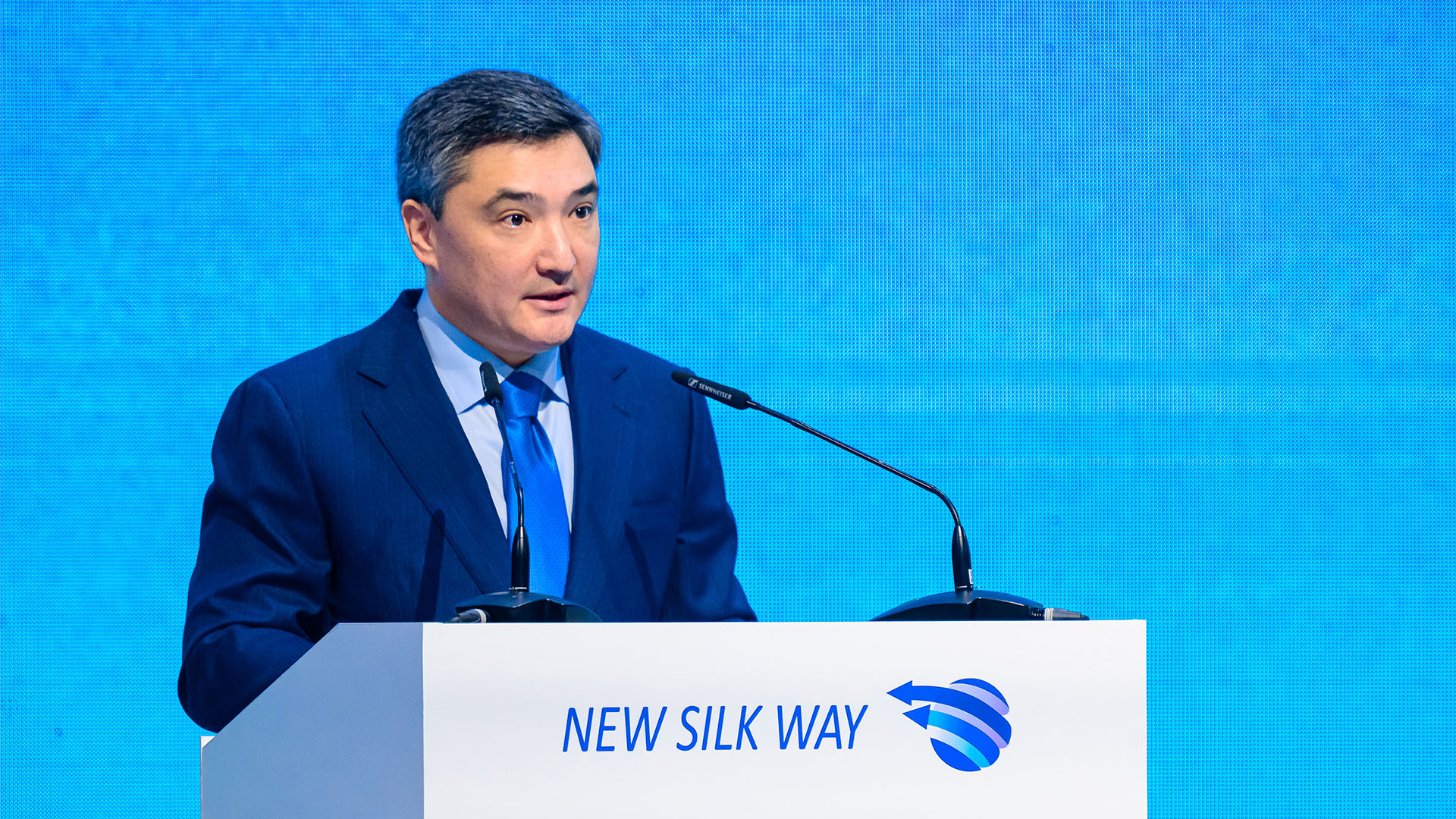
Prime Minister Olzhas Bektenov. Photo credit: PM’s press service.
The forum brought together transport experts from around 40 countries to discuss railway, road, maritime and air transport, digital logistics, international freight efficiency and workforce development. Participants included representatives of transport authorities from Azerbaijan, Armenia, Afghanistan, Belarus, Georgia, Iran, the Kyrgyz Republic, Pakistan, Russia, Turkmenistan, Türkiye, Uzbekistan and the Czech Republic, as well as international organizations, logistics companies and diplomatic missions.
According to the officials, Kazakhstan’s transport sector grew 7.2% in the first nine months of 2026, making it one of the country’s leading economic sectors, according to figures presented at the event.
“President Kassym-Jomart Tokayev has identified the development of transport and logistics potential as one of the country’s strategic priorities. Modern transport infrastructure contributes to expanding international trade, attracting investment, creating new production facilities and strengthening economic ties between countries,” Bektenov said.
Infrastructure investment supports transit ambitions
Kazakhstan has been implementing a large-scale transport infrastructure development program. Over the past seven years, the country has built or repaired 36,300 kilometers of roads, while 5,000 kilometers of railway lines have been built or modernized over the past five years.
The country is also developing border infrastructure, seaports and airports. Aviation security has reached 95.7%, according to the information presented at the forum.
Transit cargo volumes through Kazakhstan increased 18% in 2025, reaching 39.1 million tons. By 2035, the country plans to increase the capacity of its seaports fourfold, expand its fleet capacity fivefold and raise annual transit cargo volumes to 100 million tonnes, according to the Ministry of Transport.
Connecting major Eurasian transport corridors
Participants discussed ways to improve connectivity along the East-West and North-South routes, the Trans-Caspian International Transport Route and the prospective Trans-Afghan Corridor.
Bektenov emphasized the need to improve international logistics and strengthen connections between these routes. Priorities include developing infrastructure, digitizing logistics processes and ensuring seamless transit across borders.
Governments were also urged to address infrastructure bottlenecks and administrative barriers that can delay international freight shipments. Proposed measures include introducing “green corridors” and a “single window” principle to simplify cross-border procedures and reduce delivery times and costs.
The discussions also highlighted the importance of moving toward joint investment and infrastructure projects involving countries along the transport corridors.
Transport corridors offer broader economic potential
The forum also addressed the potential economic benefits of more efficient international transport networks. According to the World Bank assessment cited at the meeting, combining infrastructure investment with simplified trade procedures and shorter border delays could increase the gross domestic product of countries by nearly 15%.
For Kazakhstan, the strategy extends beyond expanding physical infrastructure. Better coordination between neighboring countries, digital solutions and more predictable border procedures are intended to improve the efficiency of freight transport and strengthen the country’s position in Eurasian trade.
The target of 100 million tons in annual transit cargo by 2035 reflects Kazakhstan’s ambition to expand its role as a transport and logistics link between Europe and Asia while supporting trade across several international corridors.
