
ASTANA – President Kassym-Jomart Tokayev has called for Kazakhstan and South Korea to double bilateral trade and deepen cooperation in advanced manufacturing, critical minerals, energy, transport, artificial intelligence and other high-value sectors. Speaking at the opening of the Kazakhstan–South Korea business roundtable in Seoul on Sept. 15, Tokayev said bilateral trade exceeded $3 billion last year and could be doubled through joint efforts by the two governments and businesses.
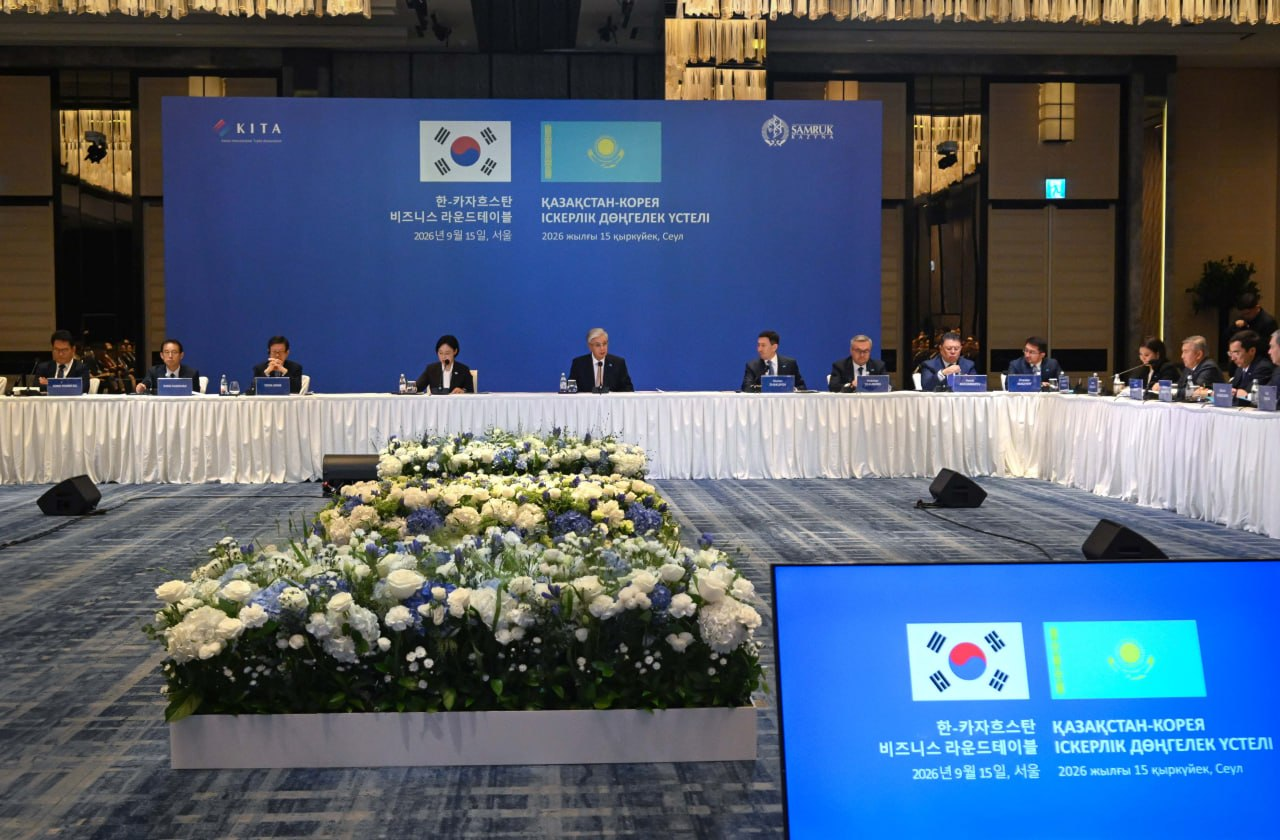
President Kassym-Jomart Tokayev at the opening of the Kazakhstan–South Korea business roundtable in Seoul on Sept. 15. Photo credit: Akorda.
“This visit provides a good opportunity to consolidate the progress achieved and give new impetus to bilateral cooperation,” Tokayev said.
He also emphasized that Kazakhstan and South Korea had built strong relations over the past three decades based on mutual respect, trust and friendship. According to him, South Korea is now among Kazakhstan’s major trade and investment partners, with Korean companies playing an increasingly prominent role in the country’s economy.
Korean companies have invested more than $12 billion in Kazakhstan, while more than 1,000 companies with Korean capital operate in the country, including Samsung, Kia, Hyundai, Lotte, Doosan Enerbility and Shinhan Bank.
Industrial partnership enters a new stage
Tokayev identified industrial cooperation as one of the strongest foundations of Kazakhstan–South Korea economic relations. The countries’ joint industrial portfolio currently comprises 51 projects in automotive manufacturing, machinery, metallurgy and other sectors worth more than $4 billion.
Kazakhstan also produced nearly 170,000 vehicles in 2025, setting a national record, while local production of Korean consumer electronics is also expanding, including Samsung household appliances.
“Our goal is to create a fully integrated industrial ecosystem encompassing localized components, advanced materials, electrical equipment and electronics, with a focus on serving the broader Eurasian market,” Tokayev said.
President Tokayev also said Kazakhstan was closely following South Korea’s new industrial strategy under President Lee Jae Myung, including the Three Mega Projects and Seven Major SEED initiatives.
Urban development opens opportunities for Korean companies
Construction and urban development were highlighted as another promising area of cooperation.
“Kazakhstan is currently entering an important stage of infrastructure development. We intend to significantly accelerate the pace of construction throughout the country – from transport and utility systems to housing and social infrastructure. I consider this one of the key priorities of my work as President,” he said.
Tokayev noted South Korea’s international experience in construction, engineering and infrastructure development and invited Korean companies to participate in large-scale projects across Kazakhstan. Potential areas include hospitals, children’s rehabilitation centers, multifunctional medical centers, modern schools, sports facilities and transport infrastructure.
The Kazakh President said the government would prepare a specific list of infrastructure projects to create new mutually beneficial ventures and advance investment initiatives.
Critical minerals could create new value chains
Critical minerals represent another strategic area for expanding bilateral cooperation, according to Tokayev. Kazakhstan’s significant reserves of strategic minerals create opportunities for cooperation with South Korean companies in advanced industries and other high-value sectors.
“We propose a ‘resources–technology–industry’ model for jointly developing complete value chains,” Tokayev said.
He highlighted the planned creation in Almaty of a Center for Technological Cooperation in Rare and Rare-Earth Metals as a step toward turning cooperation in the sector from resource exploration into concrete industrial projects.
Energy remains an important component of Kazakhstan–South Korea cooperation, with Tokayev highlighting growing Korean interest in Kazakhstan’s energy sector. He identified further opportunities in gas processing, petrochemicals, energy infrastructure and renewable energy. Tokayev also proposed expanding cooperation in peaceful nuclear energy, particularly in developing small modular reactors.
As one of the world’s largest uranium producers, Kazakhstan has significant potential in the nuclear energy sector, while SMRs are gaining increasing attention as an emerging energy technology.
Kazakhstan seeks greater Korean role in Middle Corridor
Tokayev said Kazakhstan was investing heavily in railways, roads, ports, terminals and other infrastructure to increase the capacity, speed and reliability of the country’s transport links between Asia and Europe.
“We believe the time has come to expand Korea’s participation in the development of the Middle Corridor,” he said.
The President highlighted the activities of Korean logistics companies, including CJ Logistics and LX Pantos, which are developing logistics centers, multimodal terminals, warehouse facilities and digital supply-chain solutions in Kazakhstan.
Tokayev also welcomed cooperation between Kazakhstan’s Shin-Line and Lotte Global Logistics to develop new logistics opportunities.
AI cooperation targets regional technology leadership
Artificial intelligence and new technologies were identified as another major area for future cooperation. Tokayev stressed that human capital would be central to Kazakhstan’s AI strategy and highlighted cooperation with Seoul National University of Science and Technology on establishing Kazakhstan’s first Institute of Artificial Intelligence.
“Our goal is to position Kazakhstan as the main computing center of Central Asia and a bridge between Europe and Asia,” Tokayev said.
He said Kazakhstan was ready to deepen cooperation with global technology companies such as Samsung Electronics and SK Hynix, including supplying materials and components for microelectronics and semiconductor production.
Human capital remains central to partnership
Tokayev emphasized that technological and economic cooperation would depend on developing human capital. Universities in Kazakhstan and South Korea currently maintain academic cooperation through more than 230 agreements, laying the groundwork for expanding research and educational partnerships.
He also said Kazakhstan’s next stage of economic modernization would focus on new industries, technologies, research capabilities and human capital. South Korea’s own transformation into a global economic and technological power, he noted, provides valuable experience for Kazakhstan as it pursues its modernization agenda.
“I am confident that today’s event and the agreements being signed will give a powerful impetus to a more ambitious partnership,” Tokayev said, calling on Korean businesses to increase investment in Kazakhstan.
