
ALMATY – Kazakhstan has built the core digital infrastructure for its financial sector and is now entering a new stage focused on developing new products, attracting new market participants and creating innovative business models, National Bank Governor Timur Suleimenov said at the Central Asia Fintech Summit 2026 in Almaty on Sept. 11.

The summit, held on Sept. 11, brings together regulators, financial institutions and experts to discuss the future of financial markets. Photo credit: CAFS.
Speaking at the opening of the third annual summit, Suleimenov said Kazakhstan’s financial sector has already reached a high level of digitalization, with more than 90% of payments made without cash and most basic banking and government services available through digital platforms.

National Bank Governor Timur Suleimenov. Photo credit: CAFS.
The summit, held on Sept. 11, brings together regulators, financial institutions, technology companies and experts to discuss the future of financial markets, digital currencies, artificial intelligence, digital assets, cybersecurity and other areas of fintech.
Suleimenov said the National Bank’s approach has evolved from simply digitizing its own operations to actively encouraging innovation across the financial market.
“We decided to change the approach altogether – instead of being the one who is pushed, to become the one who pushes the market,” he said, describing the regulator’s role as creating a “push” for the market and encouraging participants to move faster.
Kazakhstan builds digital financial infrastructure
Kazakhstan has established a national digital financial infrastructure. It includes biometric identification, interbank payments, the digital tenge and mechanisms designed to protect citizens and businesses from financial fraud.
The infrastructure has been expanded through successive stages, with the digital tenge entering industrial use in 2023, the National Anti-Fraud Center launched in 2024 and new interbank and QR payment infrastructure introduced subsequently.
The digital tenge is gradually being integrated into government financial processes, including public procurement, budget planning and the management of state funds. Suleimenov said the National Bank, together with the government, intends to increase the volume of digital-tenge operations to 2 trillion tenge (US$4.4 billion) over the next 12 months.
Suleimenov pointed to the interbank mobile payment system launched this year as one of the latest developments. The system includes transfers by phone number and a unified QR code. Since its launch on July 19, it has processed more than 20 million transactions worth around 400 billion tenge (US$888 million), according to the National Bank.
He described the high level of digitalization as a major achievement, noting that in many countries reaching 50–60% of non-cash turnover remains a challenge.
From infrastructure to products
The next challenge, Suleimenov said, is no longer primarily about building the technological “rails” of the financial system but about using them to create products that meet the needs of businesses and consumers.
During the opening plenary, moderator Vitaliy Volyanyuk, co-founder and CEO of Digital Business, asked Suleimenov to assess what the measures introduced by the NBK and other regulators had actually delivered and how Kazakhstan’s financial sector looks today.
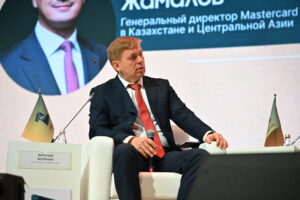
Vitaliy Volyanyuk, co-founder and CEO of Digital Business. Photo credit: CAFS.
Suleimenov described the sector as bank-centered but increasingly diverse, with the domestic financial system, the Astana International Financial Center and emerging digital-finance initiatives creating complementary opportunities.
“Briefly, the system is strong, highly capitalized and digitalized, and it has a huge future,” he said.
But Suleimenov stressed that infrastructure alone would not be enough.
“The second step is, of course, financial infrastructure, on which these solutions have to run. We are also creating that. But now, probably, the main step is creating products,” he said.
“We cannot and will not create the products ourselves,” he added, calling on banks, traditional financial institutions and new financial companies to work both together and in competition to develop new products and business models. The objective, he said, is to make access to financing, payments and cross-border transactions easier for both businesses and individuals.
Digital maturity remains uneven
The transformation, however, is not taking place at the same pace across the entire financial sector, Chair of the Agency for Regulation and Development of the Financial Market Madina Abylkassymova said during the summit.
Volyanyuk also asked about the readiness of smaller banks, insurance companies and other financial institutions for digital and AI transformation, rather than focusing only on the largest banks with significant technological and financial resources.
Abylkassymova said the agency had assessed the digital readiness of 94 financial organizations this year, examining process digitalization, data quality, infrastructure, cybersecurity, AI use and employee competencies.
“Banks remain the leaders, with almost 75% already using artificial intelligence. However, a gap remains between banks and other parts of the financial sector, particularly insurance and microfinance,” she said, stressing that digital transformation is not simply about introducing technology.
“It is also about the competencies of employees,” Abylkassymova added, arguing that digital and AI tools need to be embedded into the actual processes of financial organizations.
According to her, the agency is now developing a strategy for large-scale digitalization and further AI adoption across the financial sector. It has identified 1,200 specific measures and prepared individual development plans for the 94 organizations assessed.
Kazakhstan looks to export financial services
Suleimenov identified exporting Kazakhstan’s financial industry as another strategic priority. This includes helping domestic financial companies enter foreign markets and attracting international players that can serve global customers through Kazakhstan’s jurisdiction and financial infrastructure.
He said the country has a strong domestic financial jurisdiction alongside the Astana International Financial Center, which he described as an additional driver of competition and investment.
The next stage, however, will depend on whether market participants can turn the established infrastructure and regulatory framework into products that can compete both domestically and internationally.
“We have a strong foundation, but now we need the market to become more active – with new products, partnerships and business models that will allow us to fully use these opportunities,” Suleimenov said.
The Central Asia Fintech Summit 2026 brings together more than 120 speakers and experts. It focuses on the development of digital finance, including payments, digital assets, AI, cybersecurity, tokenization and anti-fraud technologies.
