
ALMATY – The rapid decline of the Caspian Sea is emerging as one of Kazakhstan’s most complex water and environmental challenges, with falling water levels threatening ecosystems, fisheries, coastal infrastructure and communities. As the country strengthens its broader water management system, the changing Caspian is adding urgency to efforts to improve how Kazakhstan monitors and uses its water resources.
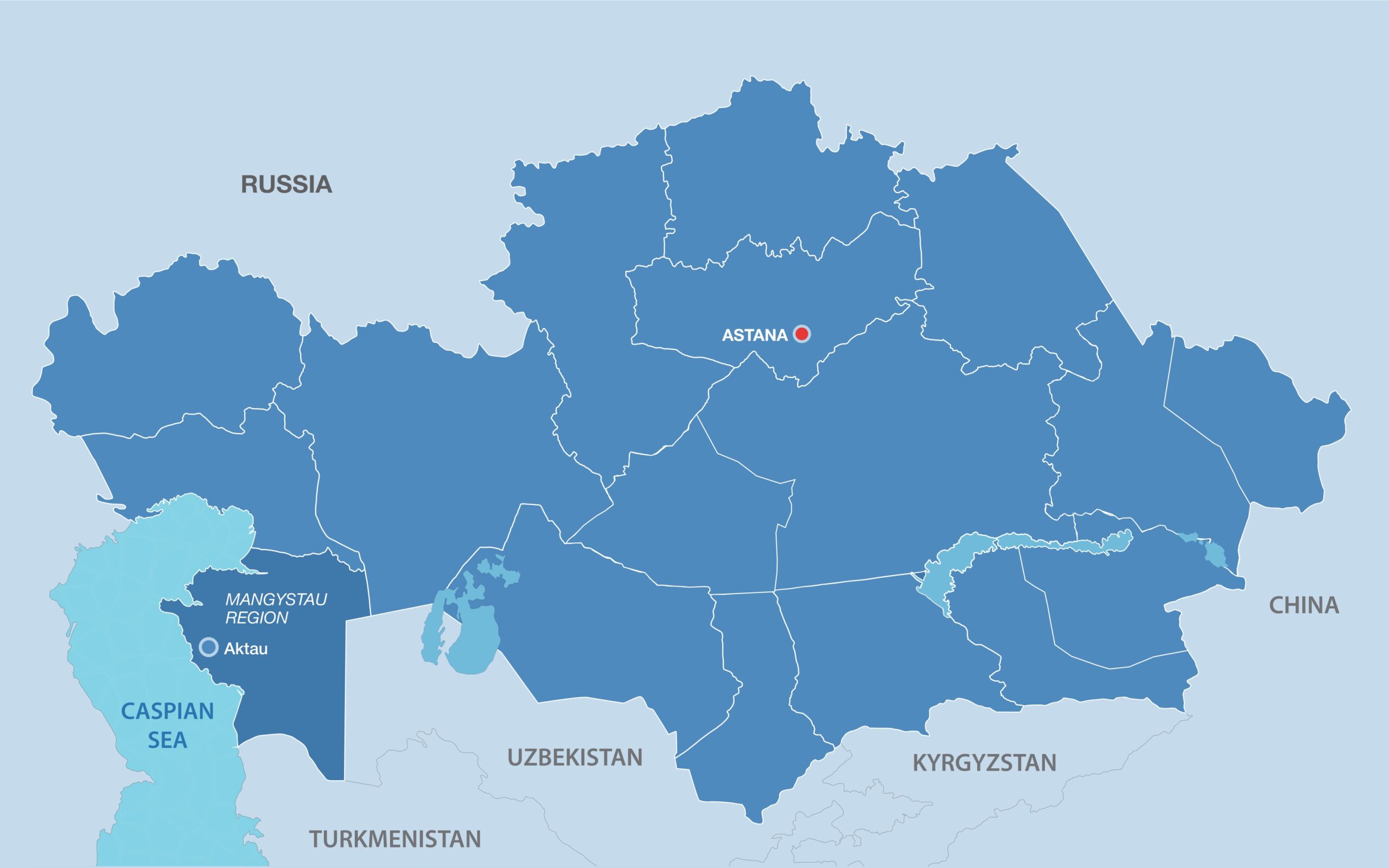
The water level of the Caspian Sea along Kazakhstan’s coastline continues to decline. Photo credit: Tengrinews. Click to see the map in full size. The map is designed by The Astana Times.
The scale of the challenge is becoming visible along Kazakhstan’s Caspian coast. A newly emerged island, already referred to locally as Rybachy, has become a visible sign of the sea’s retreat, while scientists have warned of potentially significant ecological consequences.
Experts have compared some aspects of the current situation with the deterioration of the Aral Sea, although the two water bodies have very different causes and dynamics.
Vadim Ni, founder of the Save the Caspian Sea movement and director of the Social and Environmental Fund, said the consequences are already being felt in several sectors, including shipping, cargo transportation, fisheries, tourism and drinking water supplies in Aktau.
At the same time, speaking with the Inbusiness agency, he noted that the full economic cost of the Caspian’s decline has yet to be systematically assessed.
A changing sea creates economic risks
The Caspian is particularly important for Kazakhstan because its economic role extends far beyond the coastline. The sea supports fisheries, ports and tourism, while Kazakhstan’s ports form part of the Trans-Caspian International Transport Route, linking China and Europe.
A continued decline in water levels could therefore create additional costs for maritime transportation and port infrastructure. Shallowing waters can restrict access for larger vessels and require adjustments to navigation channels and coastal facilities.
Economist and financial adviser Arman Baiganov said declining water levels could disrupt port infrastructure because deep-draft vessels may no longer be able to access and dock at some facilities. However, the exact economic impact remains difficult to calculate because it will depend on the speed and extent of the decline, as well as the measures taken to adapt infrastructure.
The same uncertainty applies to tourism. Kazakhstan has invested heavily in developing Aktau and other Caspian destinations, but a retreating shoreline could eventually change the location and viability of existing recreation facilities.
“If the water significantly retreats from the shore, tourist bases and recreation areas located today along the coast may have to be relocated or rebuilt closer to the sea,” Baiganov said.
Fisheries face a double pressure
The reduction of shallow-water areas in the northern Caspian affects habitats that are important for fish feeding and reproduction. This is particularly significant for sturgeon species, historically associated with the Caspian ecosystem.
Ni noted that declining water levels are already making fishing more difficult in parts of northeastern Kazakhstan, including the Atyrau region. The geography of the industry has also changed. In 2006, Atyrau accounted for around 13,650 tonnes, or nearly 40%, of total fish catches, according to Ni. By 2024, its share had fallen to just over 20%, with catches of about 9,480 tonnes.
At the same time, Mangystau’s catch increased substantially, from 315 tonnes in 2006 to almost 5,000 tonnes in 2025. But the sea’s decline is only one factor affecting fisheries. Overfishing and poaching also place pressure on fish populations, making it difficult to attribute changes in catches to water levels alone. This mix of environmental and human pressures means adapting to the changing Caspian will require more than infrastructure measures.
Scientists warned about climate change
According to a forecast cited by Ni from researchers at universities in Bremen, Giessen and Utrecht, under a lower-emissions climate scenario the Caspian’s surface area could decline by 23% and its level fall by about nine meters by the end of the century. Under a more severe warming scenario, the area could decline by 34%, with a similar fall in water level.
These projections are long-term scenarios rather than forecasts of what will necessarily occur, but they illustrate the scale of potential change facing the region. Against this backdrop, Kazakhstan is simultaneously overhauling its wider water governance framework.
A new Water Code that entered into force last year introduced new principles for protecting and using water resources, including stronger requirements to protect small rivers and lakes and provisions for establishing water protection zones.
The legislation also provides for a General Plan and basin-level plans to protect and use water resources. Their recommendations are intended to be incorporated into state planning.
These measures do not directly solve the Caspian problem, but they form part of a broader strategy to make Kazakhstan’s water management more efficient at a time when the country faces increasing uncertainty over water availability.
The North Aral Sea experience demonstrates the potential impact of coordinated water management. Through agreed reservoir operating regimes on the Syr Darya, Kazakhstan has maintained stable inflows into the North Aral Sea, increasing its volume from 18.4 cubic kilometers at the beginning of 2023 to 23.5 cubic kilometers currently.
The Caspian presents a much more complicated challenge, but the principle is similar: reliable data, coordinated management and long-term planning become increasingly important as environmental conditions change.
As Water Resources and Irrigation Minister Nurzhan Nurzhigitov said, the next stage is to move from strategic and regulatory measures toward the timely completion of specific projects and tangible improvements in water security.
