
ALMATY – Kazakhstan has one of the relatively young population structures globally, with people under 18 accounting for 34.2% of the population in 2025 and placing the country 80th among 163 countries and territories. Experts say the large share of children gives Kazakhstan a potential demographic dividend, but realizing that opportunity will depend on education, healthcare, employment and long-term planning.
Photo credit: Andrei Shupilo
According to data from the UN Population Division Data Portal, Kazakhstan ranks between countries with substantially older population structures and the world’s youngest societies. The Central African Republic has the highest share of people under 18 at 56.2%, followed by Niger at 53.3%, Somalia at 53.0%, Mali at 52.9% and Chad at 52.7%.
At the other end of the ranking, children account for just 12.9% of South Korea’s population, while Japan, Taiwan and Singapore also have shares below 15%.
The contrast highlights two very different demographic challenges. Countries with large youth populations need to create enough schools, healthcare services and eventually jobs for growing generations. Countries with very small younger generations face a shrinking future workforce and increasing pressure from population aging.
For Kazakhstan, experts say the current age structure creates a window of opportunity, but one that is time-limited.
A young population is a potential dividend, not a guarantee
Independent financial analyst Andrei Chebotaryov said Kazakhstan’s relatively young population should be viewed as an economic opportunity rather than an automatic source of prosperity.
“A large number of children is by no means automatically wealth. It is a potential demographic dividend,” he wrote on his Telegram channel.
According to Chebotaryov, that dividend materializes only if a country provides younger generations with quality education, healthcare, skills and opportunities to find employment. If those conditions are met, a large youth cohort can eventually become a substantial workforce, a larger group of taxpayers and consumers, and a source of entrepreneurship and domestic demand.
“Kazakhstan is in an interesting position. Our population is noticeably younger. This means that Kazakhstan currently has a very valuable window of opportunity: the young generation is already here. Now the main thing is to use it correctly,” Chebotaryov wrote.
The demographic gap of the 1990s is still being felt
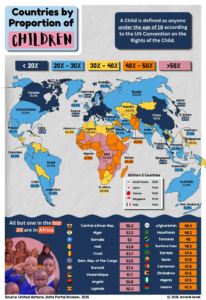
Photo credit: Iswardi Ishak/Visual Capitalist.
Kazakhstan’s current age structure, however, is also shaped by demographic disruptions that followed the collapse of the Soviet Union. Demography researcher and PaperLab Making New Experts graduate Darina Dauletbek, speaking on the Zhiza podcast on YouTube, said the country’s demographic situation cannot be understood without considering the sharp decline in births during the 1990s.
She described this as a demographic “pit” – a significant drop in the number of births that later moves through the population structure in waves. In the late 1980s, around 400,000 children were born in Kazakhstan, according to figures Dauletbek discussed. By 1999, the number had fallen to just over 200,000.
The decline coincided with the economic crisis following the collapse of the Soviet Union, as well as significant migration out of Kazakhstan. The effects are now visible in the size of the generation reaching adulthood.
People born in the late 1990s and early 2000s are now roughly in their late 20s and 30s — the age when many people marry, have children, and establish careers and businesses. Because relatively few people were born during that period, fewer people are reaching these life stages.
“This demographic pit creates the noise we are seeing today: falling birth rates and a decline in the number of marriages,” Dauletbek said in an interview with the Zhiza podcast.
Fertility matters, but so does the size of each generation
Dauletbek also highlighted the importance of the total fertility rate: the average number of children a woman is expected to have over her reproductive years. In Kazakhstan, the total fertility rate fell to about 1.8 in 1999, compared with approximately 3.5 during the Soviet period, according to figures cited in the interview.
A fertility rate of around 2.1 is generally associated with replacement-level fertility under stable mortality and migration assumptions. When fertility remains below that level over a prolonged period, population growth becomes increasingly difficult to maintain without other demographic factors.
Kazakhstan subsequently experienced a recovery in fertility, but the demographic effects of the 1990s did not disappear. They moved through the age structure and are now affecting the number of potential parents. This illustrates why demographic trends are difficult to reverse quickly. A smaller generation today means fewer potential parents tomorrow, regardless of whether those people individually want larger families.
Kazakhstan has a window, but it will not last indefinitely
The global comparison makes Kazakhstan’s position particularly notable. Africa dominates the countries with the largest shares of children: 28 of the top 30 countries in the ranking are African, with Afghanistan and Yemen the only exceptions. Higher fertility rates have contributed to these youthful population structures.
But a young population becomes an economic advantage only when institutions and infrastructure can absorb the coming generations. East Asian economies illustrate the opposite challenge. South Korea, Japan, Taiwan and Singapore all have child shares below 15%, meaning substantially smaller generations are entering the future workforce.
Kazakhstan sits between these two demographic models. Its 34.2% share of people under 18 gives it a relatively young population and a potentially favorable labor-force trajectory, while the demographic consequences of the 1990s and the prospect of population aging create longer-term constraints.
As Chebotaryov put it, the demographic bonus cannot simply be postponed. The children who represent potential future workers, entrepreneurs and taxpayers will eventually become those people, and the policies adopted today will influence how large an economic dividend Kazakhstan ultimately receives.
