
ASTANA – Two young Amur tigers brought from Russia as part of Kazakhstan’s tiger reintroduction program are planned to be released into the wild in May 2027, marking the next stage of efforts to restore the species in the Ili-Balkhash ecosystem.
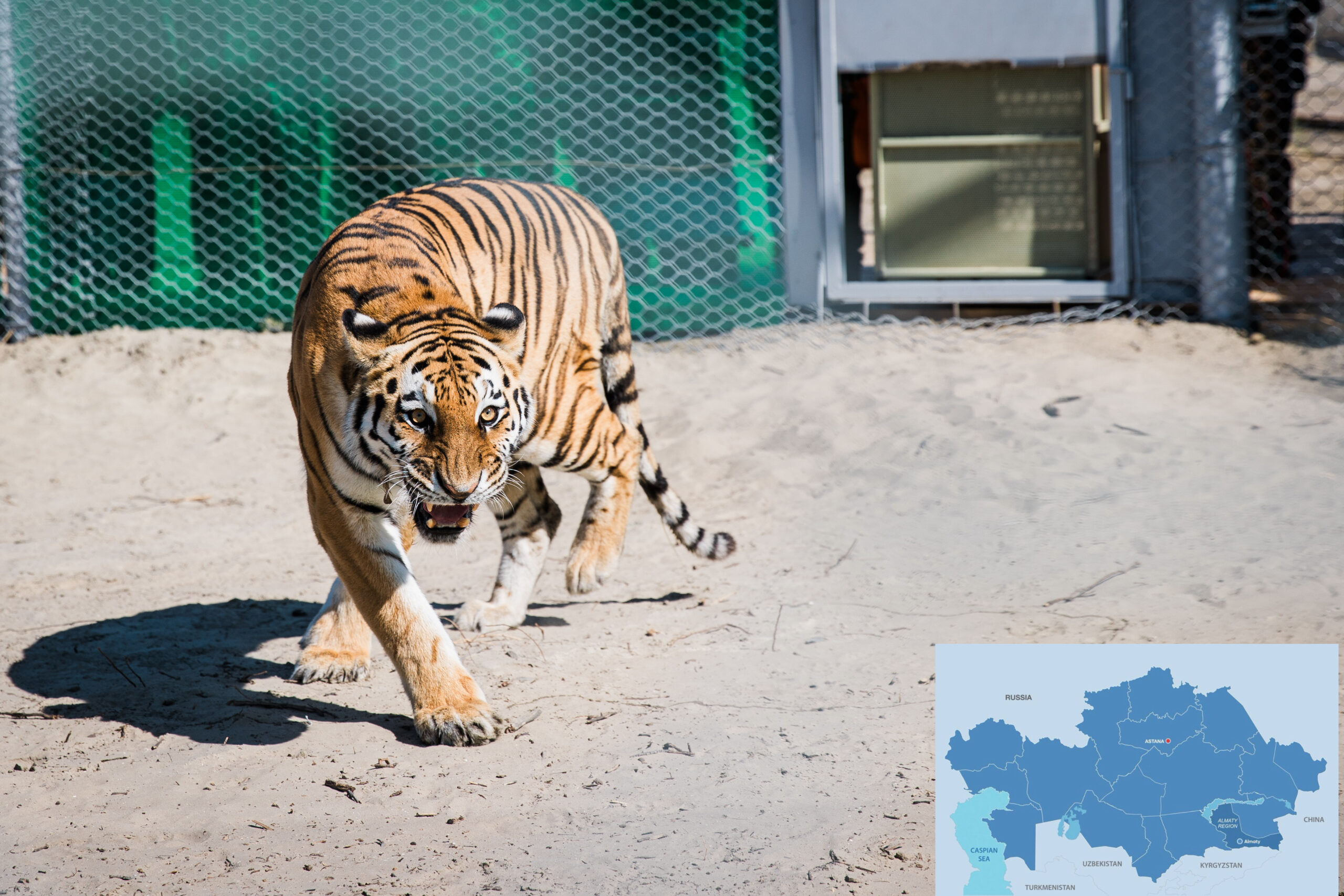
Photo credit: wwfcentralasia.org Click to see the map in full size. The map is designed by The Astana Times.
“Two tiger cubs are planned to be released in spring 2027, in May. They will be released differently, through a temporary enclosure. In this way, we will be able to try all possible release methods in Kazakhstan. The decision will be made in 2027,” Director General of the Amur Tiger Center Sergey Aramilev told TASS at the Eastern Economic Forum in Vladivostok on Sept. 1.
Four Amur tigers were brought from Russia for the program: two adults, a male and female aged three to four years, and two cubs that were six to seven months old at the time of transfer.
The first adult female, Umit, was released into the wild in August. Specialists are monitoring her adaptation to the new territory, and the results will help determine when the male can join her.
Restoring the tiger to Kazakhstan
The program aims to establish a self-sustaining tiger population in the Ili River delta and southern Lake Balkhash region, the historical habitat of the extinct Turan, or Caspian, tiger.
Kazakhstan began preparations for tiger restoration in 2010. The reintroduction program was subsequently developed in cooperation with the World Wide Fund for Nature (WWF), while the Ile-Balkhash State Nature Reserve was established in 2018 as a key part of the project.
Amur tigers were selected because of their close genetic relationship to the extinct Turan tiger, making them suitable for the reintroduction program.
Preparing the ecosystem
The project involves not only bringing tigers to Kazakhstan but also restoring the habitat and prey base needed to support them. Kazakhstan has reintroduced kulans and Bukhara deer and is monitoring other potential prey species.
The four tigers from Russia were joined by two animals transferred from the Netherlands in 2024. Specialists use satellite collars, camera traps and field observations to track the animals and assess their adaptation.
Umit’s release marked the first return of a tiger to the wild in Kazakhstan in more than 70 years. The planned release of the two cubs through a temporary enclosure will allow specialists to test another approach as the reintroduction program develops.
The ultimate goal is to establish a stable wild tiger population in the Ili-Balkhash region through successful adaptation and reproduction.
