
ASTANA — Kazakhstan has released a tiger into the wild for the first time in more than 70 years, marking a historic milestone in a decade-long effort to restore the predator to its former habitat and revive the wider ecosystem of the southern Lake Balkhash region.
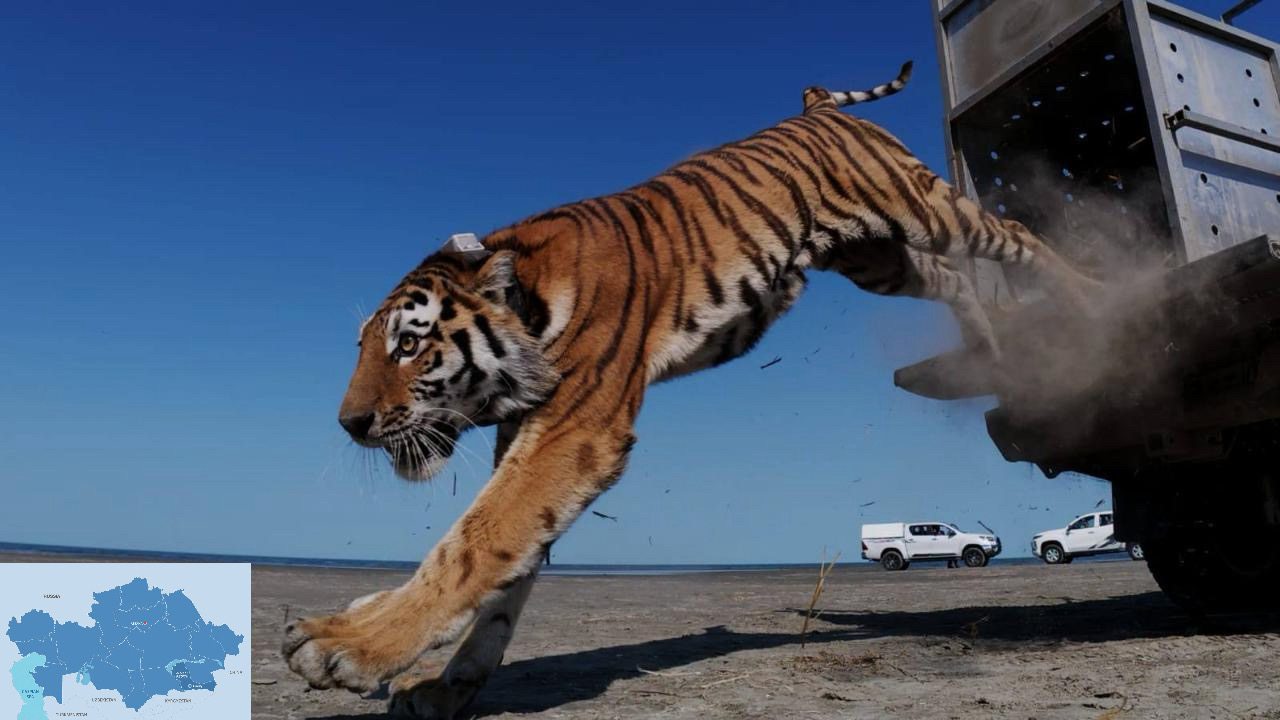
Photo credit: gov.kz Click to see the map in full size. The map is designed by The Astana Times.
An adult female Amur tiger named Umit, meaning “hope” in Kazakh, was released on July 31 in the Ile-Balkhash State Nature Reserve in southeastern Kazakhstan. Equipped with a satellite tracking collar, she is now moving independently through an area once inhabited by the extinct Caspian, or Turan tiger, reported the Ministry of Ecology and Natural Resources.
The release represents the first practical stage of Kazakhstan’s tiger reintroduction program and one of the country’s most ambitious wildlife restoration projects.
“Today, we witnessed a truly historic event,” Minister of Ecology and Natural Resources Yerlan Nyssanbayev said at the release ceremony.
“For the first time since the tiger disappeared from Kazakhstan more than 70 years ago, the first tiger has been released into its historical range. This is the result of many years of work by the state, our Russian colleagues, scientists and international partners,” he said.
Nyssanbayev said that the release was only the beginning of a much longer process.
“A great deal of work lies ahead to monitor the tigers and establish a sustainable population, but today we have taken the first and very important step,” he said.
“The tiger disappeared from Kazakhstan in 1948, and I would suggest that when Vsevolod Sysoyev signed the world’s first outright ban on tiger hunting in the Khabarovsk region that same year, he was guided in part by this evidence,” said Konstantin Chuychenko, Russia’s justice minister and chair of the supervisory board of the Amur Tiger Center.
“Awareness of the immediate threat of extinction, followed by enormous conservation efforts, made it possible to save the Amur tiger. Nearly 80 years later, animals from the Khabarovsk region are now helping restore the tiger population in Kazakhstan. This historical parallel underscores the depth and significance of cooperation between Russia and Kazakhstan,” he said.
A decade-long effort
The tiger stands at the top of the food chain. Its presence depends on healthy forests, reliable water resources, sufficient populations of wild ungulates and effective protection against poaching. Returning a tiger, therefore, required Kazakhstan to prepare an ecosystem and restore much of the natural ecosystem that once supported it. That preparation took more than 10 years.
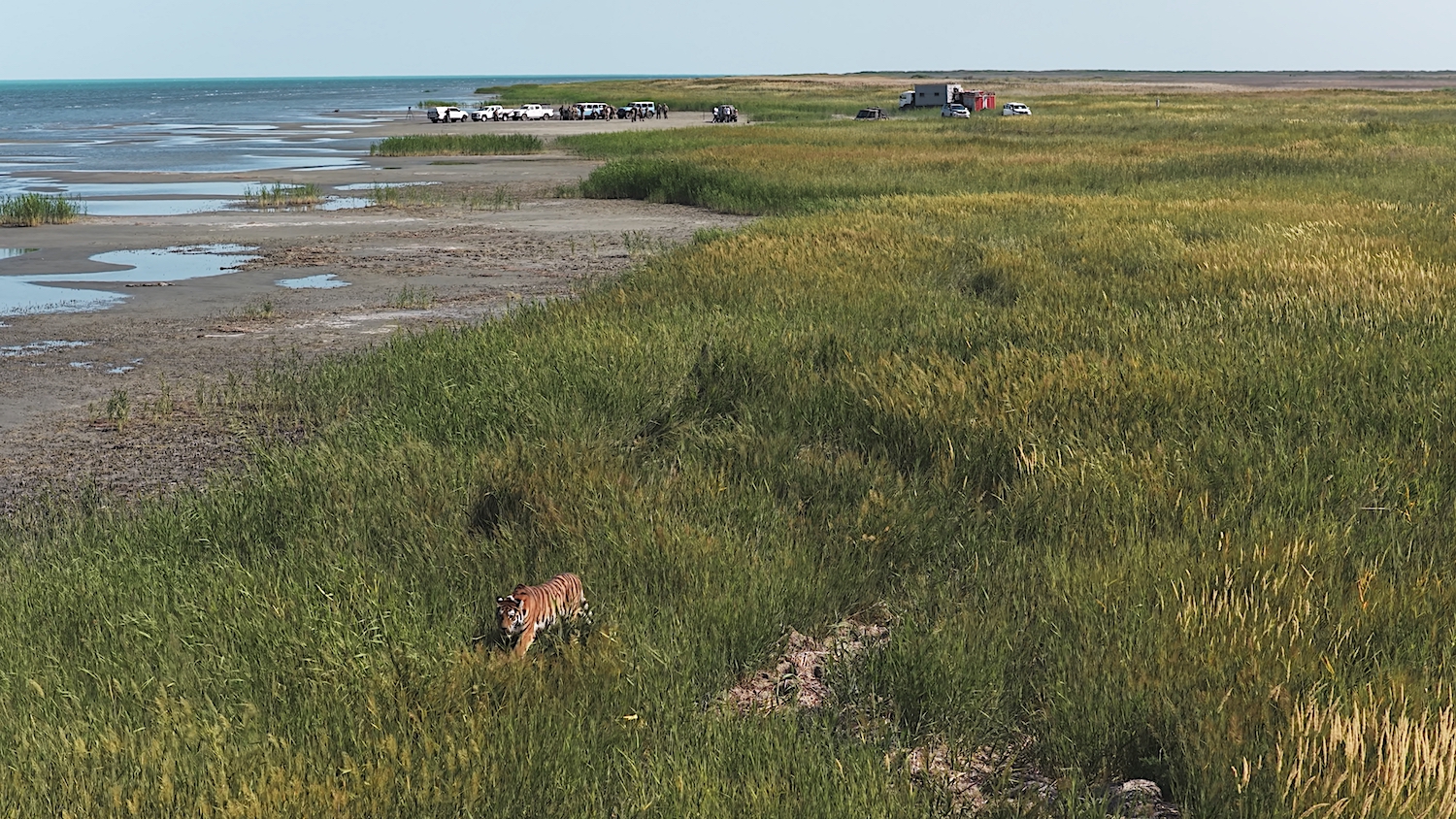
Photo credit: amur-tiger.ru
The government established the Ile-Balkhash State Nature Reserve in 2018, strengthened protection of the territory, and worked to increase populations of wild boar, Bukhara deer and other animals that form the tiger’s natural prey base.
Adaptation enclosures, veterinary facilities and monitoring infrastructure were also constructed inside the reserve. Specialists were trained to track the animals, assess their behavior and respond to possible encounters between tigers and people.
How did tigers vanish?
The lower reaches of the Ili River and the southern Lake Balkhash area were once part of the natural range of the tiger. The predator inhabited the dense tugai forests and river floodplains of Central Asia, including areas along the Ili and Syr Darya rivers. These landscapes provided water, cover and abundant prey.
By the middle of the 20th century, however, the tiger had disappeared from Kazakhstan. The destruction and fragmentation of tugai forests, decline in the numbers of wild ungulates, expanding human activity and uncontrolled hunting left the predator without enough habitat or food to survive. The last reliably documented sightings in Kazakhstan occurred more than seven decades ago.
Four tigers bring hope
Umit, which translates as hope in Kazakh and gives the project a symbolic dimension, is one of the four tigers brought from Russia to Kazakhstan in May. The group includes an adult male named Amur, Umit and two cubs named Turan and Ussuri. The animals were brought from Russia’s Khabarovsk region and placed in specially constructed adaptation enclosures in the Ile-Balkhash reserve.
Before her release, Umit passed veterinary examinations and behavioral assessments aimed at determining whether she could live independently. Specialists evaluated her health, hunting ability, reaction to people and capacity to adapt to unfamiliar surroundings. The results indicated that she was ready to enter the wild.
Immediately before the enclosure was opened, Umit was fitted with a GPS/GSM satellite collar.
Her location and movements are now being monitored around the clock. Specialists are using satellite data, camera traps and field observations to study how she navigates the territory, selects resting sites and searches for prey.
The monitoring system is also designed to provide an early warning if the tiger approaches settlements or other areas of human activity.
Unlike males, which tend to travel considerable distances, females generally remain closer to their established territory. Releasing her first will allow specialists to observe her behavior at a stage when neither people nor the tigers themselves yet know what to expect.
Gradual approach
The adult male Amur remains in an enclosure and continues to undergo behavioral tests. A decision on his release will be made only after specialists conclude that he is prepared to survive independently.
The two cubs, which arrived in Kazakhstan at approximately six to seven months old, will remain under supervision as they grow and develop. The ministry said they are expected to stay in the reserve’s specialized enclosures until they are at least 18 months old. Each cub will then undergo separate veterinary and behavioral assessments before any decision is made about a possible release.
The gradual approach reflects the complexity of reintroducing a major predator.
The choice of the Amur tiger is rooted in science. In 2009, genetic research showed that the extinct Turan tiger and the Amur tiger are virtually identical, paving the way for plans to restore the species in Central Asia. Early signs suggest the animals can adapt.
Kazakhstan has moved beyond commemorating an animal that vanished from its territory and has begun the far more difficult task of creating a landscape in which that animal can live again. The long-term goal is to establish a viable, reproducing tiger population in the Ili River delta and the southern Lake Balkhash region.
Cooperation across borders
The program has been developed through cooperation between Kazakhstan and Russia, with support from scientists and international conservation organizations.
The two countries signed a memorandum on tiger reintroduction at the International Tiger Conservation Forum in Vladivostok in 2022. A joint working group was established to oversee the implementation of the tiger reintroduction program.
In February 2025, the working group held its first meeting in Kazakhstan. Russian experts inspected the Ile-Balkhash State Nature Reserve, and reviewed the infrastructure prepared for the arrival and adaptation of the animals. The second meeting took place in Khabarovsk in September 2025.
During President Kassym-Jomart Tokayev’s state visit to Russia in November 2025, the two countries signed a joint action plan for the transfer and adaptation of Amur tigers in Kazakhstan.
Under the approved plan, Kazakh specialists completed training in Russia in December 2025 and February 2026. The initiative has been described by its organizers as the first international program of its kind aimed at restoring a tiger population in a country where the animal had disappeared.
