
ASTANA — The Eurasian Development Bank (EDB) has directed a cumulative $2 billion toward sustainable development projects and expanded its green investment portfolio to $1.08 billion in 2025, according to the bank’s Sustainability Report presented during its Annual Meeting and Business Forum on June 26 in Almaty.
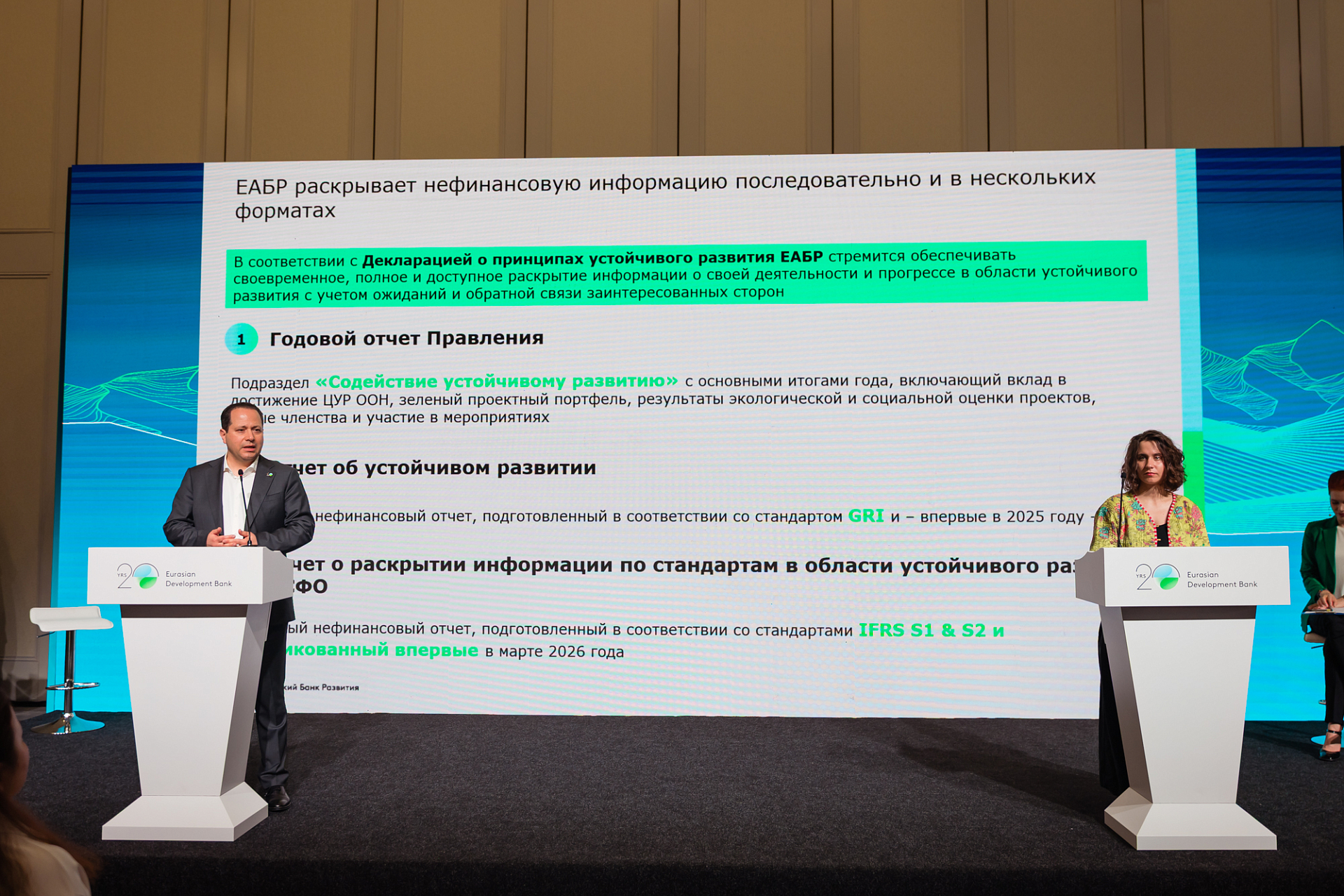
EDB Deputy Chairman and Chief Economist Evgeny Vinokurov (L) speaks at the presentation of the report during the Eurasian Development Bank’s Annual Meeting and Business Forum in Almaty on June 26. Photo credit: EDB
The report highlighted the bank’s growing role in financing green energy, climate resilience and sustainable infrastructure projects across its member states, while also outlining new efforts to assess climate-related risks in its investment portfolio.
Speaking at the report presentation, EDB Deputy Chairman and Chief Economist Evgeny Vinokurov said sustainability reporting has become an important tool for both transparency and institutional development.
“ESG reporting helps us become better. Investors, rating agencies and partners assess us and expect high-quality disclosure. Each year, while preparing the report, we re-evaluate our activities, introduce new methodologies and standards, assess results from different perspectives and ask ourselves difficult but important questions,” said Vinokurov.
He noted that the bank received an A- rating from international ESG rating agency CCXGF, which he said confirms that the institution is moving in the right direction.
In 2025, EDB experts conducted a comprehensive climate risk assessment of the bank’s investment portfolio for the first time, evaluating potential impacts under four climate scenarios throughout the full life cycle of loans.
The assessment identified water scarcity as the most significant climate risk, with potential losses estimated at $36 million. Other major risks included extreme temperatures, with estimated losses of $26 million, and droughts, with estimated losses of $14 million.
Despite these challenges, the bank estimated that total potential climate-related losses would not exceed 1.23% of its current investment portfolio.
To strengthen climate resilience across the region, EDB expanded cooperation with international organizations. In Kazakhstan, the bank partnered with the United Nations Development Program and the Ministry of Water Resources and Irrigation to launch a project to develop a business ecosystem for sustainable irrigation and improve adaptation to climate change.
The bank also collaborated with the CAREC Institute on a study examining the readiness of Central Asian countries and Azerbaijan to introduce carbon pricing mechanisms. EDB’s green investment portfolio continued to grow throughout 2025, reaching $1.08 billion, while cumulative green investments rose to $2 billion. Most of the financing was directed toward renewable energy and energy-efficiency projects.
Among the flagship initiatives is the construction of a 300-megawatt solar power plant in Kyrgyzstan’s Issyk-Kul Region, one of the largest solar energy projects in the Commonwealth of Independent States. Projects contributing to the United Nations Sustainable Development Goals accounted for more than 25% of the bank’s total portfolio by the end of 2025.
“The demand from member states for green economic transformation continues to grow,” said Evgeniya Klochkova, head of EDB’s Sustainable Development Center.
“Over the year, the volume of our active green portfolio exceeded $1 billion, while cumulative green investments reached $2 billion. This means that in just seven years we have more than tripled the volume of green financing. At the same time, despite the growth of the investment portfolio, emissions per dollar invested declined by more than 15% over the year, making the portfolio more climate-efficient,” she said.
Participants at a warm-up session held alongside the forum also discussed the future of adaptation finance, a segment increasingly viewed as critical for addressing the impacts of climate change. According to experts, global adaptation financing needs are estimated at $310 billion to $365 billion annually, while actual investments amount to only about $26 billion per year.
In Central Asia, less than a quarter of climate financing is allocated to adaptation projects, while approximately 75% is directed toward reducing greenhouse gas emissions. Private-sector investments in emissions-reduction projects in the region exceed $3.7 billion. To narrow the financing gap, participants proposed expanding guarantees for private investments in adaptation projects, increasing technical assistance for project preparation and creating a unified regional climate platform that would bring together investment projects and harmonize evaluation standards.
Experts said such a platform could facilitate financing for cross-border climate initiatives and strengthen regional cooperation on climate adaptation.
The EDB is a multilateral development bank that finances projects across Eurasia. As of the end of 2025, its cumulative portfolio included 326 projects with total investments of $19.6 billion. The bank’s portfolio focuses on transport infrastructure, digital systems, green energy, agriculture, industry and manufacturing projects with regional integration benefits.
