
ASTANA — Central Asia’s next logistics challenge is no longer building highways. It is ensuring that roads, railways, ports, warehouses, customs systems and digital platforms operate as a single, seamless network. That was the central message from a panel discussion on transport connectivity held during the Eurasian Development Bank’s (EDB) Annual Meeting on June 25, where government officials, development financiers, transport operators and international organizations discussed that the region’s competitiveness will increasingly depend on coordination rather than concrete alone.
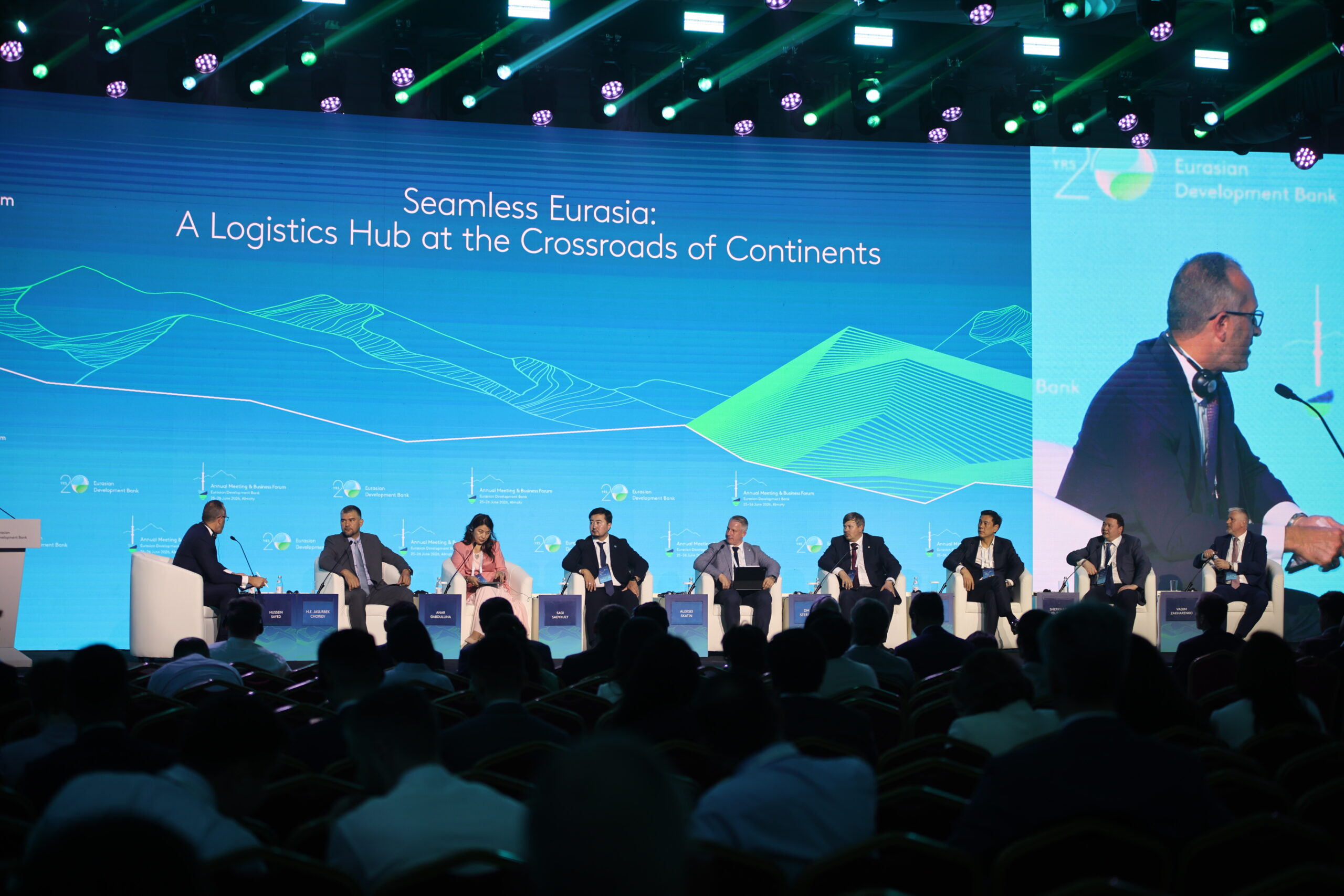
Speakers at a panel discussion on transport connectivity during the Eurasian Development Bank’s (EDB) Annual Meeting, June 25. Photo credit: EDB
The discussion reflected how geopolitical shifts have reshaped global supply chains and elevated the strategic importance of overland trade routes, including the Middle Corridor and the North-South corridor. Alexei Skatin, vice chairman of the Management Board at the Eurasian Development Bank, said Central Asia should no longer be viewed merely as a transit bridge between Asia and Europe.
“Much less often do we remember that 80 million people live here. This is already an independent market with significant domestic demand, interesting not only from the perspective of transit, but also as a destination for goods and for developing trade within the region,” he said.
Skatin noted that every government represented at the forum had spoken about economic expansion rather than stagnation.
“If economies are growing, consumption is growing. In this sense, Central Asia and the EDB member states are becoming a self-sufficient market. Our task is to ensure that the value moving along Central Asia’s highways, the Trans-Caspian route and the North-South corridor does not simply pass through the region, but remains here,” he said.
According to Skatin, geopolitical uncertainty has transformed land corridors from alternative routes into increasingly strategic trade arteries while positioning Central Asia at the crossroads of East-West and North-South commerce. Kazakhstan is responding with both physical and digital infrastructure investments.
Anar Gabdullina, deputy chairman of the Committee for Roads at the Ministry of Transport, said the ministry is developing E-Zholdar (e-roads). This unified digital road management platform will integrate information systems from KazAvtoZhol, the National Center for Quality of Road Assets and KazdorNII. The platform will include digital road passports, maintenance records, public monitoring tools and administrative services, allowing authorities to collect and manage road data through a single system.
Gabdullina also said Kazakhstan is reconstructing 37 border checkpoints, expanding crossing capacity, installing new inspection systems and creating improved service areas for passengers and freight carriers.
“All this will help reduce queues and increase the capacity of border crossings,” she said, adding that the ministry is also eliminating bottlenecks across the country’s road network while continuing large-scale development of international transport corridors.
For Vadim Zakarenko, general delegate to Eurasia at Transport Corridor Europe-Caucasus-Asia (TRACECA), today’s geopolitical realities have reinforced the importance of regional integration.
“The Middle Corridor and the Silk Road corridor provide opportunities for trade, for access to new markets, and for building new trade links between countries,” he said.
After the collapse of the Soviet Union, countries initially focused on building independent economies, Zakarenko noted. Today, however, sustainable growth increasingly depends on cooperation.
“It took time before many of them realized that sustainable development would be impossible without regional integration,” he said.
Zakarenko noted that governments should look beyond national priorities and work together to connect transport corridors, harmonize regulations and strengthen business cooperation. He also stressed that small and medium-sized enterprises should embrace the digital transformation already adopted by global logistics companies.
“Companies like DHL, FedEx and UPS have integrated AI into their logistics chains for years. SMEs are the ones who create value. They are the ones who really drive our economies today,” he said.
He called for closer cooperation between businesses, international financial institutions and development banks, saying digital solutions already exist but need to be scaled across the region. Today TRACECA unites 14 countries, with additional states expressing interest in joining.
“The reason is simple. We are able to take the concerns of businesses and bring them directly to the political level,” Zakarenko said.
Warehouse capacity emerged as another major theme. Prompting the discussion, moderator Hussein Syed noted that warehousing remains one of the weakest links in regional logistics and asked what infrastructure is most urgently needed.
Nurmat Syrkulov, CEO of Mercury Property Solutions, argued that the region’s challenge is not a shortage of warehouse space but a lack of modern logistics facilities.
“We have warehouse capacity. What we do not have are enough modern, high-tech logistics hubs,” he said.
He identified three forces reshaping logistics: geopolitical tensions, the adoption of AI and advanced technologies, and structural changes across regional economies. According to Syrkulov, supply chains passing through Central Asia are increasingly viewed as reliable alternatives amid global uncertainty, while digital technologies can make logistics faster, cheaper and more efficient. However, he warned that much of the region’s warehouse stock dates back to the Soviet era and no longer meets modern requirements. Without significant investment, Central Asia could face a shortage of high-quality logistics facilities within the next five to seven years.
Road infrastructure remains equally critical. Dmitry Sterligov, deputy CEO of Russia’s Avtoban Road Construction Company, said the effectiveness of transport corridors should be measured not by kilometers of asphalt but by speed, predictability and coordination.
“An efficient transport corridor is, first of all, about speed and the time required to travel long distances. Secondly, it is about predictability,” he said.
Sterligov said that countries must synchronize infrastructure development, modernize border crossings, invest in digital connectivity and prepare transport corridors for autonomous freight vehicles already being tested in Russia. Equally important, he added, is ensuring roads are properly maintained throughout their entire lifecycle.
Attention also turned to the Caspian Sea, a critical component of both the Middle Corridor and the North-South route. Sherkan Sugubekov, CEO of Caspian Integrated Maritime Solutions, said the industry’s objective is to transform the Caspian from a logistics bottleneck into a reliable transport bridge.
“We are making every effort to ensure that the Caspian Sea no longer remains a bottleneck,” he said.
He noted that port infrastructure and shipping capacity continue to develop. Still, he emphasized that reliability, operational efficiency and unified digital systems will determine whether the maritime corridor can fully support growing freight volumes.
“We are confident that the efforts being made today will allow the Caspian Sea to become not a bottleneck, but a reliable transport bridge,” he added.
Despite approaching the issue from different sectors, participants ultimately reached the same conclusion: the next phase of Eurasian connectivity will not be determined simply by how many roads, ports or railways are built. It will depend on whether countries can synchronize infrastructure, harmonize regulations, digitize logistics, modernize warehousing and remove operational bottlenecks across borders. In short, the challenge is no longer to build corridors. It is to make them seamless.
