
ASTANA – Thailand sees Kazakhstan as a strategic partner at a time when the rules-based international order is under growing pressure and multilateral cooperation is weakening, Thailand’s Deputy Prime Minister and Foreign Minister Sihasak Phuangketkeow said in an interview with The Astana Times.
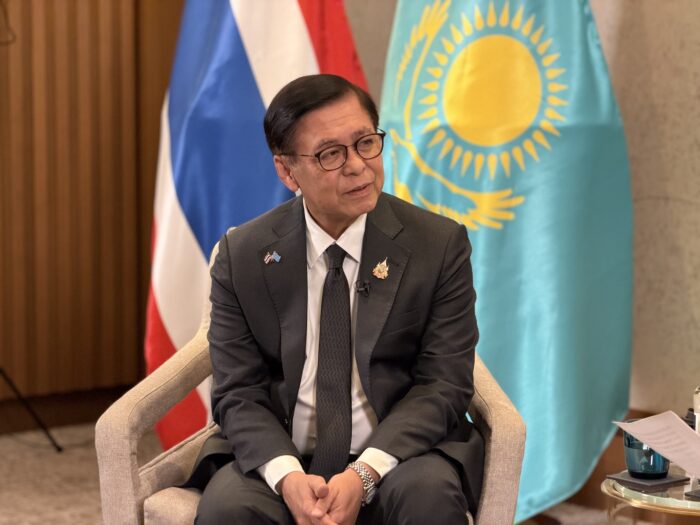
Sihasak Phuangketkeow, Thailand’s Deputy Prime Minister and Foreign Minister. Photo credit: The Astana Times/ Nargiz Raimbekova
Phuangketkeow is paying the first official visit to Kazakhstan on June 24-27, bringing a business delegation with 11 leading Thai companies.
“We see Kazakhstan as a strategic partner,” he said. “I think we see eye to eye that we need to work hard to maintain peace and stability in our respective region and in the world at large at a time when the rules-based international order is being challenged, and at a time when we see a weakening of multilateralism.”
He said Thailand and Kazakhstan are well positioned to serve as bridges between Southeast Asia and Central Asia, with both countries playing leading regional roles and sharing an interest in advancing peace, stability and deeper interregional cooperation.
Phuangketkeow hopes the visit will “generate momentum,” ahead of the 35th anniversary of diplomatic relations next year, using the milestone to deepen political, economic and cultural ties.
Growing business interest
Kazakhstan remains Thailand’s largest trading partner in Central Asia, accounting for more than 70% of Thailand’s total trade with the region. Bilateral trade reached $255.1 million in 2025, with $216.5 million of those being Kazakh imports. Fifty-five Thai companies are registered in Kazakhstan, according to data from the Kazakh government.
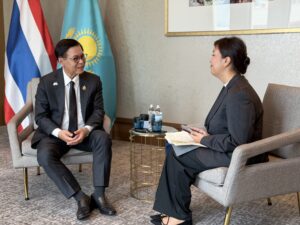
Phuangketkeow is paying the first official visit to Kazakhstan on June 24-27, bringing a business delegation with 11 leading Thai companies. Photo credit: The Astana Times/ Nargiz Raimbekova
Phuangketkeow emphasized that Thailand sees Kazakhstan not only as a market of 20 million people but as a gateway to Central Asia’s combined market of roughly 80 million.
He said Thai companies are exploring opportunities to expand food exports while also investing in Kazakhstan as a manufacturing and food-processing hub serving neighboring Central Asian countries and markets beyond.
Reflecting growing business interest, a delegation of Thai private-sector representatives accompanied his visit and is scheduled to take part in a business forum in Almaty on June 26 aimed at connecting companies from both countries and generating new investment and trade opportunities. The latest business forum was held in Bangkok in May, where The Astana Times was present.
Another priority for Thailand is reaching a Free Trade Agreement with the Eurasian Economic Union (EAEU), a market of more than 185 million people with a combined GDP exceeding $2.4 trillion.
“Kazakhstan is playing a pivotal role there,” he added.
Better connectivity
Connectivity emerged as a recurring theme during the talks with Kazakh officials, said Phuangketkeow. Kazakhstan’s role as a Eurasian transport hub and Thailand’s expanding rail links to China offer opportunities to build more efficient trade corridors between Central and Southeast Asia.
“Logistics is important if we are going to have more trade and investment,” he said. “We have what we call the North-South Economic Corridor, which is enhancing the railway links between Thailand and China, going from Bangkok to Laos and up to Kunming.”
Expanding direct flights, improving logistics and streamlining trade processes, he noted, are some of the practical steps needed to translate political commitment into higher levels of trade and investment.
Promoting dialogue and stability
Phuangketkeow said that the rules-based international order should evolve to reflect shifting global realities.
“We have to think, first of all, how do we maintain the rules-based international order? But not the rules-based international order that, as we have known since World War II. We need a new kind of rules-based international order that reflects the changes that we have seen in the world, the shift in the power balance, the rise of new powers, the rise of the Global South,” he explained.
According to him, Kazakhstan and Thailand share a pragmatic vision of multilateralism.
“When we think of multilateralism, especially from the perspective of middle powers, we have to think in practical terms. Maybe the UN is not the only institution where we can cooperate. Maybe we have to think of new forms of multilateralism when we look at the particular issue facing us,” he said.
Asia’s role in global economy
For Phuangketkeow, Asia’s rise is one of the defining geopolitical shifts of the century.
“We have seen what they call the power shift from the West to the East. Some would say from the West to the rest. But I think Asia is rising,” he said. “Of course, Asia can mean different things to different people.”
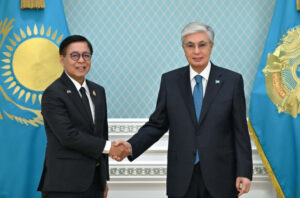
Phuangketkeow met with President Kassym-Jomart Tokayev and Foreign Minister Yermek Kosherbayev. Photo credit: Akorda
He said Thailand envisions an open and inclusive region that is not confined by geography but includes partners with meaningful economic and strategic links. In that vision, Kazakhstan has an important place.
“We want to see Kazakhstan as having more engagement with ASEAN,” he said.
While in Astana, Phuangketkeow met with President Kassym-Jomart Tokayev and Foreign Minister Yermek Kosherbayev.
“Your country is one of Southeast Asia’s leading economies, an important representative of the Global South and a respected member of the international community. Kazakhstan is interested in deepening our bilateral cooperation,” Tokayev said, inviting Thai Prime Minister Anutin Charnvirakul to pay an official visit to Kazakhstan.
