
ASTANA – Long before modern courts emerged, disputes on the Kazakh steppe were resolved by biys, a respected judges whose authority stemmed not from official appointment but from public trust, deep knowledge of customary law and a reputation for fairness.
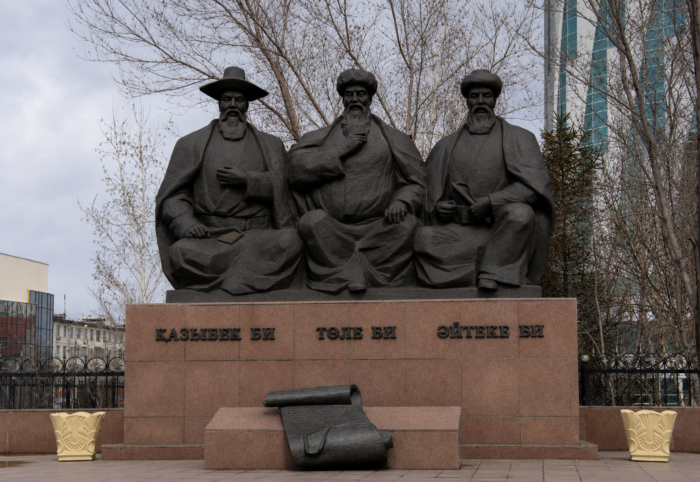
A monument in Astana to the three Kazakh prominent biys who established the foundation of Kazakh code of laws. From left to right: Kazybek bi, Tole bi, Aitekek bi. Photo credit: adebiportal.kz
Zharilkasyn Zhappasov, a candidate of historical sciences and professor at the International Engineering and Technological University, explained how the institution of the biy functioned in traditional Kazakh society.
According to Zhappasov, becoming a biy, which refers to a noble judge in Kazakh, was never a hereditary privilege or a government appointment. Instead, individuals earned the title through their mastery of customary law, eloquence, life experience and ability to deliver fair judgments.
“The title of biy was not granted through elections or official appointments. As the renowned Kazakh scholar Shokan Ualikhanov wrote, a person became a biy by mastering customary law and demonstrating exceptional oratory skills. A biy had to know the law thoroughly and apply it fairly in every individual case,” Zhappasov said.
The role demanded exceptional oratory. Because disputes were settled orally, a biy was expected to present persuasive arguments, mediate conflicts and guide both sides toward reconciliation.
“The well-known Kazakh expression describing a ‘fair biy who can split a single hair in two’ reflects these expectations. A biy’s status depended not on wealth or noble birth, but on knowledge, fairness and the trust of the people,” Zhappasov said.
Learning through experience
Zhappasov noted that contrary to popular belief, the position was not reserved for members of elite families. While children raised in the households of prominent biys often acquired legal knowledge and public speaking skills from an early age, this did not guarantee they would become biys themselves.
“Even someone from an ordinary family could become a biy. It was not necessary to belong to the Tore dynasty, the descendants of Genghis Khan, or any other noble lineage. If a person demonstrated legal expertise, fairness and eloquence, society recognized that individual as a biy,” he said.
Traditional Kazakh society had no formal schools for training biys. Future judges acquired their knowledge by studying customary law, observing experienced biys and learning through practice.
Zhappasov highlighted that biys’ legal foundation rested on traditional legal codes, including Qasym Khan’s “Bright Path,” Esim Khan’s “Old Path,” and “Zheti Zhargy” (Seven Charters).
“Biys were expected to resolve complex disputes involving land ownership, inheritance, blood compensation and family matters. Knowing the law alone was not enough. A biy earned the people’s trust only by applying it fairly in every individual case,” he said.
Public trust as the highest authority
Traditional Kazakh society had no formal appellate courts. However, parties dissatisfied with a ruling could ask another respected biy to hear the case, while particularly complex disputes were sometimes decided collectively by several biys.
“Considering difficult cases with the participation of several biys strengthened confidence in the fairness of the decision. A biy’s greatest guarantee was not administrative authority but public trust. If a biy acted unfairly or showed bias, people simply stopped bringing cases before him. In this way, public oversight served as the primary mechanism for evaluating a biy’s work,” Zhappasov said.
As a result, reputation became the institution’s strongest safeguard of justice.
Historical records primarily celebrate biys remembered for their wisdom, honesty and integrity, although Zhappasov noted that unfair judges did exist.
“Because a biy’s authority depended entirely on public trust, society demanded fairness above all else. Historical sources therefore focus mainly on biys renowned for their wisdom, eloquence and honesty. This does not mean there were no unjust biys, but their reputations were short-lived,” he said.
He added that a biy retained authority only as long as the public continued to trust him, making legal knowledge, impartiality and personal integrity essential qualities.
Were there women biys?
Most historical evidence suggests that judicial responsibilities within the biy institution were carried out primarily by men. However, women also played influential roles in traditional Kazakh society.
“There is no conclusive historical evidence that women regularly served as biys in the formal sense. Nevertheless, many women known for their wisdom, diplomacy and eloquence influenced public opinion, mediated disputes and contributed to conflict resolution,” Zhappasov said.
Although these women held considerable social influence, there is insufficient evidence to conclude that they formally served as biys in the traditional legal sense.
The article was originally published in Kazinform.
