
ASTANA – Kazakhstan is taking decisive steps to strengthen its socio-economic and international potential in the face of a rapidly changing global economy, President Kassym-Jomart Tokayev said at a Feb. 10 expanded government meeting.
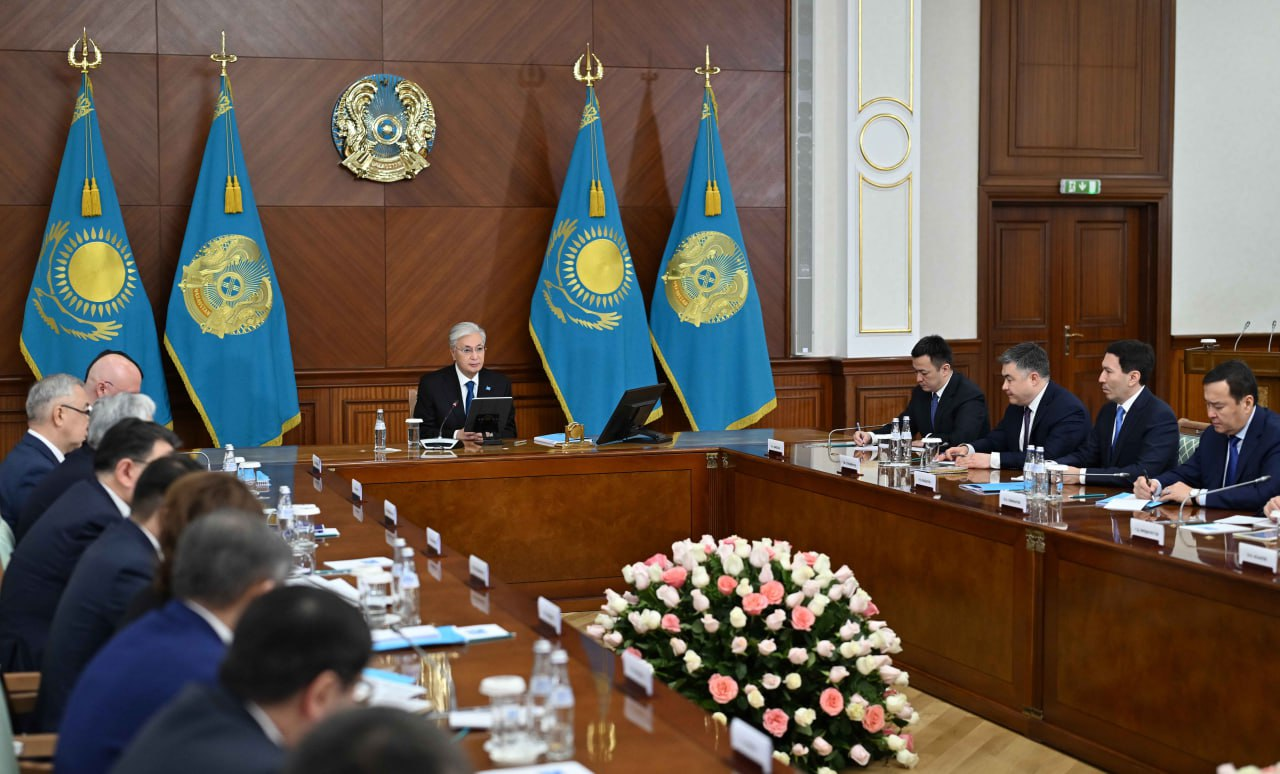
Addressing inflation, Tokayev instructed the government and the National Bank to develop a clear plan to reduce it within three years. Photo credit: Akorda.
“Global economic growth is expected to slow, international trade is declining, and foreign investment in developing countries is shrinking. Protectionism, tariffs, and deglobalization are intensifying, reshaping the global geopolitical map,” he said.
Adapting to a changing global economy
Tokayev stressed that past economic approaches are becoming ineffective. He also emphasized that despite external pressures, Kazakhstan’s GDP grew by 6.5% last year.
“Developed countries are creating new models for global economic development. We cannot fall behind,” he said, outlining the government’s central mission.
“The percentages of GDP growth must be reflected in the real incomes of our citizens. This is the primary task of the government. Economic growth should go hand in hand with improving the quality of life,” he added.
Productivity, inflation, and digitalization
Tokayev also emphasized productivity, technological modernization, and human capital development. Digitalization and artificial intelligence, he said, must move beyond auxiliary roles.
“AI should not be seen as a slogan but as a fundamental pillar of the economic model and the unshakable core of national ideology. Its implementation will create modern industrial, energy, and transport infrastructure and integrate Kazakhstan into global digital economy chains,” he said.
Addressing inflation, Tokayev instructed the government and the National Bank to develop a clear plan to reduce it within three years. He added that the new Tax Code, implemented this year, has already brought over 180,000 self-employed citizens into the legal system, with projected additional budget revenues of 4.4 trillion tenge (US$8.92 billion).
“The planned indicators must not be achieved through undue tax pressure or unjustified burdens on business. The State Revenue Committee must become a fully digitalized ‘factory’ for fiscal data. This is the only correct path,” Tokayev said.
Budget efficiency and governance reform
Tokayev also called for strict financial discipline and budget consolidation, as the government and regional administrations must stop financing projects based on subjective choices or out of fear of unused budgets.
“We need a comprehensive review of all budget programs to eliminate inefficiencies. Ministries must move from a focus on budget execution to managing the efficiency of public investments,” he said.
He stressed the role of digital technologies in optimizing expenditures, reducing administrative barriers, and preventing ineffective management decisions.
“The foundation of digital transformation should be a platform-based approach via QazTech. Full AI integration must be central to all digitalization policies,” Tokayev said.
Entrepreneurship and strategic infrastructure
President Tokayev emphasized the role of digital technologies and AI in fostering business growth. According to him, 40% of GDP and 70% of all capital investments come from small and medium-sized businesses, reflecting years of systemic support.
“Despite significant efforts to stimulate mass entrepreneurship and create a favorable environment, it is clear that current approaches are insufficient for today’s requirements,” he said.
Tokayev also highlighted the strategic importance of transport and logistics in Kazakhstan’s new economic model.
“Inefficient use of Kazakhstan’s unique position on the Eurasian continent would be a strategic mistake our people would not forgive. This task is therefore of exceptional importance,” he said.
According to Tokayev, transport infrastructure, previously focused primarily on connectivity, now plays a central economic role. Railways carry 60% of the country’s freight, making the expansion and modernization of the network a top priority. Tokayev called for launching new railway lines, completing upgrades of the Altynkol – Zhetygen and Beineu – Mangistau lines, and commissioning the Bakhty – Ayagoz line within the set deadlines.
