
ALMATY – A sweeping package of constitutional amendments affecting 77 articles, which amounts to 84% of Kazakhstan’s Constitution, was presented to members of the Constitutional Reform commission on Jan. 28, marking an extensive legal transformation.
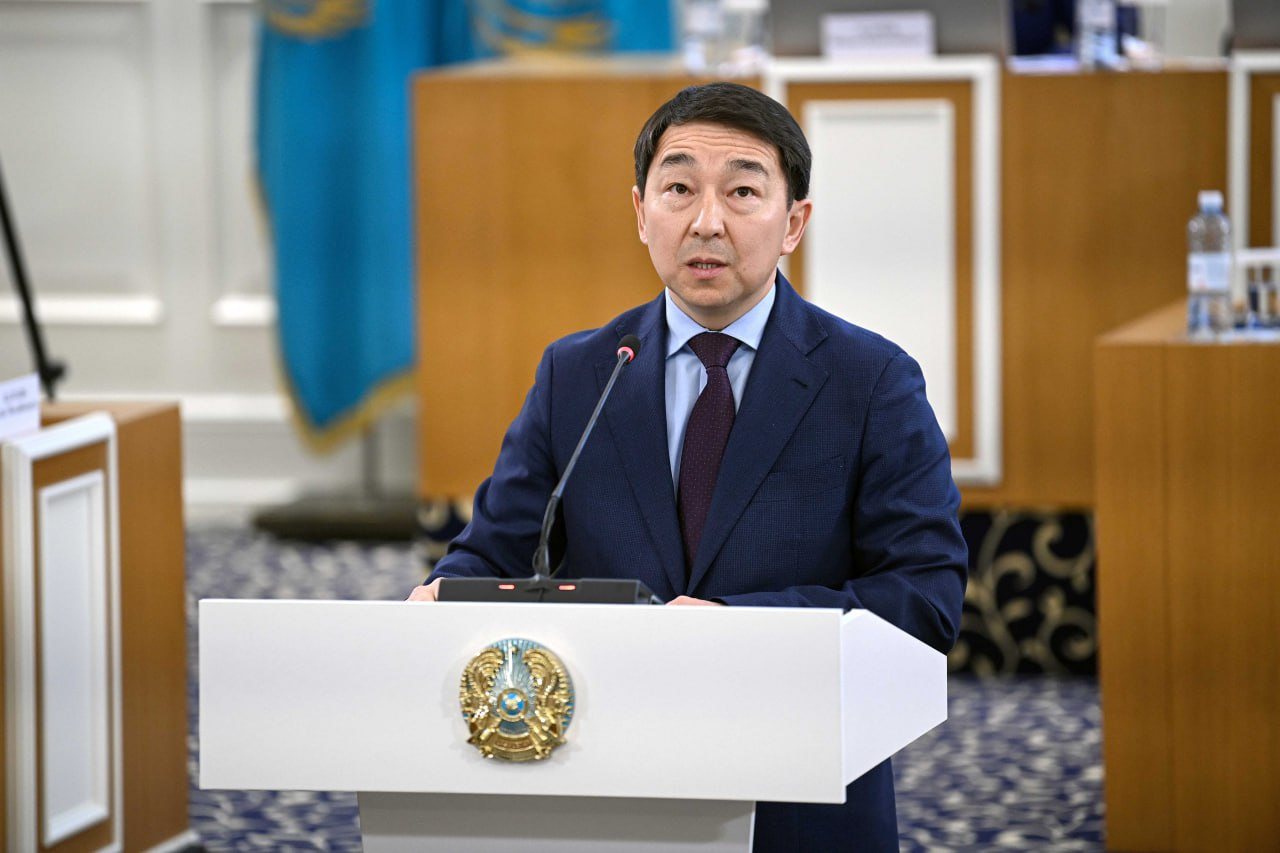
According to Nurmukhanov, the proposed new version of the Constitution will include a preamble, 11 sections and 104 articles. Photo credit: the Constitutional Court’s press service.
The draft was introduced by Deputy Chairman of the Constitutional Court Bakyt Nurmukhanov, who said the document was developed after considering proposals from citizens, political parties, public organizations and legal experts.
According to Nurmukhanov, the proposed new version of the Constitution will include a preamble, 11 sections and 104 articles. Two entirely new sections, such as The People’s Council and Introduction of Amendments and Additions to the Constitution, have been added, while four existing sections have been renamed.
“The proposed changes are an important and deeply thought-out step that revises conceptual approaches, strengthens legal precision and improves the quality of the Basic Law,” Nurmukhanov said.
New preamble and state principles
The preamble of the Constitution is set to be completely rewritten. Nurmukhanov said the new version will reflect modern challenges and updated national values, while outlining the historical context and cultural foundations shaping the country’s development path.
“The draft defines the status of the state. Kazakhstan is recognized as a democratic, secular, legal, and social state, whose highest values are the human being, his life, rights, and freedoms,” Nurmukhanov said.
Expanded human rights protections
A major focus of the reform is the strengthening of human rights guarantees. The renamed section, Fundamental Rights, Freedoms and Duties, will further reinforce protections based on the principle that the individual is the highest value of the state.
“These include the absolutization of the right to life, a human-centered approach, the constitutional protection of personal inviolability and ‘Miranda rules,’ the protection of personal data in the digital era, stronger safeguards for honor and dignity, social rights, and the principle of legal certainty,” Nurmukhanov said.
Several provisions now listed as principles of justice will be moved into this section as direct guarantees of human rights. The draft also gives renewed emphasis to freedom of speech and creativity, including specific protections for intellectual property.
The Constitution will also strengthen the values of marriage and family, as well as establish a clearer duty to protect the environment.
Judicial reform and legal institutions
Changes are also proposed in the renamed section Justice. Prosecutor’s Office. Protection Mechanisms. These amendments focus on expanding the range of judicial proceedings and strengthening constitutional principles of justice and judicial independence. A separate article will formally define the constitutional status of the legal profession.
In addition, the legal status of the Constitutional Court will be directly enshrined in the Constitution.
“It involves establishing its status as an independent state body that exercises constitutional control and ensures the supremacy of the Constitution throughout the country,” Nurmukhanov said.
Introduction of the people’s council
One of the most notable institutional innovations is the creation of a People’s Council of Kazakhstan, to be established as a supreme consultative body composed of the country’s citizens.
The new body will represent the interests of the people and will be granted the right of legislative initiative. Its creation has also required targeted amendments to the section on local state administration and self-government.
A new section, Introduction of Amendments and Additions to the Constitution, will outline procedures for updating the Basic Law in line with advanced international practice.
Special legal regimes for economic development
The draft also introduces a provision allowing for the establishment of special legal regimes in the financial sphere. Nurmukhanov noted this applies, in particular, to the Astana International Financial Centre and the development of Alatau city, and is aimed at promoting effective economic growth.
At the same time, he stressed that this norm must be viewed in strict connection with the Constitution’s fundamental provisions.
“The constitutional norm on the unitary nature of the state, as well as the integrity, inviolability and inalienability of Kazakhstan’s territory, remains unchanged,” Nurmukhanov said.
