
Every day, on my commute from the place I am still learning to call home to the university, I find flowers. Not the kind of flowers people expect to receive on a special occasion, carefully wrapped in florist’s paper and given with a particular purpose. These are different. They are little mosaic roses, scattered throughout Ravenna, waiting along familiar paths and hidden in the tiniest streets. I keep finding them in places I might have otherwise walked past, and somehow, these small encounters have become something I look forward to on my way to university.
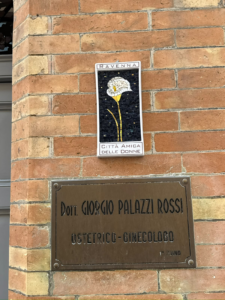
Mosaic roses scattered across Ravenna, as if waiting to be found. Photo credit: The Astana Times.
When you move somewhere new, you start to notice things you might never have paid attention to before. Small things become significant. A familiar route, the same morning light, something beautiful that you happen to come across on your way somewhere.
I think it is the feeling they leave me with that makes me remember them. My usual commute has become a small reminder, almost every day, that I am not alone. There is something comforting about finding them along the way, especially on mornings when everything feels unfamiliar, when being far from home feels heavier than usual, or when I am reminded of just how much it takes to build a life somewhere new. Moving to another country is not only about the excitement of discovering a new place or the growth that comes with it. It is also about allowing yourself to feel the difficult parts: the uncertainty, the loneliness, the days when you question your decisions, and the moments when you don’t yet feel like you belong. These little roses remind me that all of it is part of the journey, that what I am doing matters, and that I am allowed to feel everything along the way – the highs and the lows – without having to make either one smaller.
I came to Ravenna to pursue a master’s degree in Protection of Human Rights and International Development. It is a city known as la città amica delle donne – a city friendly to women. And as Nov. 25, the International Day for the Elimination of Violence Against Women, approaches, I have begun to think more about what that phrase really means. What makes a city a friend to women? What does it mean to feel safe somewhere? To move freely, to walk without fear, to exist without constantly calculating the risks of simply being a woman?
Only after I started noticing the roses did I realize they weren’t there by chance. They were part of something larger, a message woven into the city itself. Suddenly, the flowers I had been finding on my way to university meant more.
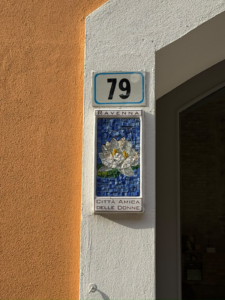
Some hide in the smallest corners; others appear right along the busiest streets. Photo credit: The Astana Times.
The mosaic roses are part of I Fiori di Ravenna – Città Amica delle Donne, or The Flowers of Ravenna – A City Friendly to Women. The anti-violence association Linea Rosa developed the initiative with Ravenna’s mosaic artists and cultural community. It uses the city’s centuries-old mosaic tradition to create a visible message of solidarity with women and awareness of gender-based violence. The roses are placed across the city, on buildings and along streets, turning its artistic heritage into something more than a reminder of its past.
The project began in 2011, bringing together artists, associations, cultural institutions and the city itself. The roses are not simply decoration. They are a promise that women should feel welcome, that violence should not be ignored, and that a community has a responsibility to notice. That’s why I find them so touching. They don’t ask you to know the story behind them before you see them. They are just there, on your way somewhere. And then, one day, you discover what they mean.
As the International Day for the Elimination of Violence Against Women approaches, I started to think about the place I come from. There, domestic violence remains a deeply serious issue. In 2024 alone, the Kazakh Ministry of Internal Affairs received around 100,000 reports of domestic violence. According to United Nations Women, approximately 72,000 protective orders were issued, and 16,000 court decisions were made. Legislative changes introduced in April 2024 reinstated criminal penalties for battery and minor bodily harm in domestic violence cases, marking an important shift in the country’s legal response. These changes matter. But laws, as necessary as they are, cannot alone change what happens behind closed doors, what a girl is taught to tolerate, what a woman is afraid to report, or what society still sometimes chooses not to see.
Coming from Kazakhstan and now living in Italy, I often find myself thinking about how differently we speak about women, and how similar many of our silences are. We speak about safety as if it were a privilege, about freedom as if it was something that can be negotiated, and about violence as if its absence was the responsibility of women themselves – to be careful, to avoid certain places, to dress differently, to make better choices.
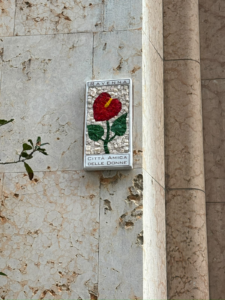
Across Ravenna, small mosaics carry a message much larger than themselves. Photo credit: The Astana Times.
But safety should not be something a woman has to earn through caution. It should not depend on how well she knows a city, how carefully she walks home, whether someone is waiting for her, or whether she can afford to leave. It should be something she is entitled to simply because she exists.
I am still learning Ravenna. I am learning its streets, its language, its habits. I am learning how to feel at home somewhere that was once only a point on a map. And perhaps that is why the roses matter to me more than I can explain. They remind me that belonging is not only about being familiar with a place. It is also about knowing that the place, in some way, is making room for you.
On my way to university, I pass these roses without always stopping. I have places to be, books to read, deadlines to meet, and a life that is still very much in progress. But I know they are there. And I like to think that somewhere, a woman passing one of these mosaics for the first time might need to see it. That she might be walking through a city she doesn’t know, carrying something she has never told anyone, and find a small flower on a wall that says she is welcome. That someone thought of her. That help exists. That she is not alone.
Maybe a city cannot promise that no woman will ever experience violence within its streets or homes, but it can decide not to look away. It can make the message visible, put it on its walls, in its institutions, in its schools, in its conversations. It can create places where women are listened to, believed and protected. And perhaps it can begin with something as small as a flower.
