
ASTANA – Central Asian countries need stronger regional coordination, better social protection mechanisms and more diversified labor migration destinations as changing migration policies and labor market demands reshape mobility patterns across the region, experts said during an online seminar organized by the Organization for Security and Co-operation in Europe (OSCE) on Nov. 6.

Photo credit: AI generated image/ The Astana Times
The seminar brought together researchers to discuss how countries in the region can adapt their migration policies, strengthen cooperation and expand opportunities for their citizens abroad.
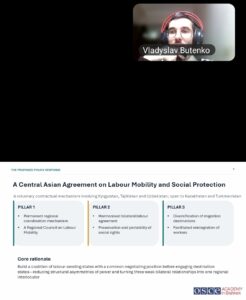
Vladyslav Butenko, an associate research fellow at the OSCE Academy in Bishkek proposed several measures to strengthen regional cooperation and improve protections for migrant workers. Photo credit: The Astana Times
Vladyslav Butenko, an associate research fellow at the OSCE Academy in Bishkek, examined how the Kyrgyz Republic, Tajikistan and Uzbekistan are responding to changes in labor migration patterns, particularly as Russia’s role as the region’s main destination for migrant workers evolves.
Labor migration remains a major component of Central Asia’s political economy, with remittances contributing significantly to household incomes and poverty reduction. However, continued dependence on the Russian labor market exposes countries of origin to changes in migration regulations, economic conditions and political priorities in destination countries.
Butenko argued that the countries sending workers abroad have yet to develop sufficiently coordinated mechanisms to protect their citizens and respond to these changes. Although national governments have introduced various migration policy measures, their efforts remain fragmented, with no common Central Asian framework for managing labor mobility.
He also highlighted differences in the protection available to migrant workers under the Eurasian Economic Union (EAEU). Kyrgyz citizens benefit from freedom of movement within the bloc, while workers from Tajikistan and Uzbekistan remain subject to Russia’s patent-based work permit system.
However, even EAEU membership does not fully guarantee social protection, particularly regarding the transfer of pension entitlements and access to social services across borders.
To address these challenges, Butenko proposed establishing a regional agreement on labor mobility and social protection, supported by a permanent intergovernmental council with a rotating secretariat.
“The council would receive technical support from the International Organization for Migration and the World Bank. Its responsibilities would include monitoring changes in migration laws in both countries of origin and destination, providing early warnings about potential restrictions and coordinating negotiations on labor agreements,” he said.
He also recommended harmonizing bilateral labor agreements to ensure better protection of social rights, including the transfer of pension savings and access to health-related information and medical records.
“The third component is diversifying labor migration destinations, a process already underway in Central Asia. Tajikistan, for example, has begun redirecting some migrant flows toward Gulf countries. South Korea and Kazakhstan could also become important destinations. However, this would require stronger domestic enterprises, more employment opportunities and more effective use of local labor and natural resources,” Butenko said.
Other priorities include establishing a regional network of vocational training centers, diversifying labor migration destinations and introducing annual monitoring of migration flows, employment status and remittances.
Bilateral agreements could open doors to Europe
The discussion also highlighted opportunities for stronger cooperation between Central Asian countries and European destinations. Matthew Heneghan, an ESRC doctoral candidate at the University of Glasgow, noted that the European Union does not have a single bloc-wide labor migration policy. Instead, countries negotiate arrangements bilaterally, with individual Central Asian countries concluding agreements with destinations such as Germany, Finland, Sweden and Latvia.

Matthew Heneghan, an ESRC doctoral candidate at the University of Glasgow examined how bilateral labor agreements are becoming more than instruments for regulating the movement of workers. Photo credit: The Astana Times
“Central Asia is doing a pretty good job of meeting the minimum domestic requirements for preparing to send their migrants abroad for specific semi-skilled jobs,” Heneghan said.
However, meeting skills requirements does not automatically create opportunities to migrate. Workers also need formal employment pathways and available positions.
“You can meet all of the skills requirements, but if there is not a position for you, if there are no state-mandated means for you to actually migrate, then you cannot,” he said.
Heneghan described bilateral labor agreements as state-level commitments that reduce uncertainty, establish institutional links and create opportunities for cooperation in areas such as trade, industrial policy and workforce preparation.
He also emphasized the need to examine these agreements beyond their immediate impact on migration flows, taking into account their broader social, economic and diplomatic effects.
