
ASTANA – Central Asia is entering a new phase of transport infrastructure development as growing trade, shifting global supply chains and the search for alternative routes reshape the region’s role in Eurasian connectivity. What is emerging is no longer simply a collection of individual roads, railways and border crossings, but an increasingly interconnected network linking China with Central Asia, the Caspian Sea, the Caucasus, Europe and South Asia.

Photo credit: Shutterstock
According to the Eurasian Development Bank (EDB), Central Asia currently has 114 infrastructure projects either underway or under consideration, with a combined value of around $72 billion. More than half of the planned investment, approximately $46 billion, is directed toward roads, while railways account for around 30%. The scale of investment reflects a broader shift in the region: transport infrastructure is increasingly being treated not only as a means of moving goods, but as a foundation for trade diversification and deeper regional integration.

Aidos Omarov, senior analyst at the EDB’s Center for Integration Studies. Photo credit: EDB
“The Central Asia region is now at a very intensive stage of not only economic development, but also infrastructure development, in connection with which the demand for high-quality transport infrastructure and, accordingly, high-quality transport services is strongly increasing,” Aidos Omarov, senior analyst at the EDB’s Center for Integration Studies, said during an EDB webinar on Sept. 11.
Central Asia’s geography makes this transformation particularly significant. All five countries are landlocked, while the region sits between some of the world’s largest economic centers, including China, Europe and the Middle East. This means improving connectivity within Central Asia can strengthen national transport systems while creating alternative international routes.
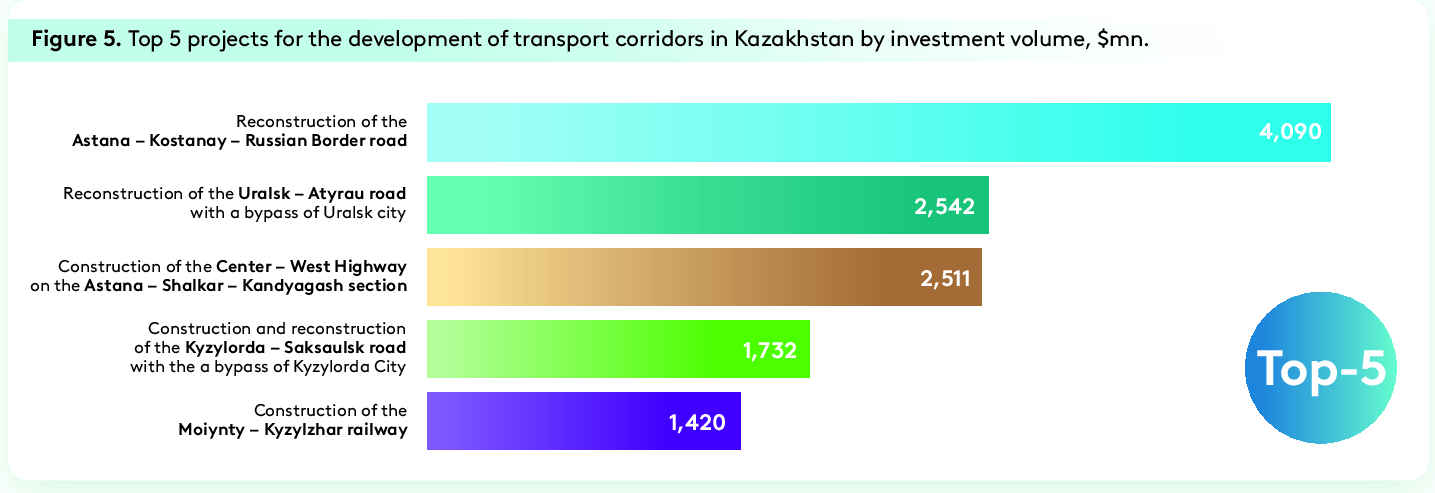
Kazakhstan occupies a particularly important position in this network. The EDB’s data identifies around 55 transport infrastructure projects in Kazakhstan with a combined value of $32.6 billion, nearly half of the region’s total investment portfolio. Around 85% of overland transit between China and Europe passes through Kazakhstan, making the country’s infrastructure critical to the wider Eurasian transport system.
The development is taking place across several corridors rather than along a single route. Investments are planned for the Middle Corridor, the Central Eurasian Corridor and the North-South route, while projects across Uzbekistan, Kyrgyzstan, Turkmenistan and Tajikistan are expanding connections between Central Asia and neighboring regions. This diversification is increasingly intertwined with China’s role in the region.
“China is now becoming the key, largest foreign investor. Chinese participation is represented in the development of transport infrastructure in all, without exception, countries of Central Asia. In our Observatory, we have presented slightly more than 20 projects involving Chinese companies and Chinese capital. Moreover, participation covers practically all types of transport. These are roads, railways, airports, seaports, and, moreover, China participates using all forms – loans, grants, technical assistance, construction, public-private partnerships and direct investment,” Omarov said.
The scale of Chinese involvement is notable. According to the EDB, the portfolio of transport projects involving Chinese companies in Central Asia is worth around $7 billion, more than the combined investment volume of all international development banks tracked by the Bank’s research.
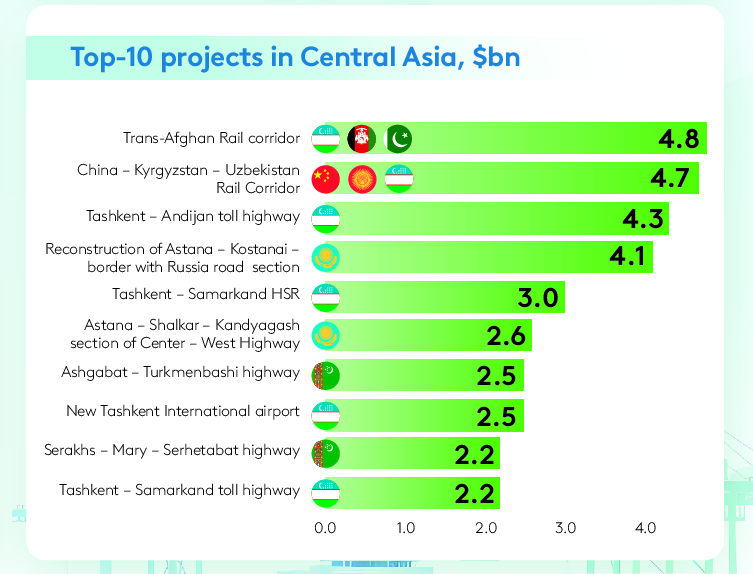
China’s role is also becoming visible in projects that could alter the region’s internal transport geography. The most prominent example is the China-Kyrgyzstan-Uzbekistan railway, which Omarov described as the largest transport project in Central Asia involving China. The 523-kilometer railway will include 27 tunnels with a combined length of 103 kilometers and 48 bridges extending approximately 16 kilometers. Its total cost is estimated at $4.7 billion, with half financed through a Chinese loan and the other half provided by a joint venture in which a Chinese company holds a 51% stake.
The significance of such projects extends beyond moving Chinese goods toward European markets. They can also create new east-west and north-south connections within Central Asia, potentially reducing individual countries’ dependence on a limited number of established routes. This is particularly important as the region develops multiple connectivity directions. Alexander Zaboev, head of the EDB’s Center for Integration Studies, said the Bank’s concept of a Eurasian transport framework, proposed in 2024, is based on a network model rather than reliance on a single corridor.

Alexander Zaboev, head of the EDB’s Center for Integration Studies. Photo credit: EDB
“Over the past 20–30 years, transport links in the east-west direction have developed very actively. Now there is also a very high need to develop sustainable links in the north-south direction. This concerns not only the traditional North-South Corridor, which everyone is talking about, but also broader meridional links that would connect, for example, Central Asia and South Asia, China with Pakistan. All this is necessary so that trade and economic relations, which are currently developing in different directions, can develop sustainably without significant detours,” Zaboev said.
The implication is that Central Asia’s transport transformation is increasingly about creating a network of options rather than choosing one “main” corridor. For China, this provides additional routes to European, Middle Eastern and South Asian markets. For Central Asian states, it creates the possibility of becoming more deeply integrated into several trade systems simultaneously.
Yet the scale of infrastructure investment also highlights a less visible challenge: a corridor is only as strong as its weakest link. Roads and railways must be accompanied by functioning border crossings, logistics centers, ports, digital systems and coordinated policies across countries.
“Since all corridors are cross-border, it is impossible to build absolutely ideal conditions on the territory of one country and not do this on the territory of another country. A transport corridor is like an electric current flowing through a wire. It requires the same conditions, the same voltage and resistance throughout the entire chain. A transport corridor cannot work only on one section,” Zaboev said.
This is where the EDB’s Eurasian Transport Observatory becomes relevant. The Observatory is a database and interactive map tracking transport infrastructure projects across 13 countries, including their cost, transport mode, corridor, implementation status, participants and expected completion dates. Its purpose is not only to map construction, but also to help identify investment needs, coordinate infrastructure development across borders and determine which projects should receive priority. The EDB estimates that more than 400 transport projects across the broader Eurasian region are either underway or planned through 2035, with around 300 already in active implementation or preparation and roughly 100 still at the planning stage.
For Central Asia, the numbers point to a transition already underway: from isolated infrastructure projects toward a more integrated regional transport system. China is a major catalyst of that transformation, but the outcome will depend on how effectively Central Asian states coordinate their infrastructure, remove border bottlenecks and connect individual national projects into functioning international networks.
