
ASTANA – Kazakhstan is expanding its international air connectivity while investing in digital technologies designed to make border and aviation services faster, signaling a broader effort to strengthen the country’s position as a regional transport and travel hub.
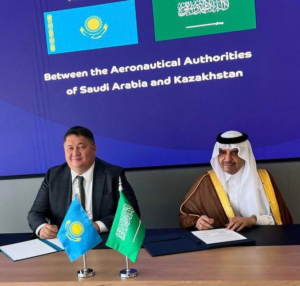
From L to R: Deputy Minister of Transport Talgat Lastayev and Acting President of the General Authority of Civil Aviation of Saudi Arabia Suleiman bin Ahmed Al-Bassam. Photo credit: Civil Aviation Committee.
The latest measures range from a significant increase in permitted flights between Kazakhstan and Saudi Arabia to the expansion of biometric border-control systems and the use of data analytics to assess the commercial potential of new air routes.
Kazakhstan and Saudi Arabia expand flight opportunities
Kazakhstan and Saudi Arabia signed an air services agreement on Aug. 26 in Riyadh, creating additional opportunities for regular air connectivity between the two countries. The agreement was signed by Deputy Minister of Transport Talgat Lastayev and Acting President of the General Authority of Civil Aviation of Saudi Arabia Suleiman bin Ahmed Al-Bassam.
Under the new arrangements, the number of permitted regular flights between the countries will increase from 28 to 70 per week. The expansion is expected to support trade and business ties, investment and tourism, while providing airlines with greater flexibility to develop new routes.
Air carriers are planning to launch direct regular flights between Astana and Riyadh and increase the number of connections with other Saudi Arabian cities.
Data-driven approach to developing routes
The expansion of air connectivity is also being supported by new analytical tools developed in Kazakhstan. Echelon Alpha, in cooperation with the Ministry of Transport, has developed a digital platform designed to optimize civil aviation route networks and assess the commercial viability of flights.
The system analyzes demand on different routes, forecasts transit potential and models possible future route networks. According to Echelon Alpha founder Rakhman Asambayev, the system was built using around 170 reports from airlines and data covering 200 million flights over the past five years.
“For building the analytical model of air connectivity, around 170 airline reports and a dataset covering 200 million flights over the past five years were processed,” Asambayev said.
The platform also takes into account regional macroeconomic indicators, population, consumer preferences, business activity and major events.
“It operates exclusively on the basis of open and commercial sources, as well as geomarketing data, ensuring forecasting accuracy of up to 90%,” he said.
The technology could help airlines and authorities make route-development decisions based not only on existing passenger flows but also on projected demand and the potential of cities to serve as transit points.
Digital border controls expand
Around 200 additional Q-Gate biometric terminals are also planned to be installed at Kazakhstan’s border checkpoints by 2028, expanding the use of a domestically developed automated passport-control system. The terminals, developed by Kazdream Special Systems, are already operating at 11 checkpoints, including the international airports of Astana and Almaty. A total of 54 terminals have been installed so far.
The system verifies a passenger using facial biometrics and passport data, with the process taking between 15 and 50 seconds.
According to Kazdream Special Systems CEO Duman Sembayev, the technology can significantly increase passenger-processing capacity without requiring an expansion of physical infrastructure.
“The terminal enables citizens aged 16 and over to cross the state border without contact and without having to approach a border service officer. Passport and facial biometric verification takes 15 seconds, increasing checkpoint capacity sixfold without expanding its physical infrastructure,” Sembayev said.
The company estimates that processing a flight carrying 200 passengers manually takes around 30 minutes, while Q-Gate can process the same aircraft in approximately seven minutes.
Another 198 terminals are expected to be installed by 2028. Work is also underway on algorithms for automated contactless processing of foreign citizens. A pilot project is additionally testing the possibility of crossing the border using a QR code generated through eGov instead of presenting a physical passport.
