
ASTANA – Melting glaciers across Kazakhstan and Central Asia are accelerating climate risks from floods today to water shortages in the coming decades, scientists warned, citing long-term data showing rapid ice loss, rising temperatures, and growing pressure on water-dependent energy and agriculture systems.
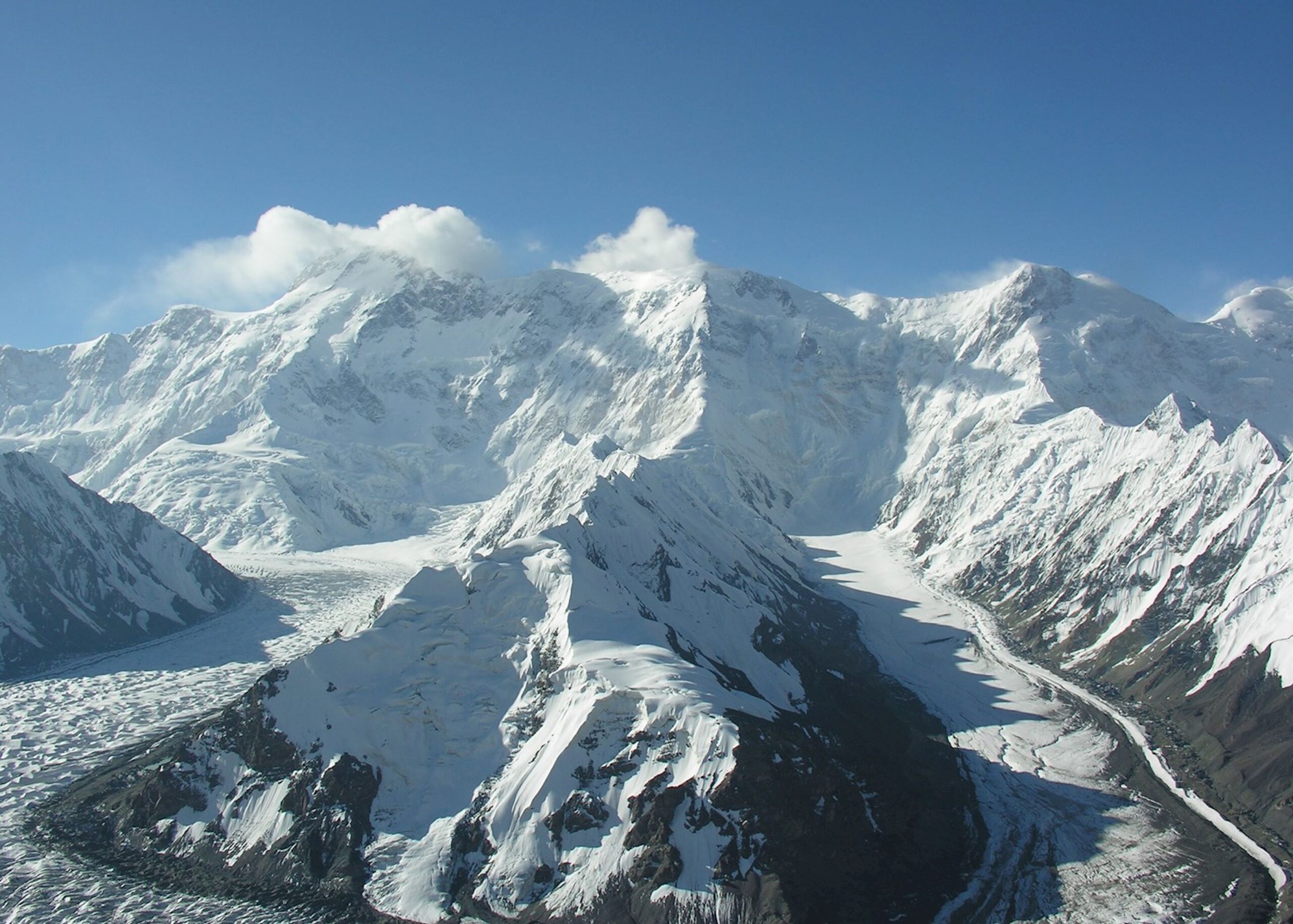
The very roof of Central Asia, the Inylchek Glacier, straddling the borders of Kyrgyzstan, Kazakhstan and China. Photo credit: audleytravel.com
The British-Kazakh Society hosted a high-level webinar on Feb. 17 that brought together international experts to examine the accelerating retreat of glaciers in the region and their implications for national and regional water security.
Rising temperatures are increasingly affecting the health of glaciers. According to Maria Shahgedanova, professor at the Department of Geography and Environmental Science of the University of Reading, the most pronounced warming between May and August is concentrated in the south, particularly in the Tian Shan mountains.
Warming and other climatic shifts occur more rapidly at higher altitudes, a pattern clearly observed in Kazakhstan’s mountainous regions.
“Two climatic variables primarily predetermine the health of glaciers. This would be summer temperature, which controls melt, and annual solid precipitation, which controls the accumulation of snow on glaciers, which, over time, is transformed into ice,” she said.
Snowfall is increasingly replaced by rain, reducing snow cover and speeding up glacier loss, she added, describing it as “not good news for the health of glaciers.”
Shahgedanova explained that glacier conditions are assessed through measurements of area and mass balance, which refers to the difference between ice gained through accumulation and ice lost through melting. A positive mass balance allows glaciers to thicken and advance, while a negative balance leads to thinning and retreat.
She highlights the rapid mass loss in Central Asia’s glaciers, except in the eastern Pamir. The most rapid losses are occurring in the northern part of the region, particularly in the Dzhungar Alatau in Kazakhstan. Significant mass loss is also observed in the northern Tian Shan, including the Tuyuksu glacier area.
From floods today to water scarcity tomorrow
Researchers emphasized that glacier change should be understood as part of broader cryospheric change. Shahgedanova said the cryosphere includes not only glaciers, but also seasonal snow, mountain permafrost, and ice stored in rock glaciers, which are all forms of frozen water.

Maria Shahgedanova. Photo credit: mountainresearchinitiative.org
Changes in the mountain cryosphere impact not only high-altitude areas but also downstream regions, particularly agriculture, which depends heavily on irrigation supplied by meltwater.
“We face two problems with developing climate change and cryospheric change. One problem is too little water, and the other problem is too much water,” Shahgedanova added.
In the short term, accelerated melting increases runoff, raising the risk of flooding. As glaciers retreat, glacial lakes form in newly exposed basins, increasing the danger of glacial lake outburst floods, which Shahgedanova describes as highly destructive events that can severely damage infrastructure and threaten lives.
“At this point, the maximum supply of water is reached, and afterwards, the water supply will decline. We call this time peak water. It is very important to know when peak water will be reached because after it has passed, we are facing a water deficiency in the region, and it affects every industry and every aspect of life in the region,” she explained.
The professor warns that the region is nearing this peak water moment.
Disrupted water cycle
“Anyone born after 1976 has lived their entire life in a climate-changed world,” said Temur Yunusov, a research affiliate at the Cambridge Central Asia Forum at Jesus College of the University of Cambridge.

Temur Yunusov. Photo credit: csap.cam.ac.uk
Rising temperatures, he said, are disrupting the water cycle and accelerating glacier loss. Warmer conditions are turning snowfall into rainfall, reducing snow accumulation that feeds rivers, agriculture, and hydropower.
“It is not that we are running out of water in general. Water is ever-present in the ocean. It is salty water. And this water, we can neither drink nor use in agriculture,” he said, pointing out that the problem is with fresh water.
Kazakhstan remains heavily reliant on fossil fuels, despite hydropower accounting for nearly 10% of electricity generation. “Hydropower, almost 10% of it, might be in danger if the glaciers have melted away, and there is no more meltwater coming down to power those hydropower turbines,” he added.
At the same time, Yunusov explained that rising heat in the atmosphere allows more moisture to accumulate, which eventually falls as precipitation. The result is that wet seasons are becoming wetter, while dry seasons are becoming drier, increasing the frequency of both floods and droughts. Recent years have seen devastating fires in Australia and the United States, severe floods in Dubai, Russia and Kazakhstan.
Long-term monitoring reveals rapid ice loss
Detailed long-term monitoring supports these warnings. Vasiliy Kapitsa, a senior researcher at the Central Asian Regional Glaciological Center under UNESCO, said that continuous observations of the Tuyuksu glacier have been conducted since 1958, making it one of the longest uninterrupted glacier datasets in Central Asia.
“The center operates three high-mountain research stations located in the Kishi [small] Almaty and Ulken [big] Almaty river basins,” said Kapitsa.
One of the key sites is Tuyuksu Station, located at an altitude of roughly 3,500 meters. Seasonal observations there capture conditions ranging from summer to spring melt periods.
“The Tuyuksu station serves as the base for monitoring the mass balance of the Tuyuksu glacier. Observations have been conducted continuously since 1958. This is what we are proud of because many monitoring programs in Central Asia were interrupted after the collapse of the Soviet Union,” he said.
Since then, the glacier has retreated by an average of around 25 meters per year, with retreat reaching up to 45 meters in unfavorable years. Satellite and drone data show that ice thickness in some sections of the glacier has declined by as much as 70 meters, or roughly 2–2.5 meters per year.
Despite a reduction of around 40–50% in glaciation, river runoff at mountain outlets has so far remained stable or even increased in some basins, Kapitsa said. One possible explanation is a temporary “compensation mechanism,” though he warned it does not eliminate long-term water risks.
