
ASTANA – Kazakh Invest and Chinese oil and gas firm Geo-Jade Petroleum Corporation signed a cooperation and project-support agreement on Feb. 3 to advance development of the Sozak gas field in Kazakhstan’s Kyzylorda Region.
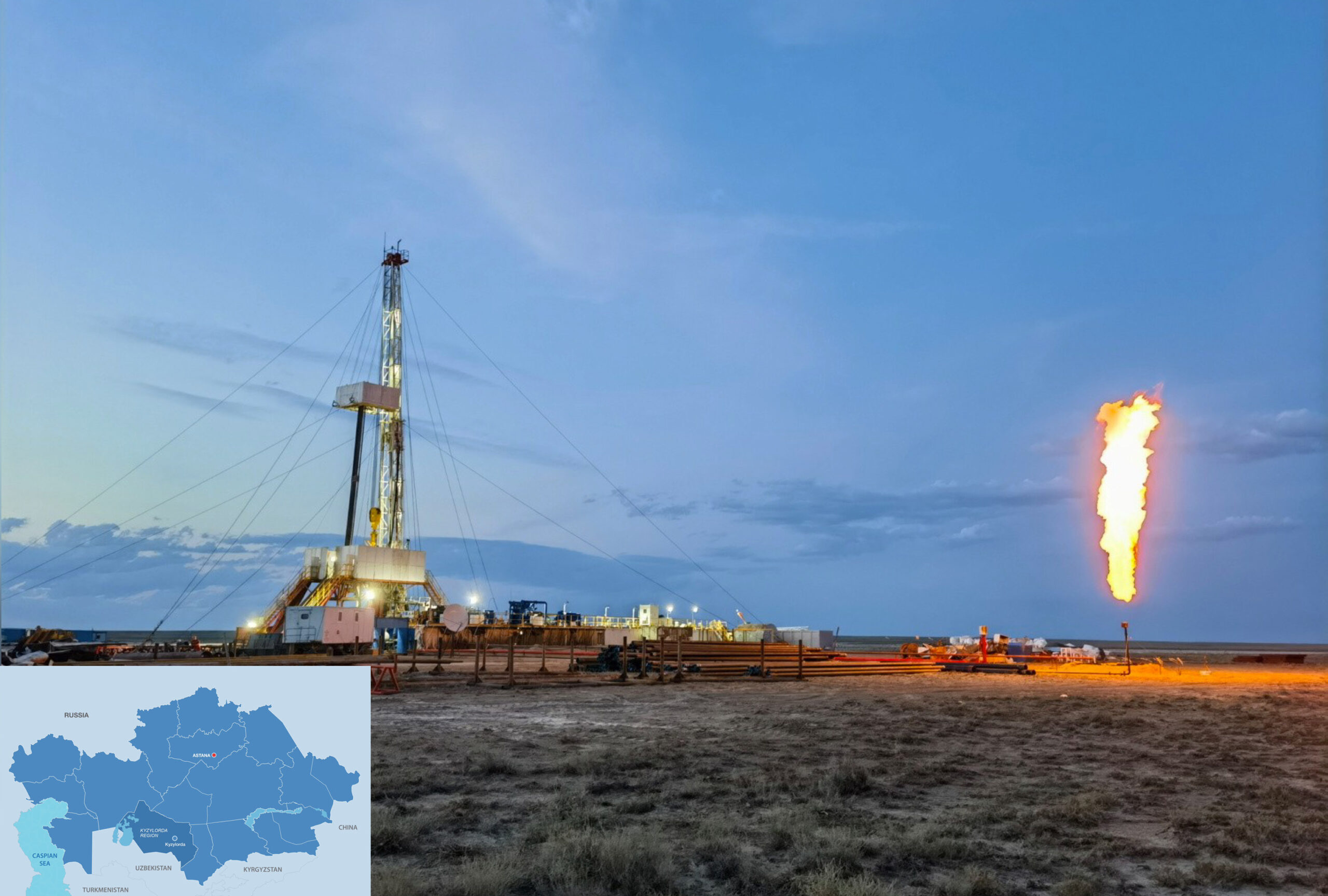
Under current estimates, production at the site could reach up to one trillion cubic meters.Photo credit: geojade.com Click to see the map in full size. The map is designed by The Astana Times.
The project could mark the launch of a new subsector in Kazakhstan’s gas industry, focusing on the production of hard-to-recover, unconventional gas.
“For Kazakhstan, and for our company, it is a very important energy project. This is a completely new direction for Kazakhstan, because hard-to-recover gas will be extracted,” Kazakh Invest Chairman Sultangali Kinzhakulov told journalists after the signing ceremony in Astana.
The planned investment totals $7.8 billion, Kinzhakulov said. Under current estimates, production at the site could reach up to one trillion cubic meters. Globally, only two countries, the United States and China, possess the capability to produce hard-to-recover gas, he added.
“According to expert estimates, global reserves of unconventional, hard-to-recover gas are roughly 10 times larger than those of conventional natural gas,” Kinzhakulov said.
The project is currently at the pre-investigation stage, with a new exploration cycle now underway. Preliminary studies are planned through the end of this year and may extend into next year.
The investor plans to spend nearly $250 million on pre-investment exploration and reserve assessment, Kinzhakulov said.
The Sozak field is located less than 200 kilometers from the Central Asia Gas Pipeline, providing access to regional transport and export infrastructure.
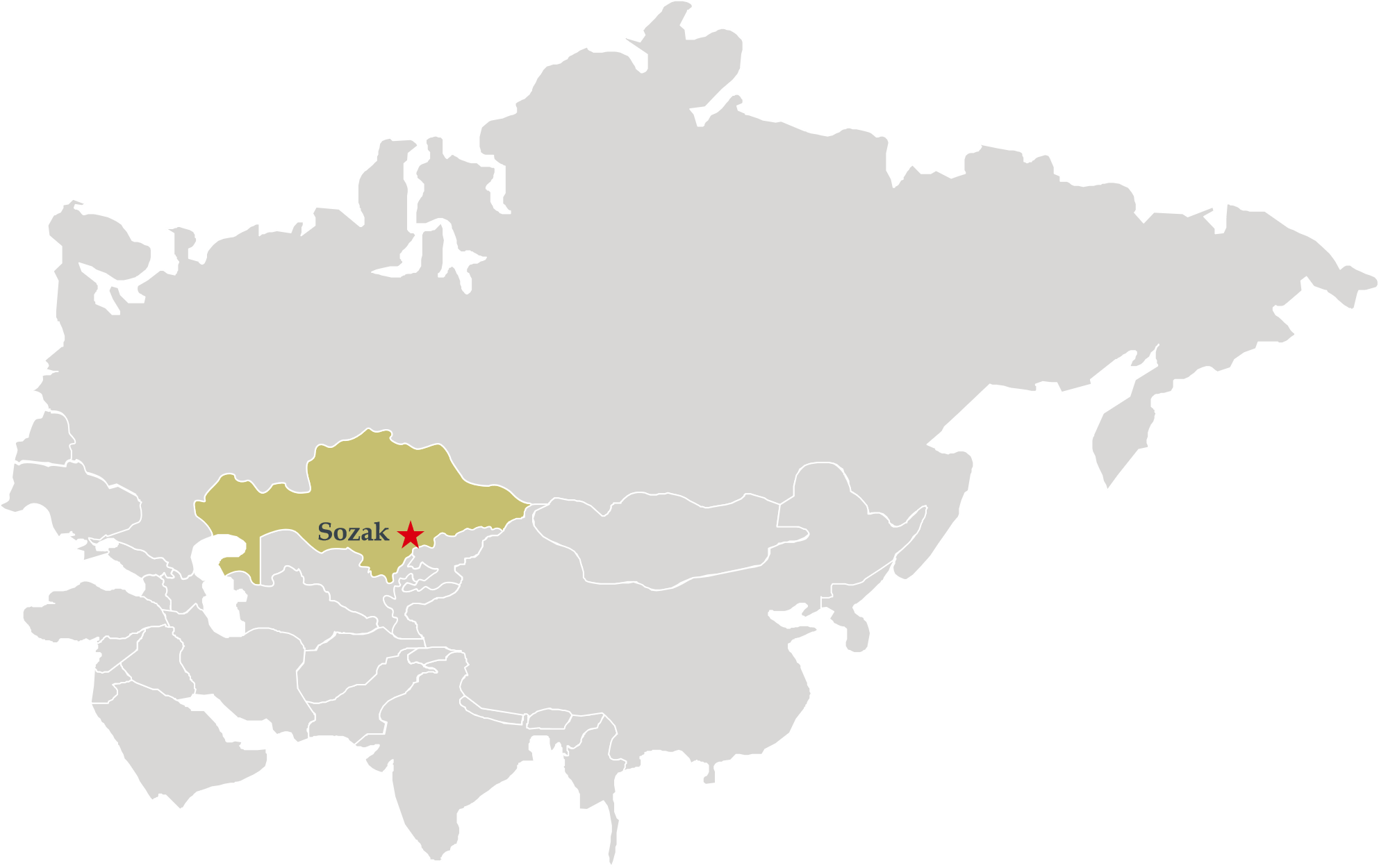
The Sozak field is located less than 200 kilometers from the Central Asia Gas Pipeline, providing access to regional transport and export infrastructure. Photo credit: geojade.com
According to Geo-Jade Petroleum Corporation, geological estimates put the project’s potential gas resources at up to one trillion cubic meters, with proven and probable (2P) reserves estimated at around 100 billion cubic meters. The field also contains significant volumes of associated helium, with recoverable resources estimated at 1.3 billion cubic meters.
The project is structured as a consortium that includes investors from China and Qatar. While Kazakhstan does not hold an equity stake in the project, Kinzhakulov noted that one option under discussion is to allocate part of the gas output to the domestic market under a production-sharing arrangement. A second option under negotiation would direct the entire gas volume to the domestic market.
The final arrangement, however, will depend on pricing and commercial terms agreed with the investor.
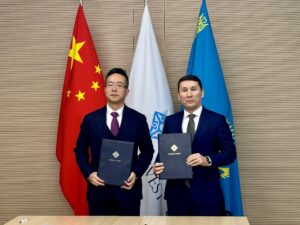
Chen Huanlon and Sultangali Kinzhakulov after the signing ceremony. Photo credit: The Astana Times
Speaking to journalists, Geo-Jade Petroleum Corporation Chairman Chen Huanlon said gas can be used for a range of purposes, including power generation and as feedstock for chemical products, while some volumes could be used for transport or export to China via pipeline. He said the priority is to meet Kazakhstan’s domestic demand, with exports to other markets depending on the level of industrial development.
Geo Jade has operated in Kazakhstan since 2014.
“It is very important to say that this is not a new investor just entering the market,” said Kinzhakulov. “The fact that you invest such a large amount in a new project is a great signal for us that our economy and our projects are very promising.”
Chen said the company’s business development focuses on four key areas: oil and gas exploration and development, investment and financial services, renewable energy, and real estate and tourism. Total assets across these segments exceed $100 billion.
He said the company’s oil and gas exploration and development operations are concentrated in three regions: Kazakhstan in Central Asia, Iraq in the Middle East, and Albania in Europe.
According to Chen, Kazakhstan remains the company’s primary market. The firm has invested more than $3.2 billion in the country since 2014 and currently operates in five regions nationwide, including Sozak, Maten, Kozhan, and Balykshy.
