
ASTANA — Kazakhstan’s manufacturers could face higher costs when exporting to the European Union if they cannot accurately measure the carbon emissions generated during production. Experts say better monitoring could help companies reduce these charges, cut energy costs and identify where their operations need improvement.
Photo credit: Shutterstock
The issue was discussed on Nov. 12 at Kazakhstan’s pavilion during the UN Climate Change Conference (COP31) in Antalya, Türkiye, where experts also presented plans for a regional platform that would use artificial intelligence (AI) and environmental data to support climate projects across Central Asia.
Why accurate emissions data matter?
Since January 2026, the EU’s Carbon Border Adjustment Mechanism (CBAM) has placed a carbon-related cost on imports of certain products, including steel, aluminum, cement and fertilizers. The rules aim to ensure foreign manufacturers face carbon costs comparable to those paid by producers in Europe.

Daniele Pernigotti, CEO of Aequilibria. Photo credit: renewablematter.eu
For Kazakhstan, the financial impact depends partly on how much carbon is emitted during production and whether those emissions can be verified. If a manufacturer cannot provide reliable figures, its EU importer may have to use EU default estimates. These estimates could lead to higher charges than those based on the company’s actual emissions.
Daniele Pernigotti, CEO of Aequilibria, an Italian environmental consultancy, said manufacturers therefore have a financial incentive to measure their emissions accurately.
“We can go in the direction of default values. This implies very high costs. Or we can focus on the real emissions of the company, but we need to have verification and accreditation,” said Pernigotti.
Kazakhstan has operated its own carbon trading system since 2013, although carbon prices remain much lower than in the EU. Under CBAM, eligible carbon costs already paid in Kazakhstan can be deducted from the EU charge if they are properly documented.

Sergio Mujica, secretary-general of the International Organization for Standardization (ISO). Photo credit: International Telecommunication Union
Companies also face differences in how emissions are measured and reported internationally.
Sergio Mujica, secretary-general of the International Organization for Standardization (ISO), said common standards could reduce the need for businesses to prepare different emissions reports for different markets.
“Imagine an organization that needs to follow two different sets of accountability, two different sets of rules so they can measure global emissions. It doesn’t work,” he said.
ISO and the Greenhouse Gas Protocol are working to align their greenhouse gas accounting standards, which could simplify and lower the cost of reporting.
Mining example shows potential savings
More accurate measurements could also help Kazakhstan’s industries reduce fuel consumption and operating costs.
Seitgali Galiyev, lead expert on digitalization at the Dinmukhamed Kunaev Institute of Mining under Kazakhstan’s Ministry of Industry and Construction, said current environmental reporting often relies on standard calculations rather than data from individual machines and production processes.

Seitgali Galiyev, lead expert on digitalization at the Dinmukhamed Kunaev Institute of Mining under Kazakhstan’s Ministry of Industry and Construction. Photo credit: metalmininginfo.kz
As a result, companies may know their estimated total emissions without knowing exactly where they come from or how to reduce them.
Galiyev presented a digital model that tracks fuel use and emissions across mining operations, helping operators identify inefficient equipment and areas for improvement.
In one coal mine studied by the institute, diesel accounted for 78% of energy consumption. The analysis found that the official standard for diesel use was 14% higher than actual consumption, revealing an estimated 1.72 billion tenge ($3.9 million) in untapped annual economic potential.
Another model showed how emissions varied along different sections of mining roads, allowing operators to identify specific areas where equipment or working methods could be improved.
Such information could help companies reduce fuel costs and pollution. For producers covered by CBAM, it could also support more accurate emissions reporting, provided the data meets EU verification requirements.
Central Asia plans AI-powered carbon platform
The session also examined how Central Asian countries could share environmental data and develop practical solutions to common climate challenges.
Kazakhstan’s Vice Minister of Artificial Intelligence and Digital Development Malik Olzhabekov said combining AI with satellite data could improve monitoring of water resources, agricultural land and natural hazards. Kazakhstan already operates Earth observation satellites and is expanding the use of satellite information in government decision-making.
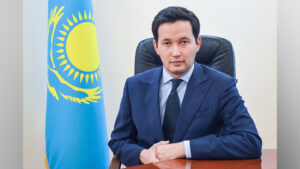
Kazakhstan’s Vice Minister of Artificial Intelligence and Digital Development Malik Olzhabekov. Photo credit: primeminister.kz
“We place special importance on using AI to address climate challenges. This means moving from predicting them in advance and from using separate sources of data to carrying out broader analysis and making better decisions. For Central Asia, where water scarcity, sustainable agriculture and natural risks are major concerns, these technologies are especially important,” he said.
Olzhabekov also highlighted a joint initiative involving Astana Hub and the University of Central Asia to develop a regional digital platform for sharing climate research and technological solutions.
During the session, Kazakhstan’s Green Academy signed memorandums with international partners to advance an AI-powered regional carbon platform based at Astana Hub.
The platform, still in development, is intended to help countries improve emissions monitoring, share research, and develop projects addressing environmental problems across Central Asia.

Christopher Gerry, rector of the University of Central Asia. Photo credit: ucentralasia.org
Christopher Gerry, rector of the University of Central Asia, said access to satellites, sensors and AI is increasing, but the challenge is turning the information they generate into reliable evidence that governments and businesses can use.
“An algorithm alone cannot turn poor data into trustworthy evidence simply by processing it more quickly. We need to know: Where did the data come from? How complete is the data?” he said.
He identified irrigation, flood risk management and industrial emissions as possible areas for joint projects, stressing that each should address a specific problem and deliver measurable results.
According to Gerry, the partners plan to identify priorities, assess available data and establish how they will work together during the first three months of 2027. They would then prepare detailed project proposals and aim to begin testing two or three pilot projects in the second half of the year. The initial work will focus on testing whether the proposed solutions deliver practical benefits before expanding them across the region.
