
ASTANA – Central Asia’s role in shaping global governance, strengthening regional cooperation and advancing sustainable development was the focus of an international conference hosted by Narxoz University on Nov. 4 in Almaty, the university’s press service reported.
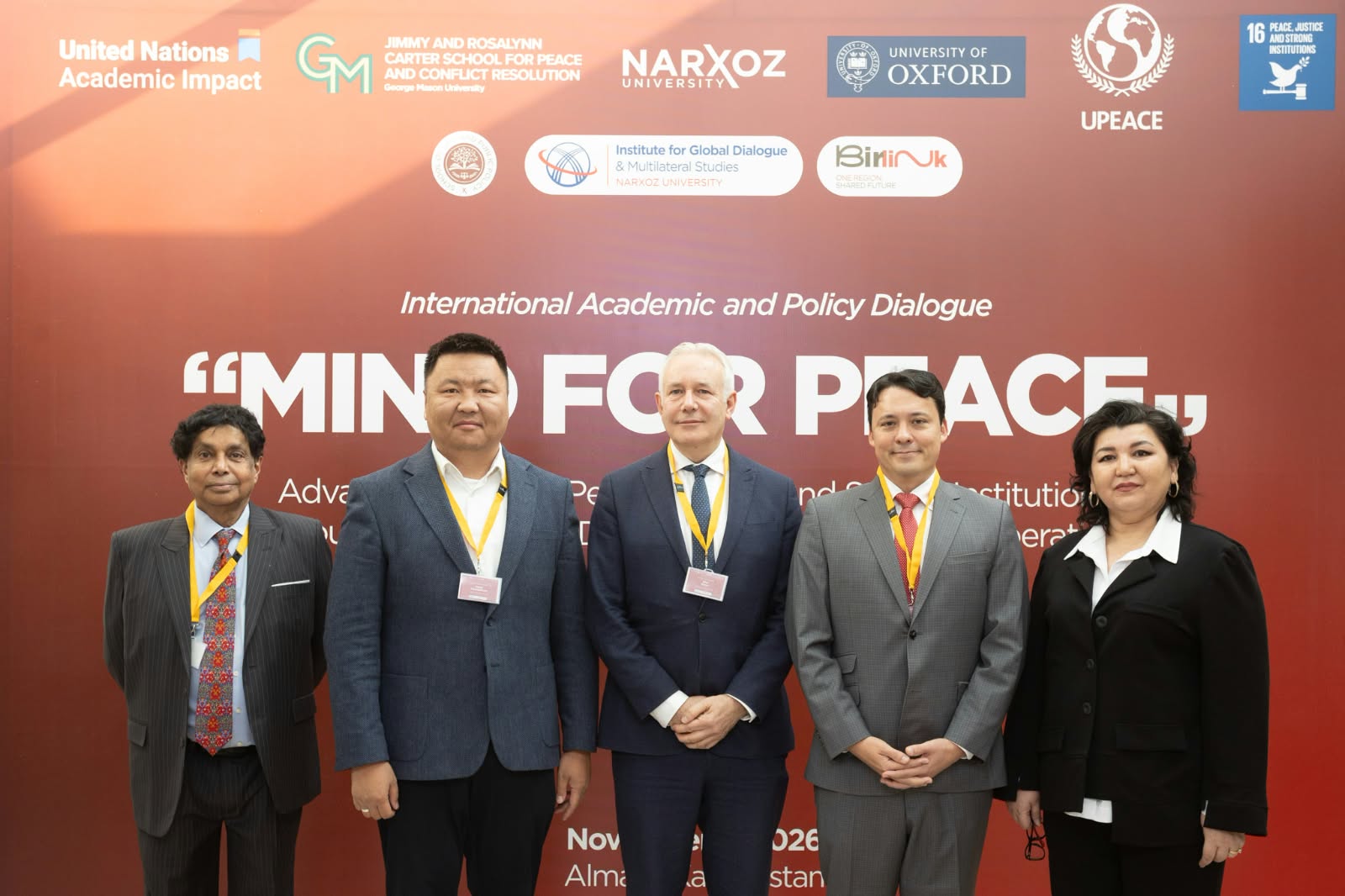
An Oct. 4 Narxoz conference brought together diplomats, international organizations and academics to discuss regional and global issues. Photo credit: Narxoz University
The Mind for Peace conference examined how education, academic diplomacy and regional partnerships can contribute to peace, justice and stronger institutions.
The conference brought together representatives of diplomatic missions, international organizations and academia to exchange views and explore common approaches to regional and global issues.
Opening the event, Narxoz University President Kanat Kozhakhmet said the conference was taking place amid major geopolitical and technological changes.
He emphasized that peace, stability and mutual trust are essential not only as political priorities but also as conditions for sustainable development.
Kozhakhmet also reaffirmed Kazakhstan’s support for multilateral cooperation and the central role of the United Nations in international affairs.
Anara Dutbayeva, an adviser to the representative office of Kazakhstan’s Foreign Ministry in Almaty, highlighted the importance of a coordinated regional voice and the development of C5+ cooperation, a format connecting the five Central Asian countries with external partners. She pointed to opportunities for cooperation in trade, transport connectivity, artificial intelligence regulation and water management.
Dutbayeva also emphasized the importance of peaceful and inclusive societies, access to justice and accountable institutions. Achieving these goals requires cooperation among governments, international organizations, universities and civil society, she said.
European Union Ambassador to Kazakhstan Aleška Simkić highlighted the importance of advancing regional cooperation through the C5+ format. She expressed hope that Central Asian countries would eventually achieve a level of integration that could support the establishment of supranational institutions.
According to Simkić, such a body could facilitate the EU’s engagement with the region as a whole, rather than requiring separate negotiations with individual countries. It could also help address issues related to legal frameworks, cooperation and logistics.
Su Fangqiu, China’s consul general in Almaty, described the conference as timely amid major global transformations. He linked discussions on global governance to four initiatives proposed by Chinese President Xi Jinping: the Global Development Initiative, Global Security Initiative, Global Civilization Initiative and Global Governance Initiative.
Su Fangqiu highlighted Central Asia’s growing international standing, Kazakhstan’s achievements over the past 35 years and expanding cooperation between China and the region. He pointed to the China-Central Asia mechanism, established three years ago, as a framework for strengthening regional cooperation and building a closer community with a shared future.
Participants also explored the possibility of establishing a U.N. University presence in Central Asia, particularly in Kazakhstan. The proposed initiative could support research, education and expert dialogue on global governance, sustainable development and emerging technologies.
Conference sessions examined C5+ cooperation in public administration, water management, energy, climate, digital connectivity, artificial intelligence and human mobility. Another track focused on the universities’ role and academic diplomacy in promoting international dialogue and peace.
Aizhan Smailova-Schmidt, Director of the Institute for Global Dialogue and Multilateral Studies, emphasized that education and critical thinking underpin peace and effective institutions.
She highlighted investment in education, youth leadership and international exchanges as contributions to a more peaceful and sustainable future, describing the conference theme as an expression of Central Asia’s shared responsibility.
The conference also featured a youth program that allowed students and emerging professionals to discuss regional challenges through BirliNk C5+, a Narxoz initiative. The university also inaugurated its International Students Sustainability Club to expand student engagement in sustainable development.
