
Before the fall of 2026, South Korea-Central Asia relations were akin to a plot without main characters: bilateral relations primarily conducted at the ministerial level without institutionalized regional engagement. Now, the story features presidents and critical minerals overcoming complex customs procedures and inadequate transport infrastructure in a new regional integration play: The first South Korea-Central Asia summit.
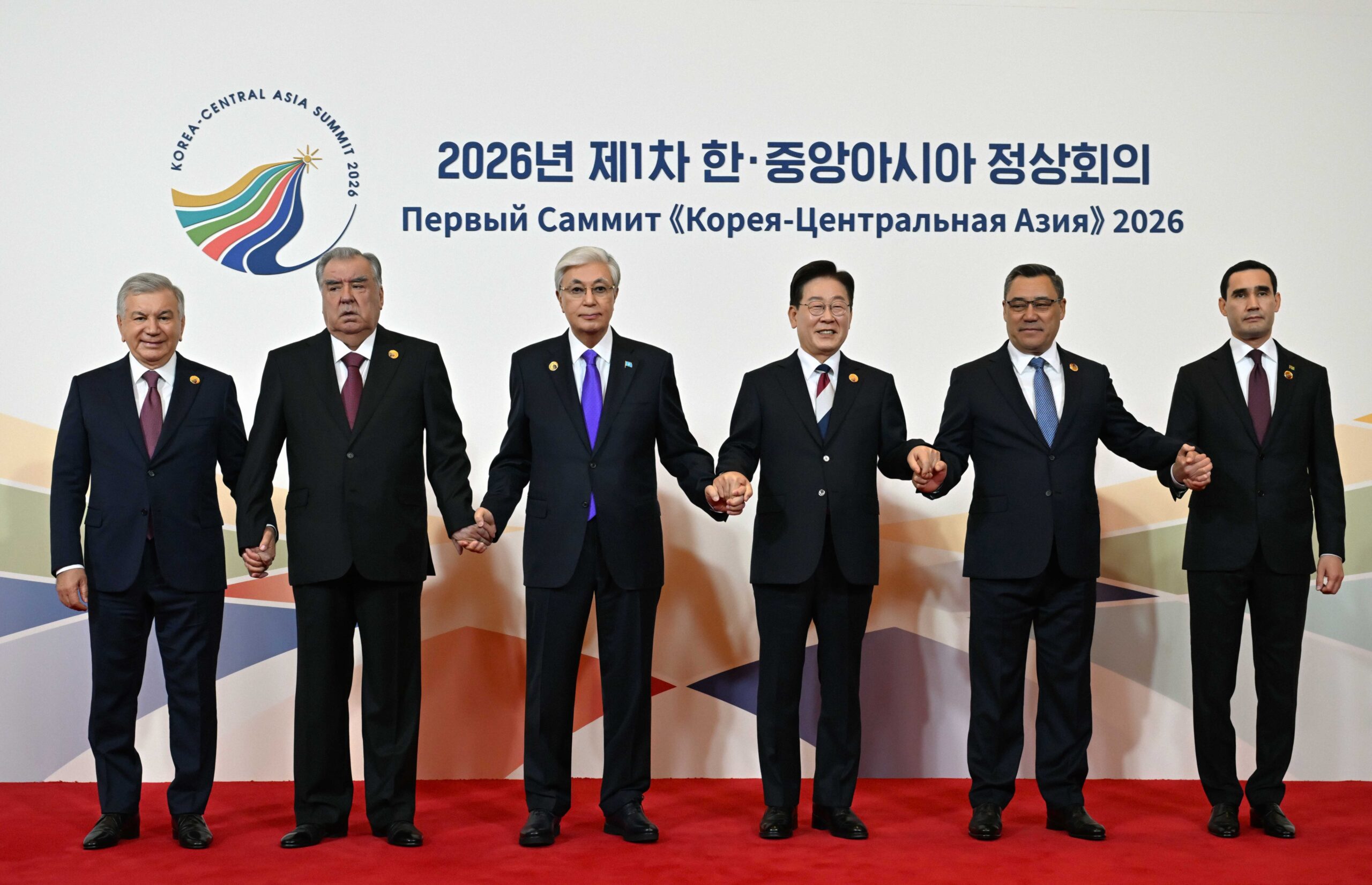
L-R: President of Uzbekistan Shavkat Mirziyoyev, President of Tajikistan Emomali Rahmon, President Kassym-Jomart Tokayev, President of the Republic of Korea Lee Jae Myung, President of the Kyrgyz Republic Sadyr Japarov and President of Turkmenistan Serdar Berdimuhamedov at the the first Central Asia – Republic of Korea Summit in Seoul on September 16, 2026. Photo credit: Akorda.
The inaugural summit on Sept.16 brought together the presidents of South Korea and all five Central Asian countries under the theme “Walking Together Toward the Future: Partnership for Trust and Prosperity.” The summit and associated presidential visits resulted in the Seoul Declaration, which outlined areas for cooperation, and in multiple agreements and memorandums.
In Korean and Central Asian joint history, people and culture precede business. In the second half of the 19th century, many Koreans began moving to Russia, and later to the Soviet Union, following Japanese colonization. The Koryo-Saram, the ethnic Koreans of Central Asia, arrived in the region through Stalin’s mass deportations in 1937.
According to the Korean Ministry of Foreign Affairs, approximately 310,000 Korean descendants live in Russia and Central Asia today, with the greatest number of them, 178,000 living in Uzbekistan, followed by Kazakhstan at 110,000. A South Korea-inspired canal promenade, Seoul Mun, meaning “Seoul Gate” was even built in Tashkent in recent years.
Business interest has been active since the five countries’ independence ranging from South Korea’s Daewoo car assembly plant in Uzbekistan in the 1990s, to its New Northern Policy (2017) and the K-Silk Road initiative (2024).
The significance of September’s summit rests on the fact that it was the first at a presidential level and in that it signals a move from bilateral relations to more institutionalised regional engagement moving forward.
President of the Republic of Korea Lee Jae Myung delivers remarks at the forum. Photo credit: Akorda.
“Through this summit, relations between South Korea and Central Asia will be consolidated into a leader-level multilateral cooperation framework, and the New Northern Policy we have pursued is expected to gain momentum,” Korean President Lee Jae Myung commented on television according to Reuters.
Like most roads in international relations, this one, too, leads to security. Over 82% of South Korea’s mineral imports, needed for products from semiconductors to batteries and electric vehicles, come from China. Central Asia is rich in critical minerals and offers an opportunity for South Korea to diversify its trade partners and supply chains.
“There is an economic partnership because currently Kazakhstan is the first source of these raw materials, since Korea is short of raw materials,” Abagan Akerke, the head of the Far East Department at Farabi University in Kazakhstan told the state-associated broadcaster K24.
In addition to having an abundance of uranium reserves, Kazakhstan in particular is located at a strategically important point, being part of the Middle Corridor (Trans-Caspian International Transport Route) connecting Europe to Asia.
Further highlighting critical minerals, Uzbek President Shavkat Mirziyoyev proposed the establishment of a regional investment alliance for rare earth minerals during his visit to Seoul.
“This initiative is aimed at creating large industrial clusters in the region that will cover all stages of production – from geological exploration and extraction, to deep processing of raw materials and the production of high-value-added products,” he said in his address at the summit.
Central Asia is looking for critical mineral supply chains that go beyond just mere extraction, and into refining, smelting and higher-value processing.
How will minerals actually get to South Korea? A South Korean government-sponsored study found customs procedures and inadequate transport infrastructure to be a challenge. China’s Belt and Road is active, while Kazakh President Kassym-Jomart Tokayev proposed an “end-to-end transport and logistics chain” tied to the Middle Corridor and Kyrgyz President Sadyr Japarov invited Korean firms to the China–the Kyrgyz Republic–Uzbekistan railway.
Other agreements and topics of discussion centered around talent, technology, investment and climate-related projects.
South Korea’s first C5+K meeting comes at an increasingly crowded space, following the United States’ and Europe’s multilateral interaction with the region.
The next summit is set to be held in Kazakhstan in 2028 and by then it is expected that deals potentially worth billions will have commenced.
The article was originally published in Montfort Eurasia’s LinkedIn.
London-based Montfort Eurasia is the management consultancy specializing in corporate communications and investor relations. It was established in Uzbekistan in 2023 to support clients in Central Asia and the Caucasus.
Disclaimer: The views and opinions expressed in this article are those of the author and do not necessarily reflect the position of The Astana Times.
