
ASTANA — Kazakhstan is seeking to make water-sharing across Central Asia more transparent through real-time monitoring and shared data as it prepares for possible declines in water availability through 2040. The country does not currently face a nationwide water deficit, but its dependence on rivers flowing across national borders makes water security a regional issue, Water Resources and Irrigation Minister Nurzhan Nurzhigitov said in an interview with Tengrinews published on Oct. 27.
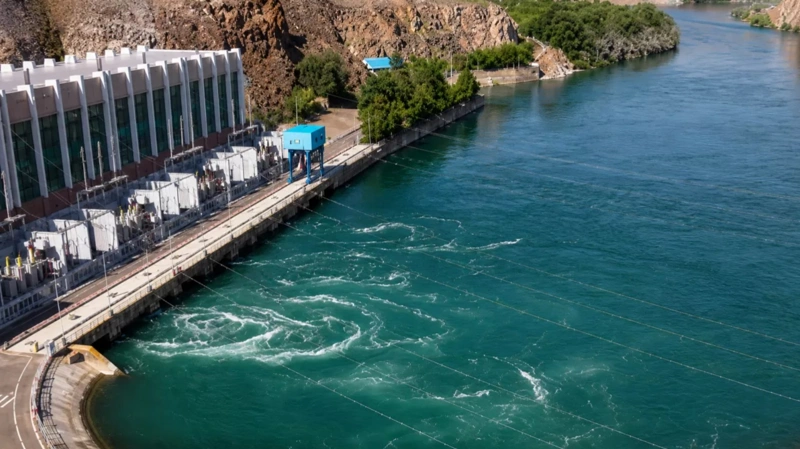
Photo credit: Ministry of Water Resurces and Irrigation.
Kazakhstan’s average annual river runoff is about 100 billion cubic meters, with approximately 45% of its river water coming from abroad. The economy, agriculture, industry and housing and utilities sectors collectively use about 25 billion cubic meters annually, according to the minister.

Water Resources and Irrigation Minister Nurzhan Nurzhigitov. Photo credit: Tengrinews.kz
Seven of Kazakhstan’s eight river basins are connected to transboundary waters. The country receives water from the Kyrgyz Republic, Tajikistan, Uzbekistan, China and Russia.
The dependence is particularly pronounced in the south, where much of the country’s irrigated agriculture is concentrated. About 90% of the water supplied by the Syr Darya River to the Turkistan and Kyzylorda regions is transboundary. Approximately 75% of the water available to the Zhambyl Region from the Chu River comes from Kyrgyzstan.
“Water availability has become a strategic issue and a matter of national security,” Nurzhigitov said.
Building trust through shared data
One of Kazakhstan’s priorities is to improve the transparency and accuracy of information exchanged by countries that share river basins. Kazakhstan and Uzbekistan have agreed to automate water accounting at 10 sites along the Syr Darya, with five in each country. The German Society for International Cooperation, or GIZ, helped prepare the project documentation. Kazakhstan has already built two hydrological monitoring stations using funds from the Turkistan regional administration. The minister said the two countries had jointly checked the stations and could now see the same data in real time.
In January 2026, Kazakhstan proposed developing a plan to digitize the entire Syr Darya basin. Tajikistan agreed to participate, and a working group was established involving Kazakhstan, Tajikistan and Uzbekistan. Its first meeting was planned for early November, with Kyrgyzstan potentially joining the initiative later.
“If we digitize the entire basin, we will see how much water flows through it and how each country fulfills its obligations. This will increase trust. There will be no situation where one country says, ‘I sent this much water,’ while another claims it received nothing,” Nurzhigitov said.
The plan for automated water accounting across the Syr Darya basin has already been developed and sent to the countries concerned, according to a note accompanying the Tengrinews interview. However, the minister did not specify a timeline or cost for a fully integrated system. The current initiative is narrower than a shared digital platform covering all five Central Asian countries. Its initial working group involves three countries, with Kyrgyzstan expected to be invited later.
Kazakhstan is also developing its own water information infrastructure. The ministry is creating a national information system and plans to open public access to selected data in 2027. The ministry is also developing the TALSIM hydrological modeling system for flood forecasting, developed in cooperation with the United Nations Development Program (UNDP), and wants to add drought-prediction capabilities.
Cooperation or competition over water?
Nurzhigitov emphasized the importance of regional cooperation, saying that water brings Central Asian countries together rather than inevitably pushing them toward conflict.
“Water unites us,” he said.
In 1992, the five countries’ water ministers signed an agreement in Almaty to use water jointly and rationally. The International Fund for Saving the Aral Sea and its associated commissions provide additional mechanisms for regional dialogue.
According to Nurzhigitov, the commissions meet at least four times a year to discuss water forecasts, available volumes and allocation limits. He said there had been no violations of agreed limits over the past three years.
Kazakhstan has also proposed a framework convention on the rational use of Central Asia’s water resources. The ministry has approved the draft domestically and sent it to neighboring countries. Discussions are underway to combine the countries’ proposals into common rules that could help limit climate change’s impact.
Asked whether one country might decide to take more water than agreed, Nurzhigitov pointed to water diplomacy and the obligations shared by countries along transboundary rivers.
“That will not happen, because water diplomacy and accountability exist. These are transboundary rivers, and each country has obligations that must be fulfilled. That is why this will never happen,” he said.
Drought exposes the limits of regional agreements
Kazakhstan’s experience in 2021 demonstrated the economic and social consequences of severe drought. According to official figures published by the Prime Minister’s press service on Aug. 12, 2021, 1,161 head of livestock had died in the Mangystau Region by Aug. 10. Another 553 livestock deaths were reported in the Aral district of the Kyzylorda Region amid a lack of water at watering points and dry pastures.
Water shortages again threatened agricultural production in the Zhambyl Region in 2023, when low inflows affected the Chu and Talas river basins. Reporting by Kazinform on Aug. 11, 2023 detailed the scale of the shortfall. From April 1 to Aug. 11, inflow into the Kirovsk Reservoir in Kyrgyzstan, which supplies the Talas River, reached just 60 million cubic meters, compared with 300 million cubic meters during the same period a year earlier. Inflow into the Orto-Tokoy Reservoir, which releases water into the Chu River, reached 55 million cubic meters, against 256 million cubic meters in 2022.
The shortage put about 4,000 hectares of onions and sugar beets at risk, Kazinform said, citing a regional official from the agency responsible for maintaining hydraulic structures.
Tengrinews’ background information accompanying its interview noted that the 2023 shortage was not simply a matter of Kyrgyzstan failing to meet its obligations. Low snowfall and rainfall had also reduced water availability on the Kyrgyz side, leaving both countries affected by the dry conditions.
Such episodes highlight a central challenge for the region: agreements can establish rules for sharing water, but they cannot guarantee sufficient supply when river flows decline.
Planning for 2040
Nurzhigitov also shared Kazakhstan’s plans for all eight water basins over five-, 10-, and 15-year horizons, extending through 2040. The plans will assess three water-availability scenarios and estimate how much water different sectors could receive under each. The minister said drinking water supplies would take priority if water were scarce.
Separately, the ministry’s press service told Tengrinews that the basin plans would account for scenarios involving reductions in water availability of 50% and 75%.
The longer-term outlook is a key reason for moving from annual allocation decisions toward more detailed planning. Nurzhigitov said forecasts suggest that water availability across Central Asia could decline by 15 billion cubic meters by 2040. This is a forecast, not a certainty, but it underscores the need to prepare for several possible outcomes.
The plans aim to help the government determine where water infrastructure is needed, how to allocate available resources, and which economic activities can be sustained under different conditions.
The ministry is also working to reduce losses and improve water efficiency at home. Agriculture accounts for about 60% of Kazakhstan’s water use, according to Nurzhigitov. Water-saving technologies were being applied to more than 700,000 hectares in 2026, with estimated savings of about 1 billion cubic meters.
By 2030, Kazakhstan aims to expand the area using such technologies to 1.3 million hectares, potentially saving an additional 2 billion cubic meters. Industrial enterprises are also expected to increase water reuse and recirculation.
As part of a broader package of measures, Kazakhstan aims to save and accumulate about 10 billion cubic meters of water by 2030 through infrastructure upgrades, new reservoirs, digitalization and more efficient water use.
