
ASTANA — Kazakhstan proposes expanding the agenda of the Conference on Interaction and Confidence Building Measures in Asia (CICA) to include artificial intelligence (AI), preventive diplomacy, water cooperation and regional transport connectivity, President Kassym-Jomart Tokayev said at the seventh CICA summit in Baku on Oct. 15.
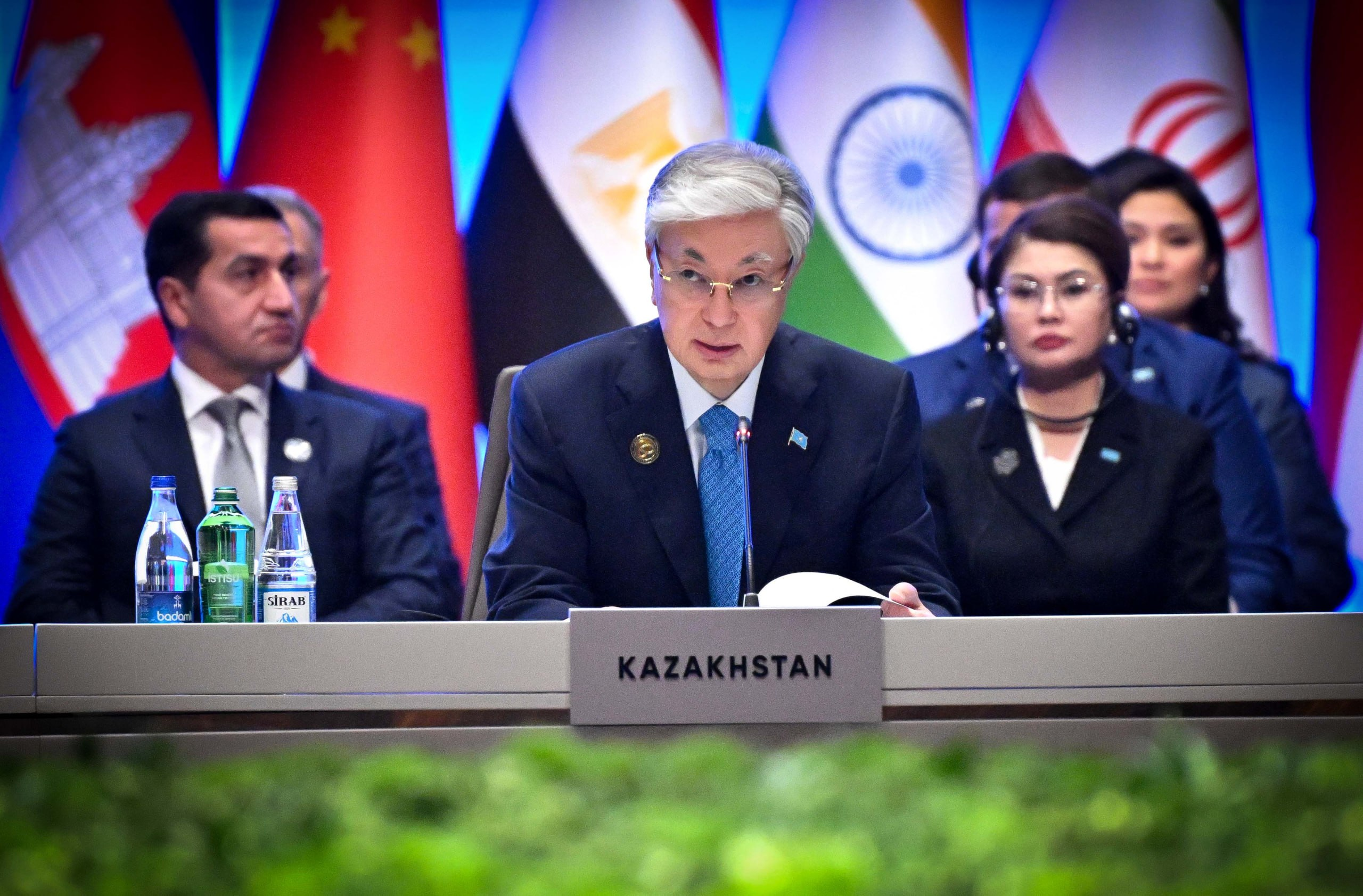
Tokayev sets out priorities for CICA’s transformation at Baku summit. Photo credit: Akorda.
Speaking at the summit, Tokayev also called for transforming CICA into a full-fledged international organization, proposed establishing new partnerships in water and human capital development, and highlighted Kazakhstan’s cooperation with Azerbaijan and other regional partners on energy and digital infrastructure.
“For Kazakhstan, the conference is of particular importance. More than three decades ago, our country initiated the creation of this forum to strengthen mutual trust and promote security in our vast region,” Tokayev said.
He noted that CICA member states cover nearly 90% of Asia’s territory and represent more than half of the world’s population. He also welcomed Laos as a new full member of the forum.
CICA urged to move from declarations to action
Tokayev said the summit was taking place amid mounting pressure on the international security system, with military force increasingly taking precedence over the rule of law.
“In essence, the very foundations of the international security architecture are gradually eroding, accompanied by a dangerous shift in priorities in favor of force and to the detriment of the rule of law,” he said.
Citing figures on armed conflicts, civilian deaths, displacement and food insecurity, President Tokayev argued that the scale of current challenges required stronger international institutions and more practical cooperation.
“The era of declarations of intent is coming to an end,” Tokayev said.
He recalled that participants at the sixth CICA summit in Astana in 2022 agreed to transform the forum into a full-fledged international organization. Kazakhstan expects the adoption of CICA’s charter to provide a roadmap for its future activities.
As a practical measure, he proposed launching a CICA Mechanism for Preventive Diplomacy to help member states address emerging disputes before they escalate.
“Peacebuilding must precede crises. Preventing a conflict is far more effective and less costly than settling an already raging confrontation,” he said.
He added that CICA should work more actively with the United Nations, the Shanghai Cooperation Organization, the Commonwealth of Independent States and other international institutions to help resolve disputes in Asia and beyond.
AI and cybersecurity added to security agenda
Tokayev also called for adapting CICA’s agenda to rapid technological change, proposing that artificial intelligence become a sixth dimension of the organization’s existing five areas of cooperation.
He warned that AI capabilities were advancing faster than international legal frameworks and pointed to the risks posed by cyberattacks and AI systems that bypass safeguards or gain unauthorized access to external systems.
“AI development must not outpace humanity’s ability to maintain effective control over it. Therefore, confidence-building measures should also extend to the digital sphere,” he said.
In a related initiative, Kazakhstan will host the United Nations Economic and Social Commission for Asia and the Pacific’s Asia-Pacific Center for Digital Solutions for Sustainable Development in Almaty. Tokayev invited CICA member states to participate in the center’s work.
Digital cooperation is also advancing through infrastructure projects. Kazakhstan and Azerbaijan are launching a project to build a Trans-Caspian fiber-optic communication line along the seabed of the Caspian Sea.
“This unique Digital Silk Road project will ensure faster and more secure data transmission across Eurasia, strengthen Asia’s digital potential and open up new opportunities for cooperation,” Tokayev said.
Kazakhstan seeks stronger transport and energy links
Regional connectivity was another focus of Tokayev’s address. He welcomed the reconciliation process between Azerbaijan and Armenia, saying developments in the South Caucasus demonstrated the potential of political leadership to overcome long-standing disagreements.
Against this backdrop, he proposed developing a CICA Strategy for Transport Connectivity to assess the potential of major international routes, including the Belt and Road Initiative, the North-South International Transport Corridor, the Middle Corridor and the TRIPP initiative.
Tokayev also highlighted cooperation with Azerbaijan and Uzbekistan on energy security, noting that the three countries had signed an agreement on strategic partnership in green energy supplies. The initiative lays the groundwork for a Caspian Green Energy Corridor intended to connect their power systems and eventually link them with European markets through the Black Sea.
New proposals on water and human capital
Tokayev identified water scarcity and ecosystem degradation as major challenges for Asia. He noted that Asia and the Pacific are home to 60% of the world’s population but account for only 35% of global freshwater resources.
To strengthen regional cooperation, Kazakhstan proposed establishing a CICA Water Partnership focused on technological exchange, joint research and the adoption of water-saving solutions.
Tokayev also reiterated Kazakhstan’s proposal to establish an International Water Organization within the United Nations system to improve coordination of the global water agenda. He suggested that Central Asian countries and Azerbaijan could jointly advance the initiative while keeping it open to other CICA members.
As part of the proposal, Kazakhstan is prepared to launch a research fellowship program on security and confidence-building in 2027 and provide scholarships to students from all 28 CICA member states. The country is also ready to offer research grants to scholars from participating states.
Tokayev concluded by wishing Azerbaijan success in continuing its CICA chairmanship and expressing confidence that the Baku Declaration adopted at the summit would provide a solid foundation for the organization’s future work.
