
ASTANA – As artificial intelligence reshapes news production and digital platforms fragment audiences, media organizations must strengthen editorial accountability, provide context and build trust to remain relevant, international media representatives said at the 10th Astana Media Week, which opened in the Kazakh capital on Oct. 14.
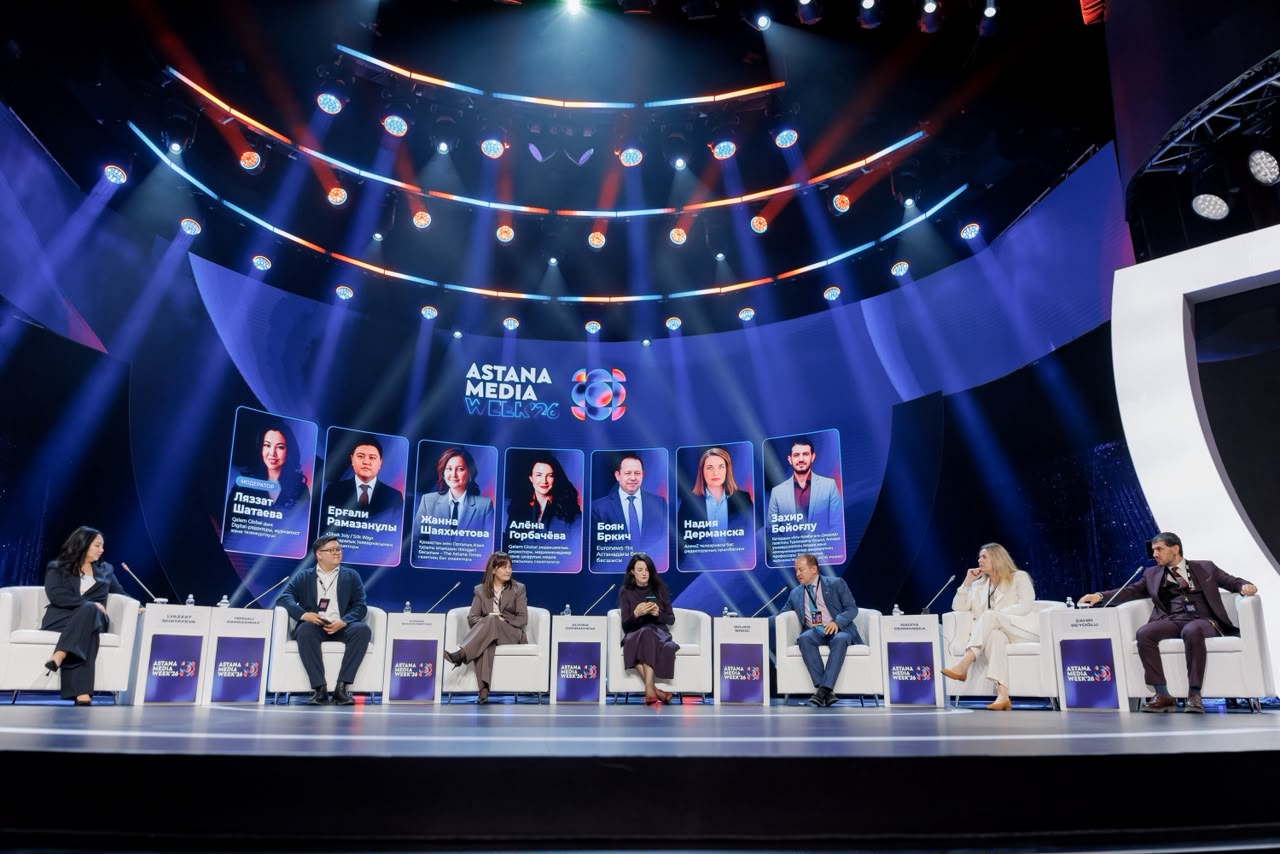
Panelists at the 10th Astana Media Week discuss AI and the future of journalism. Photo credit: Astana Media Week
The three-day forum brings together government officials, journalists, technology companies and international media organizations to discuss the future of journalism.
Opening the event’s plenary session, First Deputy Minister of Culture and Information Kanat Iskakov called for shared principles governing the use of artificial intelligence in newsrooms.
“The more opportunities any technology gives us, the higher the price of responsibility for its use,” he said.
Iskakov identified strong editorial teams, journalists’ accountability and technologies that improve information reliability as three pillars of trust. He also proposed developing ethical principles for AI use in consultation with the media community and supported labeling AI-generated content so audiences can understand how material was produced.
“An algorithm can write a text, we all understand that, but it cannot take responsibility for its words. Responsibility always rests with the journalist and the editorial team as a whole,” he said.
Trust becomes journalism’s most valuable asset
The question of responsibility was central to a panel discussion among representatives of international and regional media organizations.
Bojan Brkić, head of the Euronews Bureau in Astana, argued that professional reputation would become increasingly important as AI makes content production faster and cheaper.
“The only thing that we will have left that we will be able to sell is our reputation and our trustworthiness – our word that what we publish for you is true,” he said.
The discussion also highlighted the risks posed by algorithms that reinforce existing beliefs and keep audiences within information bubbles. As AI-generated images, videos and text become increasingly convincing, independent reporting and fact-checking are becoming more important.
Central Asia needs to tell its own stories
The panel also explored how Kazakhstan and Central Asia can strengthen their presence in international media.
Zhanna Shayakhmetova, editor-in-chief of The Astana Times, said international audiences need explanations of events, not just news.
“Our audience is no longer looking only for the news or what is happening. They are much more interested in why this news matters – in terms of geopolitical shifts and regional dynamics,” she said.
English-language journalism also carries a responsibility to provide historical and political context, she added, since international readers cannot be expected to know the background to every development in Kazakhstan.
Alyona Gorbacheva, editorial director of Qalam Global, a history-focused media outlet, said specialized media can help meet this need by exploring the historical roots of current events and building distinctive relationships with audiences.
“Journalism is answering the question of what is happening now. And we are answering the question of how we got here,” she said, describing the role of history-focused journalism.
Gorbachyova said Qalam Global’s history content reaches 10 million to 12 million people across platforms in three languages, demonstrating that a specialized editorial focus does not necessarily limit a publication’s reach.
Zahir Beyoglu, Türkiye correspondent for the Qatari newspaper Al-Araby Al-Jadeed, also stressed the importance of sharing Central Asia’s distinctive perspective with the world while maintaining regional languages and cultural identity.
The panel also featured Nadiya Dermanska, deputy editor-in-chief of AnewZ TV, Yergali Ramazanuly, editor-in-chief of the Silk Way international TV channel and was moderated by Lyazzat Shatayeva, a journalist, TV presenter and digital editor at Qalam Global.
Astana Media Week runs through Oct. 16. Subsequent sessions addressed information policy, regional media development, domestic content production and advertising, alongside practical workshops on AI, information verification and digital platforms. The forum will conclude with the Qazaqstan Media Awards ceremony.
