
BAKU – The CAMCA Regional Forum featured wide-range discussions on regional convergence on Oct. 1. Dr. Frederick Starr, the chairman of Central Asia-Caucasus Institute, introduced the topic by examining prospects for countries in the region to interact more closely and the barriers to deeper cooperation.
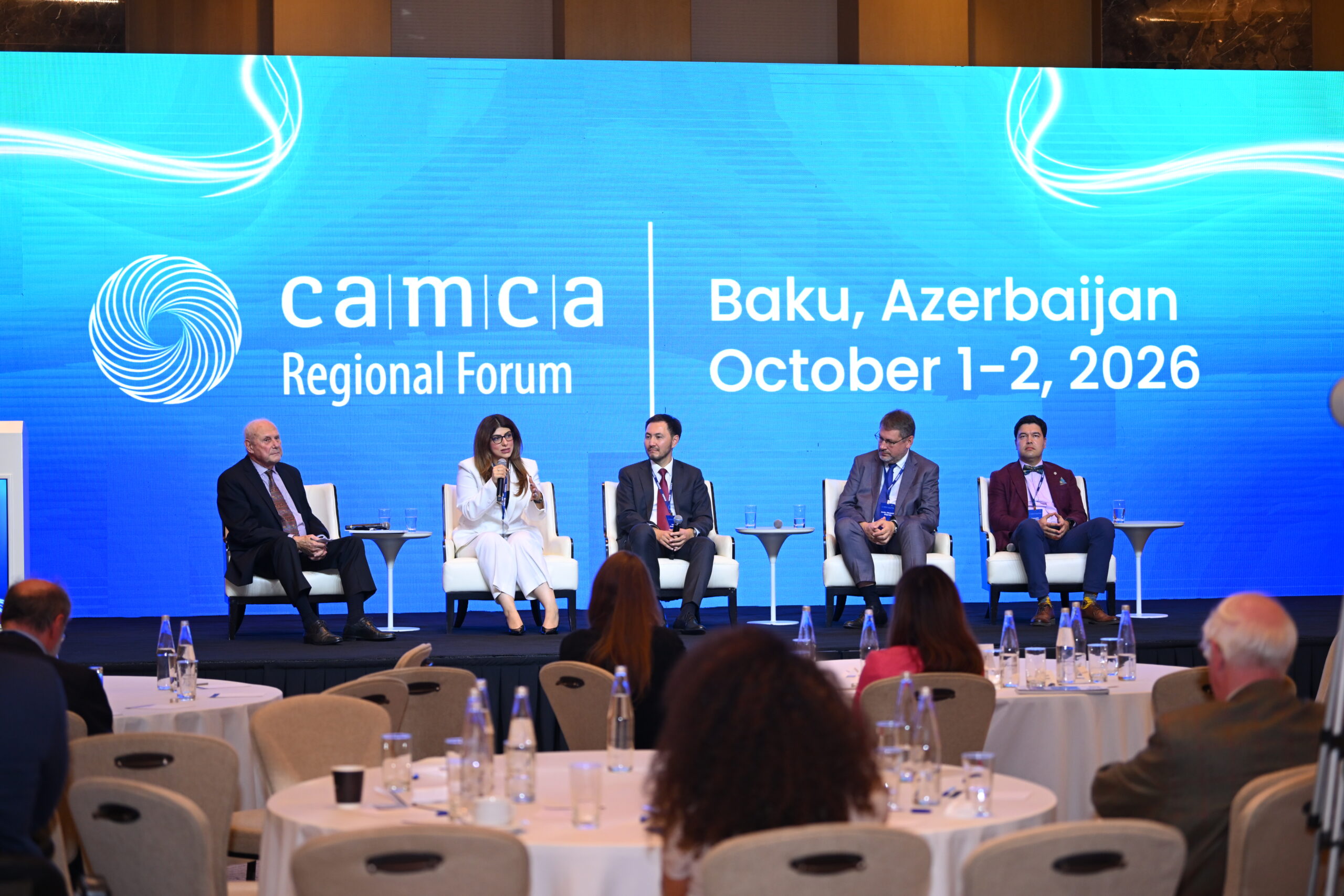
L-R: Dr. Frederick Starr, Dania Arayssi, Zhandos Shaimardanov, Ambassador Eduards Stiprais and Farrukh Irnazarov. Photo credit: Rufet Bendeliyev.
According to Zhandos Shaimardanov, director of Kazakhstan Institute for Strategic Studies, political dialogue within Central Asia and with other C5 partners is strong and Azerbaijan joining as a full-fledged participant was “very important and timely” last year.
“It’s not simply the transformation of C5 to C6. It gives the new Trans-Caspian dimension to the Central Asian vision. We should consider this new environment where Central Asia is being evolved toward. As we have stronger institutions now. We have different situations in the economy. And this gives us a different perception, both externally and internally, on the integration of Central Asia,” said Shaimardanov.
He elaborated on the concept of convergence, saying it doesn’t mean uniformity.
“How diverse we are, and we have so many commonalities and we should keep it as kind of a balance. I mean keeping this diversity. If we talk about integration, let me remind you of a musical metaphor. We are not the choir where each singer sings the same song, we are the orchestra where each player has its own musical instrument. Kazakhs have dombra, every other country has its own musical instrument. We should keep this ‘national favor’ and be synchronized with each other. We should advise each other on major topics like environmental issues, the economy, and the transport corridors. This is what makes us strong,” he explained.
Ambassador Eduards Stiprais, the EU Special Representative for Central Asia, said growing external challenges mean Central Asia countries feel an “absolute necessity to stick together and to support each other.”
He said the European Union sees growing integration as “a positive development” and is ready to share its experience if Central Asian countries “are willing to accept this experience and learn from it.”
Stiprais said Afghanistan should be part of this cooperation in the future, while noting that the process has been prevented from advancing.
“Azerbaijan de facto is a part of the consultative process. There are no formal sanctions, civil barriers, or even a formal legal basis for this sort of cooperation. The European position always was, and will continue to be, that this is a choice which must be made by countries themselves,” he said.
He said the EU sees Central Asia as a growing region.
“We already have 80 billion consumers and probably 100 billion by 2050. We are thinking about Central Asia as a source of raw materials, including the critical minerals, but also not just the raw materials, but we are looking at the possibility to develop the value-added chain within the region,” he said.
He described Central Asia as one of the few regions with a positive demographic development. The transfer of skills and knowledge to bring the region’s economy to a completely different level is vital, he said.
Dania Arayssi, assistant director at the New Lines Institute for Strategy and Policy and Professor at Georgetown University, highlighted the unequal distribution of water resources in the region.
She said Central Asian countries have ambitious AI projects and that “a lot of these projects require tons and tons of water.”
“One of the suggestions that we have put forward is establishing an organization where all these think tanks, scholars can be working together, sharing data, sharing research together instead of being fragmented,” she added.
She also spoke about the New Line’s inaugural report about regional connectivity through the S7+ framework, which addresses the dual imperatives of internal integration among Central Asian states and connection to global markets. The report provides a basis for more effective U.S. engagement with the region.
Arayssi exclusively spoke about Kazakhstan’s AI ambitions, saying they are achievable but only if they are treated as a regional project rather than a national one. Data centers need reliable power and water, and both are shared resources and among the most pressing challenges facing Central Asia today.
“That is why multilateral cooperation among the Central Asian economies is essential. The smartest path is to tie AI investment to regional cooperation on electricity grids, renewable energy, and transboundary water management, which is exactly what the S7+ framework calls for. One concrete step, recommended in the New Lines Institute’s S7+ water report, is a regional water commission to manage these shared resources together. Done right, this turns a resource constraint into an engine for deeper Central Asian integration and stronger partnerships with the U.S. and Europe,” Arayssi told The Astana Times.
Farrukh Irnazarov, co-founder of Central Asian Development Institute, said convergence is “something that actually brings us together.”
Diplomacy is advancing much more rapidly than institutional cooperation. The question is “where we either see this opportunity, or we may lose” it.
“This is the heyday of countries’ cooperation. Kazakhstan, Uzbekistan and Kyrgyzstan are developing Kambala-1, the water and energy development project. We see that Kyrgyzstan and Tajikistan were able to settle the border issue in 2025, which was a very big issue, that peace somehow became an infrastructure for connectivity, for convergence, for integration,” he said.
“The region is converging,” Irnazarov said. “And at the same time, the most important thing, we see that the leaders of countries are meeting solo, which is an amazing human-to-human approach, where they develop trust, talk to each other, and sign lots of MOUs. The issue is infrastructure. There should be an opportunity for people of the CAMCA region to translate this infrastructure project into concrete projects.”
Baku hosted the annual the Central Asia, Mongolia, the Caucasus and Afghanistan (CAMCA) Regional Forum on Oct. 1-2. Established in 2014, it brings together leaders and experts from government, business, academia and civil society to discuss regional challenges and opportunities.
