
ALMATY – Kazakhstan’s position in emerging global energy value chains will increasingly depend on the resilience of its infrastructure, diversification of export routes and investment in new production and technology, speakers said at the strategic plenary session opening Kazakhstan’s International Oil and Gas Exhibition (KIOGE 2026) in Almaty on Sept. 30.
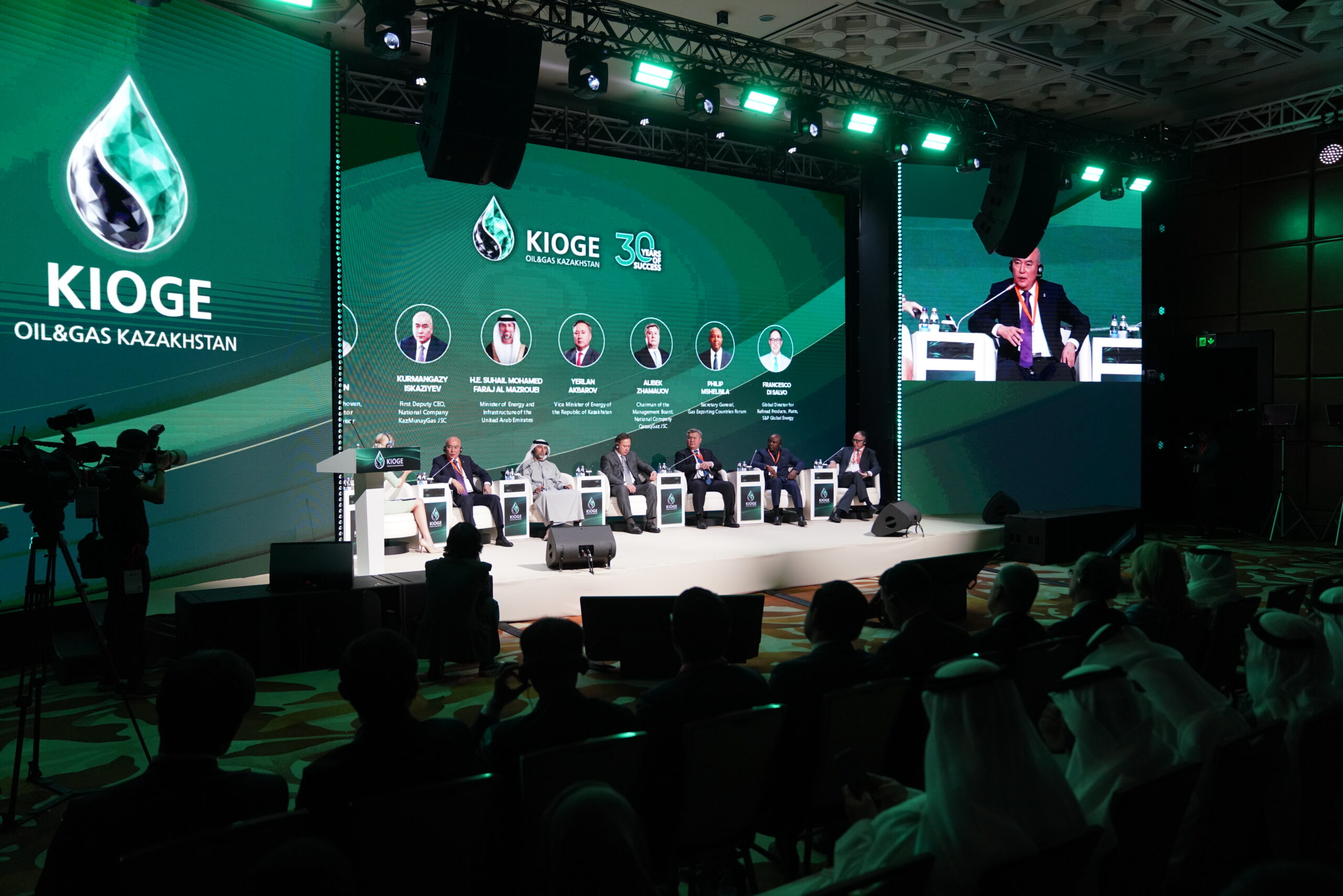
Delegates and energy industry experts attend the strategic plenary session on global energy integration and Kazakhstan’s role in emerging energy value chains at KIOGE 2026 in Almaty on Sept. 30. Photo credit: KIOGE.
The session, dedicated to Kazakhstan’s role in new energy value chains, brought together senior officials and industry experts to discuss how geopolitical disruptions, changing trade flows and growing energy demand are reshaping the global oil and gas market.
Karen Oldhoven, moderator of the session, said Kazakhstan has positioned itself as an important link between major markets at a time of significant changes in the global energy system.
“This is a year of tectonic and geopolitical shifts and at the same time the world is getting more hungry for energy and despite all this Kazakhstan positions itself as a reliable partner and also a bridge for dialogue, cooperation and investment,” she said, highlighting that the next stage would require cooperation between industry participants, governments and experts to build Kazakhstan’s future energy ecosystem.
Resilient infrastructure becomes a priority
Suhail Mohamed Faraj Al Mazrouei, the United Arab Emirates’ Minister of Energy and Infrastructure, highlighted the impact of geopolitical disruptions on energy and commodity flows. According to him, countries are increasingly looking at projects that would allow hydrocarbons to be exported through multiple routes rather than relying on a single corridor.
“Something that is very important as well, other than the optionality and building other options, is to ensure the resilience and the security of the critical infrastructure. Because those infrastructures were attacked, unfortunately,” he said.
He also stressed the importance of international cooperation, noting that disruptions to major trade routes can affect markets well beyond the countries directly involved.
“If those veins of trade are restricted, threatened, all of us are going to pay the price. It’s not just one country,” Al Mazrouei said.
The emphasis on alternative routes and infrastructure resilience is particularly relevant for Kazakhstan, whose energy exports depend on several international transportation corridors and whose role as a link between East and West is expanding.
Energy markets face a new era of uncertainty
Philip Mshelbila, Secretary General of the Gas Exporting Countries Forum, said the latest energy crisis demonstrated that geopolitical disruptions are likely to remain a recurring feature of global markets. The Gas Exporting Countries Forum brings together 20 countries holding about 70% of the world’s proven natural gas reserves, he noted.
“This conflict and the crisis that’s emanated from it has first of all taught us that geopolitical events are going to continue to happen. They will continue to happen more frequently. And we need to accept them as the new norm,” Mshelbila said.
He pointed to the COVID-19 pandemic, the 2022 conflict in Ukraine and the latest crisis as examples of major disruptions that have affected the energy sector within a relatively short period.
“What we just don’t know is what’s going to happen, when it’s going to happen, and where,” he said.
At the same time, Mshelbila said the global natural gas system had demonstrated a degree of resilience during recent disruptions. He cited accelerated projects, additional production from North America, deferred maintenance at energy facilities and increased upstream gas production as measures that helped compensate for supply losses.
“Between March and August, we estimated that about 39 million tons per annum of Liquefied Natural Gas (LNG) was taken off the market. Mainly between Qatar and the UAE. But, close to 34 million tons of that came into the market,” he said.
According to Mshelbila, this demonstrated that more than 80% of the potential LNG supply gap was compensated through various measures.
“There is already some degree of resilience in the natural gas system globally. It’s clearly not enough. And a lot more needs to be done,” he said, stressing that energy producers ultimately remain dependent on markets, even when they have sufficient resources and production capacity.
“Even if you have all the forms of energy that you need, in the quantity you need, you might actually have a surplus you want to sell to somebody. Which means you’re going to depend on the market,” he added.
Kazakhstan seen as investment and transit hub
Against this backdrop, Mshelbila pointed to Kazakhstan’s geographic position and resource base as factors that could support further investment.
“I think that Kazakhstan gives an example of an investment destination. That could welcome that sort of an investment. Because it is so strategically located between East and West. And it has its own resources in abundance. And it could actually serve as transit even more than it is already doing,” he said.
His comments come as Kazakhstan seeks to strengthen its role in regional energy and transport chains while attracting investment into both traditional and emerging parts of the sector.
KMG targets higher recovery from mature fields
For Kazakhstan’s national oil and gas company, maintaining production from mature fields remains a key part of the long-term strategy. KazMunayGas First Deputy CEO Kurmangazy Iskaziyev said the company has been working to increase output of refined petroleum products while diversifying transportation routes. However, he said expanding the company’s resource base is a central strategic priority.
“KazMunayGas has 65 producing fields, excluding major projects such as Kashagan and other large developments. About 90% of production from the company’s mature fields comes from 12 fields,” he said.
Iskaziyev said many mature fields have already depleted around 70% of their reserves, increasing the importance of identifying new resources, particularly in Paleozoic formations.
“The company has identified 23 projects and is working with the Ministry of Energy on improving the terms of the relevant contracts. The program includes 3D seismic surveys and the drilling of deep wells,” he said.
A second component involves large-scale exploration using 2D seismic surveys covering areas in the south and east of the Caspian region and the northern Caspian area.
Logistics increasingly shape oil prices
The discussion also moved beyond production to the ability to move energy products to consumers. Global Director for Refined Products, Platts and S&P Global Energy Francesco Di Salvo said current oil market dynamics cannot be explained by supply and demand alone, with logistics increasingly affecting prices and trade flows.
Speaking from the perspective of a company that provides benchmark price assessments, including Brent and CPC Blend, Di Salvo said the ability to transport crude from production sites to end users has become increasingly important.
“It is actually the ability to evacuate these molecules, to bring them from the production point to the delivery and consumption point and that is being made incredibly more difficult,” he said.
For Kazakhstan, this has direct implications for the value of its crude exports, including CPC Blend. He noted that shipping has increasingly become a key component of oil trade economics.
Refined products and changing trade flows
Di Salvo also highlighted the growing importance of refined products, particularly diesel, jet fuel and gasoline, whose values can increasingly diverge from crude oil prices. He linked this trend to the broader issue of diversification, particularly in Europe, where dependence on limited sources and routes has created additional energy security challenges.
Another major development, he said, is the reshaping of global trade flows driven by geopolitical developments and sanctions.
“We are really seeing a paradigmatic shift in the market, and I think it’s quite exciting to see, but also very challenging to have to play in this market,” he said.
The discussions at KIOGE 2026 highlighted a common idea across the different perspectives: Kazakhstan’s future role in global energy markets will depend not only on the availability of hydrocarbons, but also on the country’s ability to develop resilient infrastructure, diversify transportation routes, expand its resource base and adapt to changing global trade patterns.
The 30th KIOGE 2026 is taking place in Almaty on Sept. 30-Oct. 2, bringing together more than 500 companies from 62 countries to discuss the future of Kazakhstan’s energy sector, international cooperation and emerging technologies.
