
ASTANA — Economic growth across developing Asia and the Pacific is expected to moderate to 5% in 2026 from 5.5% in 2025 before rising slightly to 5.1% in 2027, according to the Asian Development Bank’s latest outlook.
Photo credit: Asian Development Bank
The ADB’s September 2026 outlook revised its 2026 regional growth forecast upward by 0.1 percentage points compared with its July projection. Strong investment, government support and growing technology exports linked to global artificial intelligence investment are expected to continue supporting economic activity. At the same time, geopolitical tensions and climate-related risks are putting pressure on food and energy prices.
The bank lowered its regional inflation forecast for 2026 to 4.2%, from 4.3% in July, citing price stabilization measures. However, the forecast for 2027 was raised slightly to 3.5%, compared with 3.4% previously in July. Both projections remain above the 3% inflation rate recorded in 2025.
ADB identified escalating conflicts and a strong El Niño as the main risks to the regional outlook. A prolonged or broader conflict in the Middle East, as well as an intensifying war in Ukraine, could keep global energy prices high and volatile. Meanwhile, El Niño, the periodic warming of sea surface temperatures in the central and eastern tropical Pacific Ocean, is expected to continue through the first quarter of 2027, potentially increasing energy demand and reducing agricultural production.
Kazakhstan growth forecast remains unchanged
Kazakhstan’s economic outlook remains unchanged from the ADB’s July forecast. The bank expects the country’s economy to grow by 4.8% in 2026 and 4.5% in 2027.
This projection is consistent with the ADB’s earlier assessment of Kazakhstan’s economic trajectory, which also forecast growth of 4.8% in 2026 and 4.5% in 2027 amid moderating oil production and continued government investment.
According to the report, growth will be supported by non-oil sectors and continued public investment. Manufacturing, construction and services are expected to contribute to economic activity despite disruptions in the oil sector. Off-budget financing and infrastructure spending are also projected to provide additional support.
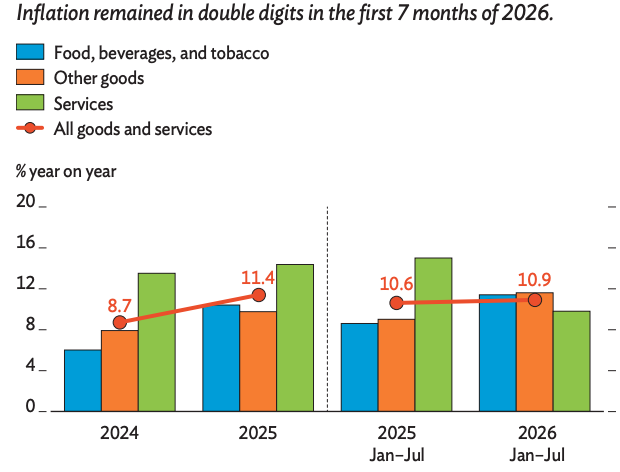
Inflation dynamics in Kazakhstan. Photo credit: Asian Development Bank’s September 2026 Outlook.
The focus on non-oil sectors comes as Kazakhstan seeks to maintain economic momentum while reducing its reliance on hydrocarbons. Recent developments in construction, manufacturing, transport, trade and agriculture have also been highlighted as potential drivers of growth.
Inflation in Kazakhstan is forecast to gradually decline to 10.4% in 2026 and 9.5% in 2027, supported by earlier monetary tightening and prudential measures.
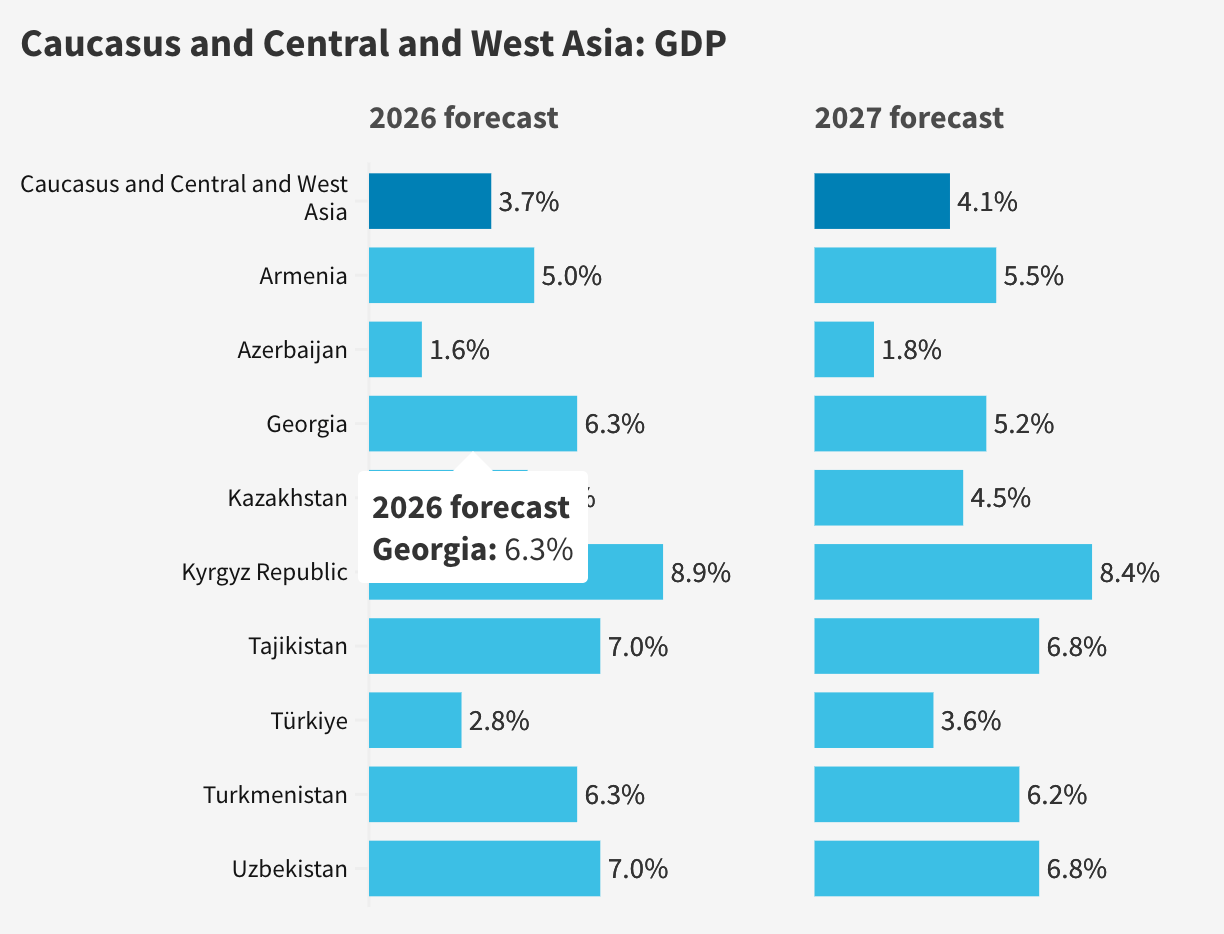
ADB forecasts growth in Asia-Pacific to remain slow, but resilient. Photo credit: Asian Development Bank. 2026. Asian Development Outlook September 2026.
Across Central and West Asia, the ADB revised its growth forecasts downward by 0.1 percentage points for both 2026 and 2027, to 3.7% and 4.1%, respectively. The revision was attributed mainly to weaker-than-expected external demand, particularly in Türkiye.
Earlier ADB forecasts have likewise pointed to inflation and external economic conditions as key factors shaping Kazakhstan’s outlook. In July 2025, the bank raised its regional growth forecast while warning of increasing inflationary pressures in Kazakhstan and other Central Asian economies.
The ADB said developing Asia and the Pacific remain resilient despite growing economic and geopolitical risks. The bank emphasized the importance of measures to protect vulnerable populations from higher food and energy costs as governments navigate continued uncertainty.
