
ASTANA – Smaller states will need flexible, issue-based partnerships to preserve their room for maneuver as the U.S.-led international order gives way to a more fragmented system shaped by power rivalry, German political analyst and writer Marc Saxer said at the launch of his new book in Astana on Aug. 31 titled “Geopolitical Conflict in the Wolf World: Great Power Competition and the Illiberal Revolt against the Liberal Order.”
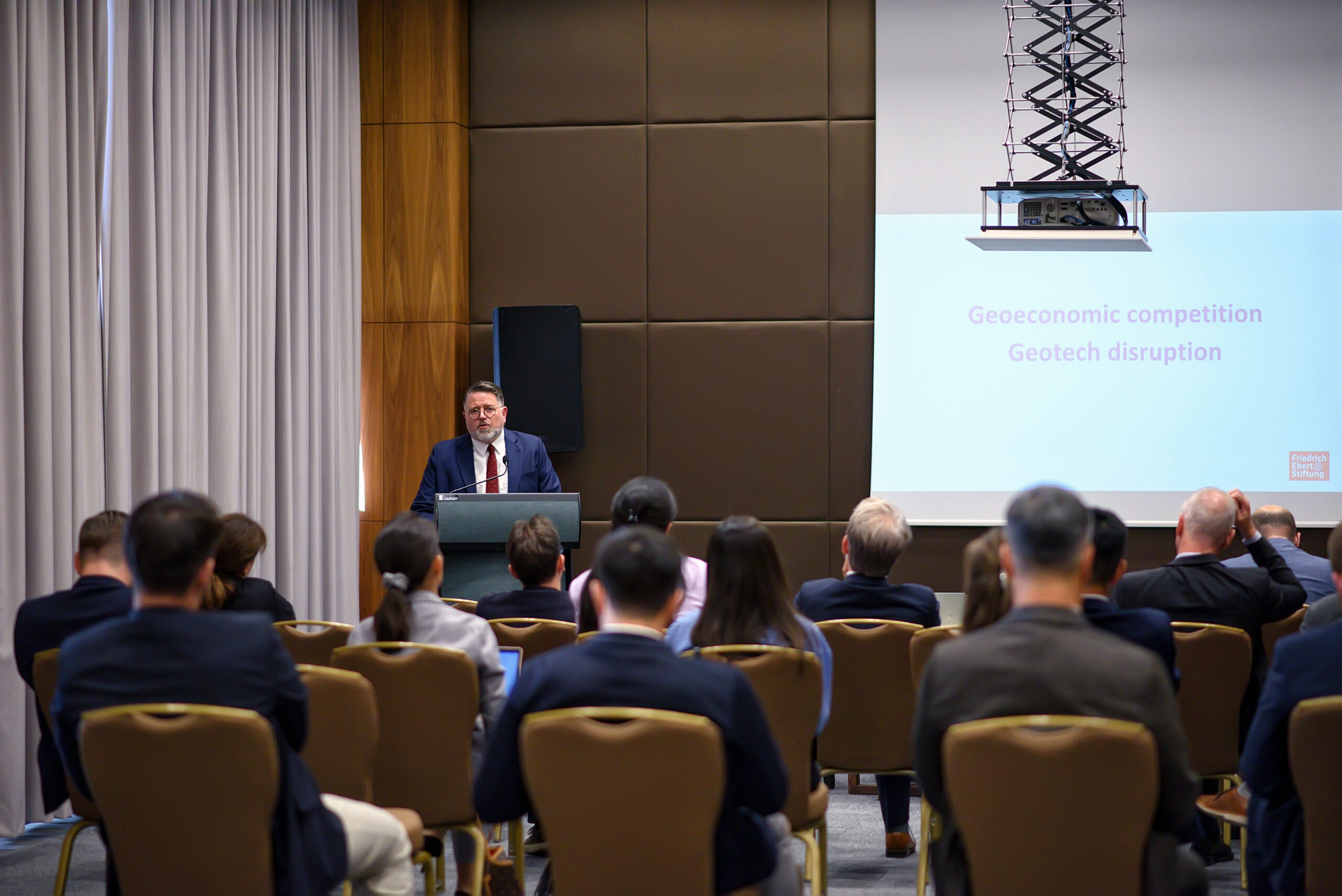
The presentation of the book took place in Astana on Aug. 31. Photo credit: FES
Saxer coordinates the Asia-Pacific work of the Friedrich-Ebert-Stiftung (FES) and previously led its offices in India and Thailand. In the book published in June, Saxer examines how countries can navigate what he describes as an increasingly dangerous and asymmetrical multipolar world.
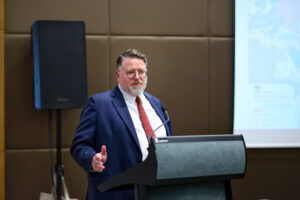
Marc Saxer. Photo credit: FES
The term “wolf world,” which he derived from the political philosophy of Thomas Hobbes, describes an international system in which institutions are weakening, power increasingly determines outcomes and “the strong prey on the weak,” Saxer said.
“What is the wolf world? The wolf world basically tries to describe the world that is emerging after the collapse of Pax Americana, after the end of the unipolar moment, with the erosion of American hegemony and the erosion and maybe collapse of the world order,” said Saxer.
In 2025, the world saw 65 state-based conflicts across 35 countries, the highest since 1946, according to the Peace Research Institute Oslo.
“We have to understand what the new chessboard really is. How can we navigate as foreign policy makers?” he added, describing this as an “existential question.”
However, Saxer noted the book seeks to move beyond just diagnosing the breakdown of the existing order. Its central questions are about how countries can navigate the emerging system, preserve prosperity and prevent geopolitical competition from producing sustained global instability.
Three theaters of competition
Saxer identified Europe, the Middle East and East Asia as the three principal theaters of contemporary geopolitical competition. In each, U.S. influence is being challenged by a regional power: Russia in Europe, Iran in the Middle East and China in East Asia.
“Even though these theaters are intimately interconnected, there are also trade-offs. There is a zero-sum game. If you are invested in one of them as a great power, you will find it challenging to actually prevail in another,” said Saxer.
He stressed that the U.S. is facing growing military, fiscal and domestic political constraints, prompting a debate in Washington over whether it should concentrate its resources closer to home or continue expanding.
China, meanwhile, views U.S. alliances and military deployments in Asia as a form of strategic encirclement, he said. Beijing’s efforts to expand westward through the Belt and Road Initiative and strengthen its position in the South China Sea can therefore be understood partly as an attempt to protect supply chains and reduce its exposure to maritime chokepoints particularly along the Strait of Malacca, which Saxer describes as the “Strait of Hormuz of Asia.”
“That’s not a theory. That’s a blueprint for action. You saw the intervention in Venezuela. You see the threats to take back the Canal of Panama. You see the threats against Cuba. You see the debate with the Europeans over Greenland,” Saxer said.
This dynamic creates a security dilemma: measures one side considers defensive are interpreted by the other as evidence of aggressive intent.
While Taiwan remains the most dangerous potential flashpoint, Saxer said the costs of a direct U.S.-China conflict could deter both sides from seeking a military confrontation. Their rivalry is therefore likely to be fought primarily through trade, technology, finance and industrial policy.
“Here you basically include the geoeconomic disruption and competition that is so definitive for the dynamics in Asia. Lots of these dynamics we see, of course, already as front line news,” he added.
Economic disruption
The shift from economic integration to strategic competition is already transforming the global economy, Saxer said. Supply chains are being reorganized as governments seek to reduce dependencies that could be exploited by geopolitical rivals.
The principle of globalization has shifted from efficiency and “just in time” production to resilience and “just in case,” he said. Reshoring, nearshoring and friendshoring are accelerating, while access to technology, markets, payment systems and critical resources is increasingly treated as a matter of national security.
These changes pose a particular challenge for developing economies. Saxer stressed that the development model used by several successful Asian economies combining low-cost labor, export-led growth and technological catch-up is becoming less viable.
“Cheap labor is no longer your comparative advantage if you compete against AI robots and algorithms. Export-led growth is not possible if in a protectionist world, your export markets are freezing up,” he said.
Industrialization is also constrained when technology transfers and access to supply chains become geopolitical tools, he added.
For Central Asia, these shifts could create opportunities as companies and governments search for new trade routes, production sites and supply partners. They also increase the risk that countries will face pressure to align with one economic or technological bloc.
Finding room between powers
In terms of navigating foreign policy in such a world, Saxer suggested a few strategies. Major powers can use economic, technological and military leverage to build asymmetric dependencies and pressure other states to choose sides.
“You can build asymmetrical dependencies, especially through geotech and geoeconomics, and try to coerce others to extract advantages. At the end of the day, it is all about forcing others to choose sides,” said Saxer.
Smaller countries, by contrast, are more likely to rely on hedging and balancing, a strategy familiar across Central and Southeast Asia.
“The question here is what is the room of maneuver? How much space do you actually have to hedge and balance when you end up in the sharp end of great powers coercing power?” he posed.
Saxer sees more value in “partnerships in the middle,” which refers to flexible arrangements in which states cooperate on specific issues without forming a rigid geopolitical bloc. Such partnerships could include smaller countries as well as established middle powers, allowing them to pool resources, diversify their relationships and exercise greater influence over the rules of the emerging system.
“Issue-based, flexible partnerships in the middle could be one of the ways to navigate the wolf world,” Saxer said.
“How to stabilize this wolf world very much depends on what kind of world is actually emerging. What we have seen is the end of the unicorner moment, and therefore the end of an order will be at rest upon its dominance,” he added.
Emerging order
“I think what we are seeing emerging is an asymmetrical multipolar world,” Saxer said.
The U.S. and China remain in a “league of their own,” but neither has the dominance Washington and Moscow exercised during the Cold War. Regional powers, including in the Global South, are gaining influence, while Russia, India and the European Union retain the potential to become independent global poles but also face significant internal constraints.
“The takeaway from this is that I believe in an asymmetrical multipolar world it is unlikely that a single power will emerge as a victor,” he said.
“I believe that for the first time in 600 years, we are in a situation where the next world order either doesn’t emerge or has to be negotiated between western and non-western powers,” he added.
Reforming global order
Addressing the gathering, Saxer outlined three possible forms the next order could take: an imperial system based on great-power spheres of influence; a Westphalian system centered on sovereignty and noninterference or a reformed multilateral order.
He also noted he believed more in preserving and adapting the rules-based system, emphasizing that global challenges such as climate change, pandemics, migration and conflict cannot be addressed without international cooperation.
“Smaller countries obviously prefer the reemergence or strengthening of a Westphalian order, where sovereignty, non-interference and territorial integrity rule,” Saxer said.
“I believe that the best course of action would be to save whatever can be saved from the rule-based multilateral order by reforming it,” he added.
The existing system, however, cannot simply remain in its form that was established in 1945, he said. Many countries in the Global South question who created its rules, whose interests they serve and why non-Western states were given so little influence over their design.
“Rules, yes, but whose rules? Who made these rules? We were not on the table,” he added.
Western countries will have to relinquish some of their influence in international institutions if they want those institutions to retain legitimacy, the expert said. They must also confront criticism over the inconsistent application of international law, what Saxer referred to as “double standards,” and universal principles.
Saxer proposed a “Helsinki 2.0” compromise modeled on the 1975 Helsinki Final Act: continued recognition of universal human rights combined with a stronger commitment to sovereignty and noninterference.
“Universality without intervention, universalism without interference,” he said, describing the approach as a possible foundation for a more inclusive international order.
Central Asia navigates this world much longer
Philipp Jahn, head of the FES Office Central Asia, said the region may need less convincing than most audiences about the book’s central premise because it has long navigated a world in which no single power can dictate the rules.
Philipp Jahn. Photo credit: FES
“When Marc [Saxer] set out to describe what he called the wolf world, a system in which single superpowers’ rules have quietly stopped applying, and no one has yet agreed on what could replace them, he was effectively describing something Central Asia has lived and managed for three decades or, more likely, for much longer,” said Jahn.
“The region did not discover multivector diplomacy (…) last week, because of some new geopolitical fashion. It built that doctrine out of necessity, long before multipolarity became the term Western capitals reached for to describe a world that makes them uncomfortable,” he explained.
He said Saxer’s framework should be treated as “a set of hypotheses, not a finished verdict,” with Central Asia offering an important test of where those arguments hold and where the region’s experience suggests otherwise.
Ullrich Kinne. Photo credit: FES
Ullrich Kinne, deputy head of mission and economic counsellor at the German Embassy in Kazakhstan, said Kazakhstan was a fitting venue for the launch because of its position among the major powers and regions examined in the book.
“It seems to me very fitting that it is presented here in Kazakhstan, as we are at the crossroads of the various forces described herein: China, Russia, the U.S., and Europe. But Central Asia is increasingly becoming a global player in its own right. Deepening regional integration has allowed Kazakhstan to pursue multivector foreign policy,” said Kinne.
Kinne noted Europe and Central Asia were both seeking to diversify their political and economic relationships, reduce strategic dependencies and strengthen ties with each other. This approach could help mitigate some of the pressures described by Saxer.
