
ASTANA — The question of AI is especially relevant for Kazakhstan, which is betting big on the technology and preparing for the transformation ahead. AI is already reshaping economic models, changing the nature of work and creating new forms of competition between countries. It is also forcing governments to ask a bigger question: what kind of country do they want to become in an AI-driven world?

Photo credit: Shutterstock
“AI is not just another tool set. AI is statecraft,” Professor Olaf Groth, AI strategist and member of Kazakhstan’s AI Development Council, said in a video interview with The Astana Times.
For Groth, the question is no longer whether governments should prepare for the AI transformation, but how they should build the foundations of an economy and a state that will remain competitive as artificial intelligence becomes increasingly embedded in public services, business and everyday life.
AI is statecraft, not just technology

Professor Olaf Groth. Photo credit:Olaf Groth’s personal archive
Groth opened the interview with a high-stakes argument that AI should no longer be treated as another technology governments can adopt when it matures, because decisions about computing power, data, governance and AI infrastructure are increasingly decisions about a country’s long-term economic and strategic position.
“AI is not just another toolset. AI is statecraft. A government needs to set the right decisions early on, this means putting the right governance structures in place so that we can both check and control and manage tool performance, meaning returns on investment, but also ethical conduct and responsibility of the models that we’re deploying, the quality of the data, and the decisions that come out of it all,” he said.
For Groth, one of the clearest ways for governments to show they are serious about the technology is through their own use of AI, including procuring AI services and developing AI-led public services.
“Kazakhstan has been doing quite well on that front already, it having been recognized by the United Nations for digital government, and it needs to continue on that path because that’s where credibility comes from,” he said.
Kazakhstan’s window of opportunity
The conversation then turned to Kazakhstan’s position in the emerging geopolitical landscape of technology, where Groth sees an opportunity for the country to move beyond simply adopting technologies developed elsewhere. According to him, Kazakhstan’s progress in digital development and AI, combined with its geography, natural resources, agriculture and transit routes, puts it in a strong position to become “the orchestrator and the unifier of the region.”
“If it does that, then, you know, you are now accumulating a lot more economic and political weight in the world, right? And I think Kazakhstan is uniquely positioned to do that. And I think we’re seeing some deals already with countries that are neighboring countries,” he said.
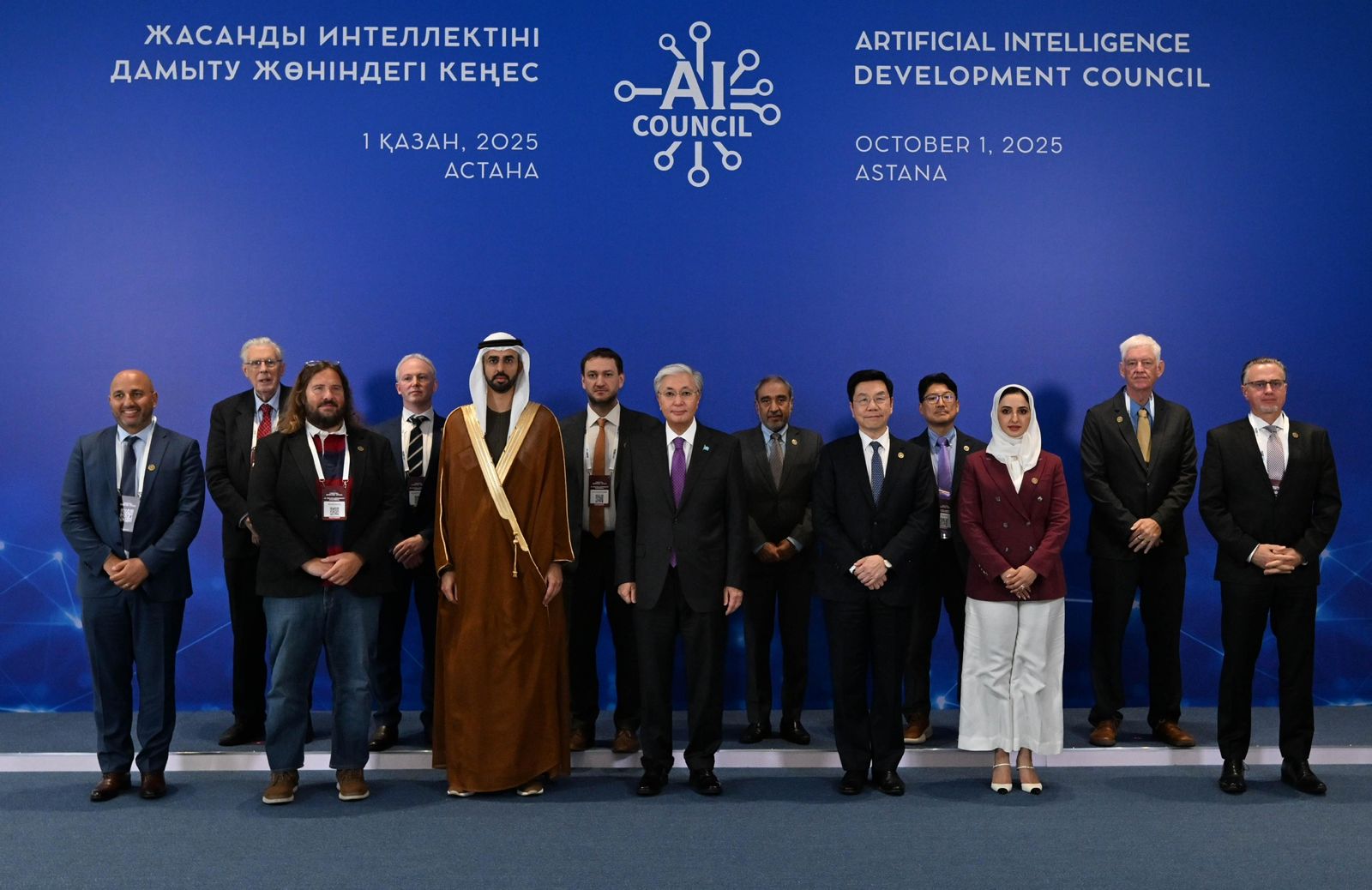
President Kassym-Jomart Tokayev chairs the first meeting of Kazakhstan’s Council for the Development of Artificial Intelligence on Oct. 1, 2025, attended by international experts and officials from the UAE, United States, China and other countries. Photo credit: Akorda
Groth said he sees particular potential in creating a Central Asian data accord that could lay the foundation for an integrated regional data economy, allowing countries to exchange data while maintaining privacy, national agency and national security safeguards.
“That’s a pretty bold vision right there. You can trade data between countries in privacy and agency and national security assured ways, of course, because every country needs to make sure its citizens are well respected, right? But that would then enable Kazakhstan to put its AI into this data market as the engine that drives the data market,” he said.
As other countries develop their own AI hubs, Groth sees another challenge in connecting those hubs through the right protocols, creating the basis for what he described as a “bold vision for the cognitive economy in Central Asia,” one that is AI-driven and led by Kazakhstan, or at least orchestrated by it.
This role, however, would require more than technological capacity, as it would also depend on leadership capable of thinking beyond the next political cycle and building foundations for the decades ahead.
Building for the next decades
As with many of the conversations with AI experts about the future, the interview also moved from technology to leadership, with Groth drawing a distinction between leaders who are “trend chasers” and those who prepare their countries for structural transformation. He said that a forward-looking leader who wants to build solid foundations for the next 20, 30 or 40 years needs what he calls “a theory of the country.”
For Groth, that means understanding a country’s asset base and how those assets can be converted into competitive positioning in the global economy, while also asking why other countries would want to partner with it and what would allow it to enter those partnerships from a position of strength.
“In other words, asking yourself the question, why would anybody else be interested in Kazakhstan or in any country? And why would that country then come at the partnerships from a position of strength? So understanding the competitive assets, the competitive positioning, the state of the governance systems,” he said.
That also means understanding a country’s strengths and weaknesses, determining how AI can reinforce its governance model, and making sure technological transformation ultimately benefits the people expected to live with its consequences.
“Addressing all of that means that you have to lay foundations,” Groth said, adding that Kazakhstan is already making progress in laying educational foundations.
In his view, the distinction between long-term leadership and trend chasing is not difficult to identify. A trend chaser may be visible at ribbon-cutting ceremonies and on social media, while a serious leader is also willing to spend years building systems, infrastructure and partnerships whose results may not be immediately glamorous.
“Sometimes the building act is unglamorous,” Groth said.
The future of work: designing human-AI partnerships
The conversation also turned to one of the most immediate questions surrounding AI: what will happen to humans in a highly technological economy? Groth does not subscribe to the idea that the future necessarily means mass unemployment, arguing instead that work is deeply connected to human well-being because it provides people with purpose, identity and a sense that they are contributing to society.
At the same time, he believes that the relationship between work, earning and learning may change as AI takes over an increasing share of routine and analytical tasks, meaning that societies will have to deliberately design new ways for people to find purpose and meaning in the economy.
“There are many, many things that humans can do that AI cannot yet do. And so instead of just taking an axe and chopping people, which is the easy thing to do, we need to – comparatively easy – we need to embrace the comparatively more difficult thing, and that is design symbiotic jobs between humans and AI,” he said.
Groth believes that such a transition could ultimately create more satisfying and potentially better-paid jobs, but only if organizations deliberately redesign work rather than simply using AI as a justification for reducing headcount.
In the emerging agent economy, he sees a future in which people increasingly work alongside dozens, hundreds or even thousands of AI agents, with the human role shifting toward overseeing, governing and directing increasingly complex chains of tasks. But, again, Groth stressed that this will not happen automatically. The challenge is to design the interface between human capabilities and AI in ways that make people more productive without removing the sense of purpose that makes work meaningful.
From digital sovereignty to strategic sovereignty
The question of digital sovereignty brought the conversation back to Kazakhstan’s wider strategic position. Groth cautioned against interpreting sovereignty as complete digital self-sufficiency or isolation, arguing that the idea that countries can become entirely independent of global technological ecosystems is largely unrealistic.
“If by digital sovereignty, you mean digital autarky, or the ability to island yourself and be completely independent of everybody else, then no, I think that’s, as we say, in America, that’s a pipe dream,” he said.
For Kazakhstan, he said, the more realistic goal should be strategic sovereignty — understanding the country’s long-term path, deciding what it wants to become and identifying which capabilities it needs to build itself and which it can develop through partnerships.
“So what does that mean for Kazakhstan? I think it should be strategic sovereignty and strategic sovereignty means you figure out what your pathway is. What’s your vision? What kind of country does Kazakhstan want to become?” Groth said.
He pointed to Kazakhstan’s agriculture, critical mineral deposits, uranium, transportation infrastructure and growing digital layer as strategic assets that can form the basis of partnerships with other countries. He also highlighted the country’s space legacy and the continuing importance of Baikonur, as well as efforts to build an innovation ecosystem around the space sector.
For Groth, the value of these assets lies not simply in possessing them, but in using them to build partnerships and strengthen Kazakhstan’s position in the global economy.
“I think leveraging those key strategic assets, right, to attract partnerships and to become indispensable to those partners, that is sovereignty. Because then you can negotiate the terms for the future evolution of the country,” he said.
For full conversation, watch the entire interview here.
